Fuel tanks filter and pump setup

ShaneO

Active Member
Joined
5 Jan 2024
Messages
63
Visit site
For a variety of reasons including ease of cleaning and monitoring, condensation reduction, and gauge accuracy, I’m replacing my big wonky steel diesel tank with plastic ones: a 60 litre one feeding the engine (via secondary filter as normal), which we’ll call the day tank, and the rest of the space occupied by a big one that’ll be connected to the fill pipe. The idea is to accept new fuel into the big tank and then pump it through a 30 micron water separating filter into the day tank as required for any forthcoming excursion, and can be topped up on the fly during long motoring passages if necessary.

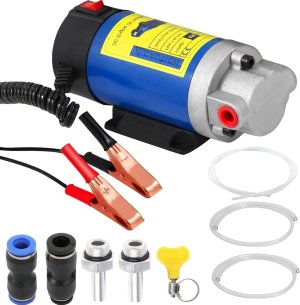
Diesel pumps on eBay seem to be like the one pictured, maybe mostly aimed at draining oil sumps or something, but they appear adequate; I’ll happily accept recommendations though! The Racor FG500 knock-offs say they’re good for a little under 4 litres per minute. The pumps are available at rates much higher, and I don’t know if that would be a problem for either the filter or the pump. Should I deliberately seek a pump that tops out at, say, 3lpm?

And, should the pump ideally be pushing or pulling through the filter? As in:
big tank -> pump -> filter -> day tank
or
big tank -> filter -> pump -> day tank

Thanks!
 

Attachments

  • IMG_4185.jpeg
    IMG_4185.jpeg
    275.4 KB · Views: 6
We use this set up in a vessel I sail on, but the main tank holds 3,000 lts. You don't mention the size of your main tank. Our 'day tank' is 800 lts, and part of the daily checks are to top up the tank each morning and when nessary if we are using the engine constantly.

Give that your day tank is 60 lts the filter would have the capacity to fill that in 15 mins, but you would never run it that low.

Will you be running a second filter from the day tank to the 10 micron filter on the engine?

Personally, I'd have a system of two filters that you can switch between if one has a problem between the main and day tank

Pump wize you may want to test the actual throughput - knowing that clogged filter will be slower than a clean one. A manual pump would be a option depending on your lts/hr usage.
 
Route the diesel return to the day tank to reduce the need to pump from the BIG tank.

I'd also retain the existing primary filter between the day tank and engine, even if putting another between the big tank and day tank.

Like Boater Sam, I am very doubtful about the suitability/advisability of the pump pictured, both the type, and that such things are primarily for occasional (i.e. light) use, and tend to be very much built down to a price and likely not that reliable or durable.

I am a bit sceptical about the practicality of the occasional filling of the day tank and then running it down. Bit of a faff, and forget to do it and . . .

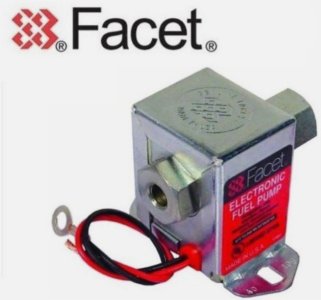
I think I'd prefer to keep that day tank full, maybe using a relatively low capacity Facet type pump (and the diesel return from the engine) to keep it so. In an ideal world one might have some sort of sensor (take off from the signal from the day tank fuel gauge?) to turn the Facet pump on when the level drops, and off again when it's full.

Alternatively, one could have that Facet pump running all the time the engine is on and, assuming the relative levels work, a drain from the top of the day tank to the big tank. This will mean the day tank is always full and (given you are putting an additional(?) fuel filter in this line) you are effectively continuously polishing fuel from the big tank.
 
Thanks all, that’s very useful. To answer or clarify a few bits:

Facet! That’s the type of thing I was expecting to find when searching for “diesel pump” on eBay but I didn’t know a brand name to use. Looks ideal!

Like Sandy, I would expect fuel to fit into the daily checks routine, it’s not something I tend to take for granted especially after the experiences leading to this system overhaul. I think the big tank will end up being 200-300 litres, I’ll have to compare the space available with what’s for sale off the shelf.

I messed up names of primary and secondary filters; yes, between the day tank and the engine (and its manufacturer’s-brand fine filter) is a 10 micron filter with a glass bowl.

Yes, the plan is indeed to have the diesel return go to the day tank.

I enjoy the idea of the always-on pump continually polishing, although part of me says it’s venturing into over-engineered territory; I’ll have a think about that!
 
I have a fuel polishing setup and the pump ha a 1 inch BSP port feeding a filter also with a 1 inch BSP port that gives a good flow rate that stir up the base of my fuel tank to remove any crud
 
The day tank will be a useful addition.

To pump fuel, we use a pair of Walbro fuel pumps. One for fuel polishing and/or fuel transfer between our main tanks, and one to transfer fuel to the day tank. The pumps are rated at 162 liters per hour. This is within the rating of the Racor 500 filters (max of 227L per hour), although we use the larger Racor 900 filters throughout.

The filter from the main tanks to the day tank is 2 micron (as is the polishing filter).

They are quality pumps with an expected life of in excess of 18,000 hours. We run our polishing pump most days, typically for five hours or more, so that particular pump has seen a lot of use without any issues. The other pump that is used to fill the day tank sees very little use. We could use one of the cheaper automotive pumps in this role, but as the pumps are identical, they are a useful backup for each other.

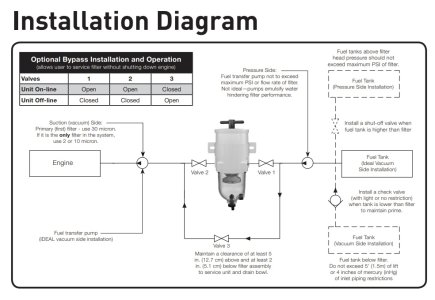
When installing any fuel pump, it should be after, not before, the Racor filter.
 
Last edited:
If you want a cheaper pump than the Walbro. The small Facet pumps (or even the many non-genuine copies) are OK. The transfer rate is slower, but this is not particularly important for filling a day tank. Ideally, the day tank should be filled before you depart.

IMG_8466.jpeg
 
I have a fuel polishing setup and the pump ha a 1 inch BSP port feeding a filter also with a 1 inch BSP port that gives a good flow rate that stir up the base of my fuel tank to remove any crud
That's the gold standard there.

The OP's redoing his fuel system and installing a day tank is the perfect opportunity to put in a fuel polishing system. The same pump can be used for polishing and for transferring. Should be set up to wash the bottom of the tank with a powerful jet of fuel.

Contrary to what some have advised, I would not use a small pump for this, even in the absence of a fuel polishing system. If you ever run the day tank dry, you will want to fill it in a hurry. And a slow pump that takes an hour to fill it, say, will mean that you will tend to forget about it whilst it's filling, and you might overflow it. I would want to be watching it as it fills.

Lastly, I would not use a 30 micron filter for filling the day tank. I would use a 2 micron filter and monitor the vacuum. That way you'll see if there's any problem with the fuel before you fill the day tank. There shouldn't be, if you've polished it, but I'd sure want to be sure.
 
this is the type of pump I have which is also available in 12Vdc
hpumpd050.jpg
 
Thanks all, that’s very useful. To answer or clarify a few bits:

Facet! That’s the type of thing I was expecting to find when searching for “diesel pump” on eBay but I didn’t know a brand name to use. Looks ideal!

Like Sandy, I would expect fuel to fit into the daily checks routine, it’s not something I tend to take for granted especially after the experiences leading to this system overhaul. I think the big tank will end up being 200-300 litres, I’ll have to compare the space available with what’s for sale off the shelf.

I messed up names of primary and secondary filters; yes, between the day tank and the engine (and its manufacturer’s-brand fine filter) is a 10 micron filter with a glass bowl.

Yes, the plan is indeed to have the diesel return go to the day tank.

I enjoy the idea of the always-on pump continually polishing, although part of me says it’s venturing into over-engineered territory; I’ll have a think about that!
We do you think you need a day tank? I have a single 500L tank that feeds my engine. I can't see the advantage of another tank. It just means more complexity for little benefit.
If you are installing a new system, you have the opportunity to design a good fuel installation with built in polisher all centred around a single tank.
 
We do you think you need a day tank? I have a single 500L tank that feeds my engine. I can't see the advantage of another tank. It just means more complexity for little benefit.
If you are installing a new system, you have the opportunity to design a good fuel installation with built in polisher all centred around a single tank.
I want to feed the engine from a tank that I can drain easily, and stick my arm into and reach all the corners to give it a good wipe from time to time. I feel like filters are a vital part of a full hygiene system, but not all of it. The idea of little microorganisms doing filthy things obscured behind baffles kind of gives me the willies. :)
 
We do you think you need a day tank?
Many, or even perhaps most, long-distance trawlers have a day tank system.

These vessels, naturally, rely solely on their fuel system for propulsion. They take extra steps to ensure their engine is as reliable as possible.

On yachts, the main engine is only a secondary propulsion source, so a day tank is perhaps overkill. Nevertheless, a day tank represents an additional measure that usefully contributes to maintaining the engine’s access to clean fuel.
 
I want to feed the engine from a tank that I can drain easily, and stick my arm into and reach all the corners to give it a good wipe from time to time. I feel like filters are a vital part of a full hygiene system, but not all of it. The idea of little microorganisms doing filthy things obscured behind baffles kind of gives me the willies. :)
like Geem I do not have a day tank but 2seperte 2000 lit fuel tanks with lids that are removable so giving access to all of the tank and with the pump shown I can flush all corners of crud and filter the fuel whenever I like

Having 2 separate tanks if I get a blockage I just change over tanks
 
Contrary to what some have advised, I would not use a small pump for this, even in the absence of a fuel polishing system. If you ever run the day tank dry, you will want to fill it in a hurry. And a slow pump that takes an hour to fill it, say, will mean that you will tend to forget about it whilst it's filling, and you might overflow it. I would want to be watching it as it fills.

Lastly, I would not use a 30 micron filter for filling the day tank. I would use a 2 micron filter and monitor the vacuum. That way you'll see if there's any problem with the fuel before you fill the day tank. There shouldn't be, if you've polished it, but I'd sure want to be sure.
This is interesting. So, I was trying to match pump speed to filter speed; I don’t know what I’m imagining about a powerful pump, sucking the filter paper out of the filter or collapsing the canister or turning the glass bowl inside out or something. You reckon that the filter can take a powerful suction through it, without stressing it and without compromising its filtering, and that it would do its job properly at its rated rate rather than being forced into fast poor filtering?

I was thinking 30 microns between big tank and day tank, 10 between day tank and engine, and the manufacturer’s recommended secondary filter on the engine. I would have expected a 2 micron filter at the first pass to get blocked up quickly and easily, and maybe be more effort than it’s worth. I’m not expecting pristine diesel in the day tank, just good enough that the primary and secondary filters can happily feed the engine. I’m interested in other schools of thought though!
 
I was thinking 30 microns between big tank and day tank, 10 between day tank and engine, and the manufacturer’s recommended secondary filter on the engine. I would have expected a 2 micron filter at the first pass to get blocked up quickly and easily, and maybe be more effort than it’s worth. I’m not expecting pristine diesel in the day tank, just good enough that the primary and secondary filters can happily feed the engine. I’m interested in other schools of thought though!
The filter between the main tanks and the day tank is usually kept as fine as possible. This filter will not stave the engine of fuel or cause the lift pump to struggle like the main engine primary filter can, so it is best kept as fine as possible. This ensures only pristine fuel ever enters the day tank and is subsequently fed to the engine.

The polishing filter is always the filter that will clog first. The polishing system processes many hundreds of times the fuel volume of any of the other filters, so here a vacuum gauge is particularly important. It will provide the first warning of a fuel system issue.
 
Many, or even perhaps most, long-distance trawlers have a day tank system.

These vessels, naturally, rely solely on their fuel system for propulsion. They take extra steps to ensure their engine is as reliable as possible.

On yachts, the main engine is only a secondary propulsion source, so a day tank is perhaps overkill. Nevertheless, a day tank represents an additional measure that usefully contributes to maintaining the engine’s access to clean fuel.
Long distance travelers with several thousand gallons of fuel are not the same a leasure boats. It's not impossible to keep a few hundred litres of diesel in good condition. It's more difficult to polish large fuel tanks.
Adding a small day tank to a relatively small main tank really isn't necessary if the main tank and it's associated pumps, filters and sump is designed accordingly.
 
Top