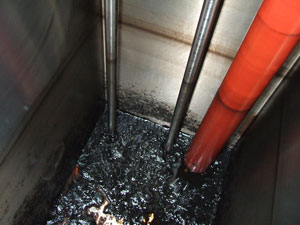
Fuel Polishing near Oban

Thank you. Why is the fuel so dirty?
If diesel sits in a tank unused and inevitably has some water in it diesel bug can ensue.
Microbial contamination of diesel fuel - Wikipedia
Tank1.jpg
 
Thank you. Why is the fuel so dirty?

3 years of sitting on the hard on the west coast, with red and white diesel mixed (so higher level of biofuel, which attracts water), and a delivery trip to do to Falmouth in May.

Despite dosing with Marine 16 ages ago, a fuel test has shown presence of diesel bug.

A sample hasn't shown an "bogey" sludge, but the fuel is cloudy.

So options are a) risk it with lots of filters, just in case, b) remove it and replace, or c) get it polished.

250 ish litres.
 
3 years of sitting on the hard on the west coast, with red and white diesel mixed (so higher level of biofuel, which attracts water), and a delivery trip to do to Falmouth in May.

Despite dosing with Marine 16 ages ago, a fuel test has shown presence of diesel bug.

A sample hasn't shown an "bogey" sludge, but the fuel is cloudy.

So options are a) risk it with lots of filters, just in case, b) remove it and replace, or c) get it polished.

250 ish litres.
Ah I understand. thank you. Not so easy to just get rid of it.
 
My boat had been sitting in a shed for five years and the tanks were full of slimy ‘orrible bug. I made my own polishing rig and spent several weekends sloshing fresh diesel from one tank to the other after dumping the old stuff. Posted about here.
 
I'm about to try a DIY rig simply using a Chinoise 12v oil/fuel pump and the retired CAV filter. Can always run through the (new) facor Racor a couple of times as a bonus at the end. Guess it depends how bad the contamination is? Our tank is bug free, just a bit grotty with the dregs from 7 years' hard standing and no access hatch to allow for more hands-on cleaning!
 
As a Fuel Blender and looking after thousands of tons of Diesels / Gasolines / Crudes / etc. - Fuel Polishing alone is a short term only solution to have a filtered fuel only. It does nothing to solve any Bug problem whatsoever.

There is only one way to really work with a possible contaminated fuel (bugs) ..... and takes time.

1. Dose tank with a Biocide / Enzyme based Bug treatment.
2. Let stand to do its work.
3. After a reasonable period - drain completely the tank to containers - getting as much crud out as well as possible.
4. Flush tank or steam clean .....
5. Leave fuel to stand in containers and crud to settle.
6. Transfer via filters to clean containers ...
7. Flush out first containers
8. Dose second containers with Bug killer (light dose only needed).
9. Let second containers stand and for anything left to settle.
10. Carefully decant second containers avoiding the settled crud transferring. It is not advised to pump or syphon this as you will be dragging up crud into the pump.
11. Leave crud in containers as bonfire stuff !
12. Leave final to stand just to check no further crud to settle out.
13. Return to clean tank.

Do not forget that your fuel lines, pumps and engine filters will have the old fuel in and need 'flushing' through. You may consider this over-kill - but remember that you will have 'return fuel' line to your tank and that could send you back to square one ... The best way to do deal with this - is to use the Volvo Trucks advisory - when change fuel filter - fill with mix clean diesel and Bug killer at an extra strong ratio ... in fact Volvo branded additive advises to only fill filter with additive and turn engine over till it fires up !! Drastic !!

I will not advise which Chemical to use. ... before anyone asks. The decision is YOURS ... what I do suggest is that an additive that breaks down the dead bug crud is what I prefer ...

For anyone interested - the last time I emptied / cleaned my tank on board was in 2011.
 
3 years of sitting on the hard on the west coast, with red and white diesel mixed (so higher level of biofuel, which attracts water), and a delivery trip to do to Falmouth in May.

Despite dosing with Marine 16 ages ago, a fuel test has shown presence of diesel bug.

A sample hasn't shown an "bogey" sludge, but the fuel is cloudy.

So options are a) risk it with lots of filters, just in case, b) remove it and replace, or c) get it polished.

250 ish litres.

What was temperature at the time ... was it Summer Grade Diesel ? What colour was the cloudiness ?

Diesel as will all Middle / Light Distillates have a Cloud Point - this is where the fuel becomes cloudy due to paraffins ... the next step as it cools further is CFPP ....
 
What a horrible job. I have been pumping out white diesel and doing it without a spill is almost impossible. I dosed it when it was put in in 2019, and apart from a bit of cloudiness seems to have kept clear of the bug, but it's going in a tractor. Not quite as critical if it stops as a marine engine.
 
Top