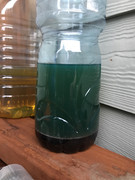
Fuel polish setup

shoc

Active Member
Joined
13 May 2006
Messages
68
Visit site
I've just setup my DIY fuel polishing rig and finished a home test, see video below.

I've noticed on the first run that there's a lot of air in the line after the water separator, is that normal? or is there air getting in someplace?

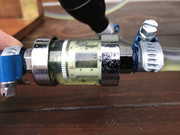
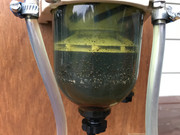
The kit I'm using is mostly ebay items, the fuel pump is unbranded with quoted flow rate of 90-110 Litres per hour, the racor style seperator is fitted with 30 micron filter, large sealey inline filter and generic washable strainer.

Any comments/advice appreciated :)


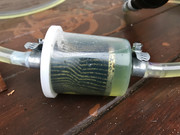
Well, air is obviously leaking in to it, probably at that orange inline filter (the purpose of which is questionable).

If your fuel tank has rubbish in it, it's useful to be able to use a rigid pipe on the suction line to try to "hoover" the gunge off the bottom of the tank. The presence of baffles can frustrate this.
 
I am waiting to finish my fuel polishing system and I have a sediment pre filter in mine system

I would replace the pre strainer and orange inline filter like this below to reduce amy big crud blocking the fine filter

Perkins 4.203 Sedimenter kit

I also use a rigid pipe through the fuel then access hatch to bet the crud off the botton and corners of my tanks.
 
agree, remove the inline filter, whats its purpose when you have a nice big filter coming next in the flow. If you want a water separator first (if that is what you believe the inline filter is doing) then get a proper water/sediment trap from from SSL diesel or similar for not many £
 
I'm expecting a lot of crud in the fuel tank hence using the washable strainer and inline filter to catch the big stuff before the water separator and 30 micron filter....but its adding a lot of clutter to the rig and that sedimenter kit could be the right job (y) instead.

I was expecting a better flow of fuel from the pump...tomorrow I'll time how long it takes to pump 1L and compare to the spec..
 
Makes a lot of sense to have a washable, re-usable gauze or sintered filter as the first stage if you're looking at really dirty systems.
I think some of those Racor things need a high flow rate to centrifuge the fuel.
The old CAv filter/sedimenter is a good intermediate stage because the paper elements are so cheap.
A filter assembly from any modern diesel car seems like a good final stage.
Not sure what the best pump is?

If I was starting from scratch, some sort of water level sensor in the sedimenter might be nice?
 
Alternatively put a hatch in the top of the fuel tank so you can eyeball what's going on in there and get your arm in to clear out any contamination. No guesswork, you can see what's going on.
 
I have a cheap 12Vdc fuel pump which sucks from the discharge side of the primary filter. A 'wand' on the inlet side of the filter allows me to reach everywhere in the fuel tank, stir the crud up and ensure it, and any water, gets captured by the filter. The fuel is returned to the tank via the dipstick hole and I'll occasionally divert some into a jar to check for clarity. When I'm satisfied the fuel is clean enough I simply fit a new filter, add some fuel shot additive, top up, and prime the system using the bulb fitted between tank and filter.

The first time I did this, due to a bad load of diesel, the filter got blocked there was so much rusty sludge in the tank it blinded the filter (the tank is stainless).
 
The only qualification I have for commenting on this subject is that I had a nightmare with diesel bug on my previous boat and I certainly don’t want to pour cold water on your polishing, I’ve tried it myself! It seems to me that fuel polishing only really works if you start off with a clean tank in the first place. In which case the fuel with polishing should remain clean. I would prefer tandem filters with a changeover valve if one becomes blocked. In my case having bought a brokerage boat that had been standing for some time, it had lumps of jelly in the tank which would just block the pipe. The previous comment re baffles rings true and I only cured the problem by replacing the tank and pipes. Throw away the old diesel and start again religiously using a diesel treatment with every fresh fuel delivery.
It works, negates the need for polishing and gives peace of mind. Cue those advising which is the best treatment. I use fuelset.
 
I'm expecting a lot of crud in the fuel tank hence using the washable strainer and inline filter to catch the big stuff before the water separator and 30 micron filter....but its adding a lot of clutter to the rig and that sedimenter kit could be the right job (y) instead.

I was expecting a better flow of fuel from the pump...tomorrow I'll time how long it takes to pump 1L and compare to the spec..

I had a washable trainer/pre filter before I fitted the sediment bowl strainer and it needed washing every 5 minutes due to the amount of crud.

The CAV type filter has the diesel pass through the filter before it passes into the glass bowl. Your main filter the diesel passed through the glass bowl then through the paper filter above. That arrangement makes it easy change he filter element but do try to filter out all the big stuff beforehand.

I also use one of the Jabsco gear type diesel pumps to get a better flow rate.

I have also got a mains gear pump to increase the flow rate even more but I am having to go to industrial filters to get the rate up to the level of the pump I have 1" BSP ports.
 
So an update on this project.

Road trip to the boat fully loaded with all the gear needed and first job was to pump out the fuel from the tank before opening the drain plug.


But the little pump on my filtering rig wasn't able for the lift so decided to crack open the plug and drain into a plastic container


Used a plug to stop the flow and then empty the 1.5L container into a jerry can...back-bracking job especially for someone who has a chronic pain condition but hey its a great distraction and keeps me busy...anyway I keep draining and filling...... and 30L later the tank is empty.....so 50L in total taken from tank wow that gauge was off a bit!

Anyway back at home I'm now filtering the fuel and its pretty bad...the washable strainer is good but difficult to clean out-even with a toothbrush, the inline's are great - just exchange and dump when its visibly dirty (it even scrunches up when really bad) and the Racor copy is ok so far. (BTW the agri diesel is green in this part of the world ;) )


Next steps continue polishing the fuel and then back to the boat, fit a drain tap and flush out the tank as much as possible. Unfortunately my tank has no access ports except for the fuel gauge hole which is too small and inaccessible to be useful and the tank has a baffle down the centre....so I'm just going to flush and put the clean fuel back with anti-bug treatment and take my chances. It may not be the full or proper solution but I'm having a lot of fun and learning lots as well. (The boat is an inland cruiser so if I breakdown due to blocked filters, its down with the anchor and on with the kettle)

Can someone suggest a better 12v pump for the polishing rig ? this is the one I'm using; (ebay link) but its really weak and won't work on the boat where it needs to lift the fuel about 2-3ft. Its just about OK on the polishing rig at home where pump and tank are on the level but I think the Racor type separator could perform better if the flow was higher. Considering it only cost a tenner its doing fine but maybe a little more money will get a more suitable pump?
 
The only qualification I have for commenting on this subject is that I had a nightmare with diesel bug on my previous boat and I certainly don’t want to pour cold water on your polishing, I’ve tried it myself! It seems to me that fuel polishing only really works if you start off with a clean tank in the first place. In which case the fuel with polishing should remain clean. I would prefer tandem filters with a changeover valve if one becomes blocked. In my case having bought a brokerage boat that had been standing for some time, it had lumps of jelly in the tank which would just block the pipe. The previous comment re baffles rings true and I only cured the problem by replacing the tank and pipes. Throw away the old diesel and start again religiously using a diesel treatment with every fresh fuel delivery.
It works, negates the need for polishing and gives peace of mind. Cue those advising which is the best treatment. I use fuelset.

Fuel Polishing ................. mmm I have a setup at home based on 200litre drums with 5mic filters.

I stopped using the fuel after having serious problems on one cruise in Swedish to Finnish Arch. I was using it to top off local bought and that was fine till I was running short and put in the remaining lot I had, making it the larger part of the volume ... arriving Marieholm ... engine decided enough was enough ...

This is me getting things going again :

evbXyJa.jpg


You may get a nice looking clearer fuel after FP ... it does not mean its 'safe'. I had my setup samples tested in my lab and all came back good ... but I didn't wait for the bugs results !! When I did test again after the cruise ... the bugs were there and I now use it to mix with fire lighter fuel !! for domestic uses ...
(The origin of the fuel in the drums being the samples to dispose of from my Lab .... FOD40 and FOD49, along with dark heating oil and Kerosine .... the mix was calculated to produce a Cetane of average for a diesel engine).

My main action now is to use my Pela to suck out the crud in bottom of fuel tank ... and then just use a good additive to break down any bugs and the small amount of suspended moisture. Free water of course is as far as possible syphoned out by the Pela.

My PoV is that fuel should be used ... idle fuel particularly diesel will not reward you for standing. So a good dose of additive is my solution.
 
Top