Fridge using lots of amps in the hot weather

Never let a good Google quote spoil the facts Jamie.

Obviously you reckon you know better than Waeco. It doesn't matter what sort of fridge you have if the condenser can't get rid of the heat (eg by being placed in a lazarette) it won't work.

And a bit of cold air flowing out of a front loading fridge when the door is opened is not important.
 
Obviously you reckon you know better than Waeco. It doesn't matter what sort of fridge you have if the condenser can't get rid of the heat (eg by being placed in a lazarette) it won't work.

And a bit of cold air flowing out of a front loading fridge when the door is opened is not important.

Read the fitting instructions that Jamie posted, they relate to the OPs fridge, yours relate to a different type if fridge, so they are irrelevant.

Roger, you also need to read what the thread is about, rather than randomly hitting the like button. It's clearly no good referring to instructions to fit the condenser in a remote location when the OP has a cabinet fridge.
 
Read the fitting instructions that Jamie posted, they relate to the OPs fridge, yours relate to a different type if fridge, so they are irrelevant.

Roger, you also need to read what the thread is about, rather than randomly hitting the like button. It's clearly no good referring to instructions to fit the condenser in a remote location when the OP has a cabinet fridge.
“there are three kinds of people in the world: those who don't know and don't know they don't know; those who don't know and do know they don't know; and those who know and know how much they still don't know.” (K M Moning)

And in case you don't know, Paul, you are the first kind.
 
“there are three kinds of people in the world: those who don't know and don't know they don't know; those who don't know and do know they don't know; and those who know and know how much they still don't know.” (K M Moning)

And in case you don't know, Paul, you are the first kind.

That's funny coming from the person that just post Google searches, most of which have no relevance to the subject matter. ?

To prove my point you had to post a Google quote here.

To further prove it, you are posting irrelevant installation instructions to the OPs fridge. You snipe that "i know better than Waeco", whilst you dismiss the fitting diagram posted by Jamie, for the OPs fridge, by Waeco.

You certainly are something special.
 
  • Like
Reactions: pvb
Paul

To be frank I would never consider fitting an air cooled condenser fridge in a boat when the outside water is a far better and more efficient of removing the heat inside a fridge.

In saying that a correctly installer with proper air ducting is OK but in a small vessel like the OP will potentially reduce the usable space. In my larger steel boat the ducting required would have less impact.

Reducing the duty cycle not only reduces the total power consumption but also reduces the ware and thus the life.

The OP has a cabinet fridge and asked how he could make it better.

Improving the ducting and more powerful fans would work but fitting an external condenser would improve the efficiency with any need to extra ducting.

The downside is cost but extra ducting would also involve some costs.

Your point about "would it be worthwhile" is a valid point in view of the weather in th UK but its up to the OP to may the decision not you or I.
 
Thanks for all the info, lots of useful info here, things I have learnt, for my current installation, include:
  • Check element is clean and the light switches off.
  • Keep fridge full, preferably with beer
  • Adding insulation to a cabinet fridge, probably not the best idea.
  • The fridge is currently in a totally enclosed space not ventilatiuon whatsoever, increasing ventilation, fanned or otherwise may help - maybe not a great reduction in amps used, but is something that I could do quickly and cheaply to try.
Longer term, I'm going to be moving to a bigger boat, so more generic things I have learnt for that include:
  • Although more expensive, keel/water cooling would lower my amp hours used
  • Top opening may be a better option as it lends itself more readily to the addition of more insulation to lower amp hours used
Lots of other bits to consider in there as well.

Thanks again.
 
="PaulRainbow, post: 7304901, member: 162895"]
?

[/QUOTE]

Thanks for all the info, lots of useful info here, things I have learnt, for my current installation, include:
  • Check element is clean and the light switches off.
  • Keep fridge full, preferably with beer
  • Adding insulation to a cabinet fridge, probably not the best idea.
  • The fridge is currently in a totally enclosed space not ventilatiuon whatsoever, increasing ventilation, fanned or otherwise may help - maybe not a great reduction in amps used, but is something that I could do quickly and cheaply to try.
Longer term, I'm going to be moving to a bigger boat, so more generic things I have learnt for that include:
  • Although more expensive, keel/water cooling would lower my amp hours used
  • Top opening may be a better option as it lends itself more readily to the addition of more insulation to lower amp hours used
Lots of other bits to consider in there as well.

Thanks again.

I believe what you are planning is a very sound move.

I think keel cooling is a good move even though sea water temperatures in places like Darwin can be up around 30° C (86° F) just about all year round. (Nice to read a comment from someone who obviously understands what he is doing)

Screenshot_2020-08-19 Darwin Water Temperature Australia Sea Temperatures.png
 
  • Although more expensive, keel/water cooling would lower my amp hours used

Don't be swayed by comments which aren't relevant to your needs. Water cooling can be a big advantage in locations where the ambient air temperature is very high. However, for UK use, the benefit is questionable. If you compare the specs of these two similarly sized Isotherm systems, you'll see that the average consumption of the water-cooled unit is higher!

Compact Air-cooled Refrigeration System - 2501 - 200 L max | KENT Marine Equipment
Compact Water-cooled Refrigeration System - 2505 - 200 L max | KENT Marine Equipment
 
Keep fridge full, preferably with beer
On a small boat this is probably the key point. The compartment my fridge is in got very warm when I first installed it, but that was starting from warm for the first time. Since then it’s been fine, I keep the fridge full of bottled water, beer and a big box of wine. Also have ice cubes and a cool box cooler in the freezer compartment so really very little for the fridge to do other than top up the cooling from time to time.
 
Don't be swayed by comments which aren't relevant to your needs. Water cooling can be a big advantage in locations where the ambient air temperature is very high. However, for UK use, the benefit is questionable. If you compare the specs of these two similarly sized Isotherm systems, you'll see that the average consumption of the water-cooled unit is higher!

Compact Air-cooled Refrigeration System - 2501 - 200 L max | KENT Marine Equipment
Compact Water-cooled Refrigeration System - 2505 - 200 L max | KENT Marine Equipment

It would be interesting to know what type of condenser the water cooled unit uses ?
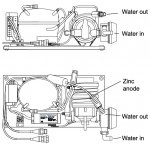
I have a frigoboat system with the keel cooler as below

Keel Coolers

The above says Using a Frigoboat keel cooler system, power consumption is reduced up to 25%.

My front opening fridge and my top opening freezer use the same components except the evaporator in the freezer is slightly bigger

Do you dispute this statement ?
 
Last edited by a moderator:
It would be interesting to know what type of condenser the water cooled unit uses ?

The Isotherm Compact Magnum water-cooled system I linked to is said to use a "copper nickel" condenser, which is a spiral arrangement wound around the water pump. The speed of the water pump is varied according to the water temperature. As mentioned previously, the average power consumption quoted by Isotherm is slightly higher for the water-cooled system. However, as I've also said, if a refrigeration system is being used in very high ambient air temperatures, a water-cooled system will be better than an air-cooled system.

This diagram from the manual gives an idea of the arrangement.

isotherm.jpg

I have a frigoboat system with the keel cooler as below

Keel Coolers

The above says Using a Frigoboat keel cooler system, power consumption is reduced up to 25%.

The important words are "up to"!

My front opening fridge and my top opening freezer use the same components except the evaporator in the freezer is slightly bigger

Do you dispute this statement ?

How could I dispute this? I've never seen your fridge or freezer.
 
Last edited:
Don't be swayed by comments which aren't relevant to your needs. Water cooling can be a big advantage in locations where the ambient air temperature is very high. However, for UK use, the benefit is questionable. If you compare the specs of these two similarly sized Isotherm systems, you'll see that the average consumption of the water-cooled unit is higher!

Compact Air-cooled Refrigeration System - 2501 - 200 L max | KENT Marine Equipment
Compact Water-cooled Refrigeration System - 2505 - 200 L max | KENT Marine Equipment

Thanks for this.
 
When I posted about pumped water cooled heat exchanger type fridge you talked about the pump taking extra power over the air cooled system.

The main factors that affect the efficiency/ duty cycle/power consumption is the the insulation of the fridge/freezer and the temperature of the heat source and sink, basic heat engine/reverse heat engine(heat pump) efficiency.

I ment do you dispute the up to 25% saving in power consumption with a keel cooler.

I also have air conditioning which is water cooled by circulating water through the hollow steel skeg on my boat, so I always better to not put more heat into the air than is necessary when the ambient temperature is higher than iss compororble.

But of course there is not the need for that much air conditioning in the UK even in the 2 or 3 days hot weather you get every so often.
 
But proves you don't need a fridge to survive in tropical waters let alone temperate ones off the UK. Unless you are one of the people who like your beer at 0.05°C so to hide the fact it has no taste.
Dear me, my irony signal must have been kaputt, again and I just had it serviced.

Somehow I too managed an eighteen month trip from Europe through the tropics to the Canadian West Coast and all without a fridge and a chart plotter even.

Our current boat has a fridge; we like it. It has a holding plate, I cut a ruddy big vent into the side of the cabinet, fitted a computer fan to move the hot air out and the thing runs off the solar. We've had over 40 degr. in the cabin and I've never given it a second thought.
 
Dear me, my irony signal must have been kaputt, again and I just had it serviced.

Somehow I too managed an eighteen month trip from Europe through the tropics to the Canadian West Coast and all without a fridge and a chart plotter even.

Our current boat has a fridge; we like it. It has a holding plate, I cut a ruddy big vent into the side of the cabinet, fitted a computer fan to move the hot air out and the thing runs off the solar. We've had over 40 degr. in the cabin and I've never given it a second thought.

My fridge compartment is built into the boat and has very thick insulation. The compressor and condenser are fitted below the sink unit, air can move freely from the bilges beneath, to spaces beneath the side decks, plus the doors of the unit are louvred. Mine also has a holding plate. It cycles very little, even in the temperatures we've had recently and it keeps everything nice and cool. During the Summer, the whole boat runs from solar power. Can't see any need for keel coolers here.

Not suggesting for a moment that the OP changes his current system to anything like mine, it would be a silly thing to do. Well worth considering for his next, bigger, boat though.
 
Top