Fridge motor on constantly when ‘on’.

fredrussell

Well-Known Member
Joined
24 Mar 2015
Messages
4,154
Visit site
It’s a 1991 boat, I assume fridge is original (compressor) one. Fridge gets nice and cool but rather than compressor ‘kicking’ in every now and then, it seems to run constantly. If you turn temp down it runs faster, and if you put it to “min” (less cool) it runs slower.
I have a waeco compressor fridge in my van which only runs compressor occasionally- should my boat one run in the same fashion?
 
Last edited:
It’s a 1991 boat, I assume fridge is original (compressor) one. Fridge gets nice and cool but rather than compressor ‘kicking’ in every now and then, it seems to run constantly. If you turn temp down it runs faster, and if you put it to “min” (less cool) it runs slower.
I have a waeco compressor fridge in my van which only runs compressor occasionally- should my boat one run in the same fashion?

It sounds as though it is controlled by varying the speed of the compressor rather than by switching on and off in the more normal way. You don't say if it is cooling properly or what make and model it is,

It would be sensible to check the temperature and if it is getting down to the correct level do nothing hasty but keep a check on it, Otherwise investigate the possibility of re-gassing as suggested. Before you do that you will have to check what the refrigerant is and how it can be done.
 
Can that be done in the same way a car AC is done, ie by buying a canister of refrigerant and plugging it in?
Not that I know. My fridge had the same issue, and was re-gassed. The professional re-gassing kit was a bit more complex than just a simple cylinder of gas. Too much pressure is also bad, hence the professionals connect up their kit then run the fridge compressor whilst feeding in fresh gas and watching the gauges on their equipment until the pressure is correct. At the age of your fridge re-gassing may only be a temporary fix as its likely that a small leak somewhere will cause pressure to drop again over a few days or weeks. That is the problem with my fridge and a new evaporator is the only solution for me as the leak is there . You will just have to see if re-gassing provides the solution but if the problem recurs then the leak has to be found and stopped. If you are very lucky the leak might just be from one of the seals between the compressor and the evaporator.

EDIT, Even a fridge with a variable speed compressor will not normally need to run all the time unless its set to run at too low a temperature for its cooling capacity.
 
Can that be done in the same way a car AC is done, ie by buying a canister of refrigerant and plugging it in?
I suspect you may have problems if it dates back to 1991 - it may well use a refrigerant that is now banned (CFCs) in which case it could prove to be a complicated and expensive process. Not sure if there are rules governing the safe-removal of old CFCs from the fridge as well
 
I suspect you may have problems if it dates back to 1991 - it may well use a refrigerant that is now banned (CFCs) in which case it could prove to be a complicated and expensive process. Not sure if there are rules governing the safe-removal of old CFCs from the fridge as well

You beat me to it .... I have had to replace various good gear in my labs in past due to change of refrigerant ..... the old Freon is not available now.
 
The OP may be OK as my fridge dates from 1998 and was refilled with R34A. That was with the old compressor, since replaced with a new one that uses the same refridgerant.
 
The OP may be OK as my fridge dates from 1998 and was refilled with R34A. That was with the old compressor, since replaced with a new one that uses the same refridgerant.
i think you mean R134a, it’s the compatibility of the oil that’s the issue between the car AC and your boat fridge, even f they both use R134a.
 
It’s a 1991 boat, I assume fridge is original (compressor) one. Fridge gets nice and cool but rather than compressor ‘kicking’ in every now and then, it seems to run constantly. If you turn temp down it runs faster, and if you put it to “min” (less cool) it runs slower.
I have a waeco compressor fridge in my van which only runs compressor occasionally- should my boat one run in the same fashion?
I salute your efforts to get this gear running again properly especially when it is delivering cool air. But at this age, the chances of long term success are not good - for the reasons others have listed. My Waeco went on the blink a season ago and I went for new - I'm sure the added cost, not that much over calling out a refrigerator technician, is worth the seasons ahead of effortless coling. A fridge that runs continuously sound more like an industrial unit as found at scale on Reefer containers

PWG
 
I salute your efforts to get this gear running again properly especially when it is delivering cool air. But at this age, the chances of long term success are not good - for the reasons others have listed. My Waeco went on the blink a season ago and I went for new - I'm sure the added cost, not that much over calling out a refrigerator technician, is worth the seasons ahead of effortless coling. A fridge that runs continuously sound more like an industrial unit as found at scale on Reefer containers

PWG
It runs continually as it cannot compress the gas, or am i missing something here
 
It’s running continuously as when short of gas, not enough to fill the liquid side of the system and when expanded to gas phase not enough duty to over cool and allow compressor to shut off. It’s all about a balanced system, that’s why gas charge critical down to grams in a small system. A small leak makes a big difference.

the compressor is doing the work to raise internal pressures but the change of phase liquid to vapour is actually doing the work
 
The simplest explanation of a fridge I ever saw went like this. The compressor compresses gas so that it turns to its liquid state. In doing so the fluid gives up its latent heat of evaporation, which is why the compressor is hot and has a fan to cool it. The liquid passes to the evaporator inside the fridge compartment where it is forced through a small orifice into the main evaporator tube. The rapid expansion causes the liquid to turn back to gas at which point it absorbs its latent heat of evaporation, making its surroundings cold. The volume of liquid is absolutely critical. Too little and the fridge struggles with the motor running almost non stop, too much and liquid can be carried through into the compressor, which will wreck it because the liqid is incompressible.
 
The only important bit missing from the above is the condenser that actually turns the gas to liquid and rejects the gained heat, the compressor only gets hot due to wasted energy from the compression. The lower compression differential the more effective the system. Thats why the condenser needs good air flow and why current drawn goes up the higher the ambient
 
I suspect you may have problems if it dates back to 1991 - it may well use a refrigerant that is now banned (CFCs) in which case it could prove to be a complicated and expensive process. Not sure if there are rules governing the safe-removal of old CFCs from the fridge as well
A 1991 fridge will almost certainly be using CFC R12, as R134a was only first tried out as an R12 replacement ~ 1993. Even if you could find any R12 adding it to your fridge would be illegal, and in my view only a cowboy fridge engineer would do this for you. You could try using R134a - might just work, as the oil would still circulate on a small system. Removing the old gas should be done with a recovery unit and the gas recovered and sent for destruction, but the tiny volume a boat fridge holds would barely purge the recovery unit.

However, if the issue is the system being short of gas then where has it gone ? It never ceases to amaze me the number one suggestion for a poorly performing fridge is a loss of gas, when for a fridge almost 30 years old perhaps the compressor valves are worn out, so with each stroke of the piston a good deal of the the gas just pumped seeps back into the cylinder.
 
It’s a 1991 boat, I assume fridge is original (compressor) one. Fridge gets nice and cool but rather than compressor ‘kicking’ in every now and then, it seems to run constantly. If you turn temp down it runs faster, and if you put it to “min” (less cool) it runs slower.
I have a waeco compressor fridge in my van which only runs compressor occasionally- should my boat one run in the same fashion?
You say "If you turn temp down it runs faster, and if you put it to “min” (less cool) it runs slower."
Has it always done this or has it just started behaving like this?
You are comparing it to your Waeco but is it working on the same principle, What make is it?
 
The only important bit missing from the above is the condenser that actually turns the gas to liquid and rejects the gained heat, the compressor only gets hot due to wasted energy from the compression. The lower compression differential the more effective the system. Thats why the condenser needs good air flow and why current drawn goes up the higher the ambient
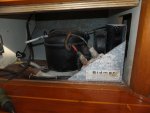
I forgot that bit, the condenser on most boat fridges is built into a unit with the compressor with a fan forcing air through it. The photo shows my old compressor, fan and condenser. The compressor and the noisy fan have have been replaced since the photo was taken, because its separate Danfoss control box had burned out and a new compressor complete with its own electronics cost little more than a replacement controller.tn_DSCF5328.JPG
 
It’s a 1991 boat, I assume fridge is original (compressor) one. Fridge gets nice and cool but rather than compressor ‘kicking’ in every now and then, it seems to run constantly. If you turn temp down it runs faster, and if you put it to “min” (less cool) it runs slower.
I have a waeco compressor fridge in my van which only runs compressor occasionally- should my boat one run in the same fashion?

Give Paul a ring at Haven Refrigeration. He won't rip you off.
 
Top