Fridge insulation options?

Tim Good

Well-Known Member
Joined
26 Feb 2010
Messages
2,888
Location
Bristol
Visit site
I had to remove the insulation from the top of my fridge to access the chainplates. The insulation was a type of blue closed cell foam. It was destroyed getting it all out again. I’ve added armaflex up against the deck and at the back against the hull. The rest is open to options.

What do you recommend?

- I could try and buy more armaflex and fill it out with different thicknesses and try to remove any gaps.

- I could get some kingsman or cellotex and try to shape it into blocks like it was before.

- I could put some more 20mm armaflex on the bottom which would leave a gap in the middle and then foam fill it .... but that would be messy and quite permanent.
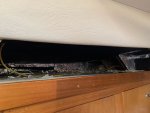
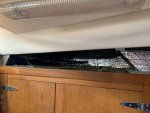
8A1A1CC1-99CD-46D6-86BE-0753FD170DCE.jpeg

70DBA1D5-4BA9-403E-B577-7F5DC62914F8.jpeg

AE853463-C10B-4826-ADA7-7F9A604BA084.jpeg
 
25mm of celotex will do the job well, thicker if you can. Over 50mm is a waste of effort and space.

At the back near the hull I have around 60mm and towards the front as much at 130mm. Let say I get 50mm in there then there will be gap of between 10mm and 80mm between the top of the celotex and the armex. What do you suggest I fill that space with. Ideally it doesn’t want to be dead air.
 
When I converted the ice box of my Westerly Renown to a fridge I used a mixture of sheet expanded polystyrene and squirty construction foam from Screwfix. Where I could get at it I used the sheet stuff and round the back I squirted in a can of foam to fill the space out to the hull.
 
You can get expanding foam in cans with all sorts of expansion rates.
It's fairly easy to hack out when cured and saws really easy.
Surely ideal for filling irregular shapes.
 
At the back near the hull I have around 60mm and towards the front as much at 130mm. Let say I get 50mm in there then there will be gap of between 10mm and 80mm between the top of the celotex and the armex. What do you suggest I fill that space with. Ideally it doesn’t want to be dead air.
Is the celotex going to be flat against the top of the fridge?

If so it doesn't matter what does in the gap above the celotex, but expanded polystyrene would probably be cheap. Surely you're just looking for a "filler"?
 
Is the celotex going to be flat against the top of the fridge?

If so it doesn't matter what does in the gap above the celotex, but expanded polystyrene would probably be cheap. Surely you're just looking for a "filler"?

yeah it could be flat on the top. I suppose I was worried about an air gap causing condensation but perhaps I could just fill out a gap with some superquilt that I have left over.
 
25mm of celotex will do the job well, thicker if you can. Over 50mm is a waste of effort and space.
Anything more than 150mm is a waste if effort. I have run the calcs on a computer when designing my fridge. We opted for 150mm on the bottom of the fridge and 100mm on the sides and top. The bottom of the fridge will be the coldest so the 150mm makes sense there. The top could get away with less than 100mm but when you assume the top could be in direct sun then anything less than 100mm causes too much heat loss. I did my calcs assuming ambient temperatures expected in the Tropics. If you are sailing in the UK you can just leave your fridge outside?
 
At the back near the hull I have around 60mm and towards the front as much at 130mm. Let say I get 50mm in there then there will be gap of between 10mm and 80mm between the top of the celotex and the armex. What do you suggest I fill that space with. Ideally it doesn’t want to be dead air.
If you can get 50mm of celotex all around you certainly don't have an insulatuion problem - laterally. Do give some thought to insulating the lid though.
Extra space? Dead air-space around 50mm of celotex is barely measurable in practice thermally. It might be helpful from a retaining point of view to fill the gaps with builders foam but in my experience it is dreadfully messy stuff, always escapes and creates havoc if you try to confine it and if you ever need to regain access around the back and sides your fridge in future the dam thing is now encased in a sarcophagus of solidified sludge that is serving little purpose while presenting a biig nuisance.
Personally I'd ensure fixing the celotex well with no gaps and joins well glued and sealed and be grateful for the access in case you ever need it.

ps.
Screenshot 2021-03-01 at 20.58.39.png
I imagine this graph is reasonably representative and it does seem to show that doubling thickness (50 to 100units ) provides an appreciable advantage but also clearly shows that anything further is of little added value at all. It certainly demonstrates the law of diminishing returns.

Even 100mm all round is 4 inches on every dimension, enough to turn a cardboard box into a packing crate. How much space do you have? How much can you afford? And how much does all this cost.

Probably much more to the point, how much less effort and cost is it to simply add another domestic battery...?
Getting transfixed by 'effiiciency savings' is all very well but yachting is a practical business.
 
Last edited:
I’ve just checked an cellotex and kingspan are not close cell. Do we think this is a bit of a problem? Perhaps using an extruded polystyrene is a better option which is true closed cell?
 
Top