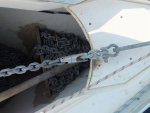
fitting a shackle to a chain link

I think you are over thinking the issue.

There are pressure fittings, made in different sizes, that look like truncated cones (work like olives). I've seen (and used them) in stainless (used in stainless pressure pipes in the food industry). I don't know what they are called nor who supplies them (mine came from a local pump supplier) and I used them on our desal unit to extend 2 pipes). These would do the trick. You could use gal washers, as you suggest. But unless the shackle you are buying is marginal in strength - you worry too much. I am assuming you have ordered a bow shackle and it is the bigger possible to fit (an expanded, drift/vice, end link).

Jonathan
 
The chain and the shackle will wear if it is in a mooring with constant movement and load. It is therefore an advantage if the link does not stay in the middle of the shackle. Spreads the wear point around a bit. So I can't see a reason to be concerned. What is important is that the shackle pin stays in place. There is a huge turning force on the pin when loaded and unloaded so peen or mouse the pin. Secondly as said wear is a constant problem. The faying surfaces rust but that protective rust gets worn off so more rust. Galvanising just does not last. So frequent inspection and replacement is essential. Certainly ona mooring once per year. ol'will
 
Will, this may be wrong but Simon had a thread earlier on 'which shackle' for his anchor chain. I had assumed this thread was a continuation off that query - so my answer is in terms of a rode. Your answer is one with which I would agree, for a mooring (and our moorings in Pittwater are all ungalvanised because (as you mention) the gal is simply a waste of time (and money).

Jonathan
 
I have seen anchor shackles where the chain has been centred on the pin using spacers.

I am not sure in most cases if it is generally a good thing, of little practical value, or detrimental.

The most important thing to check is that the shackle cannot jam or bind in an unfair position. This has been mentioned by several posters as occurring occasionally and I have seen the effect underwater. It is bad for the anchor’s stability. I think it can have a significant impact on the anchor’s holding ability. I suspect it is a factor in otherwise excellent anchors failing to hold, especially with a wind shift.

So whatever shackle you choose, take the time at the dock to pull the chain from all directions including from back towards the fluke (180° from its normal orientation) to see if the combination can lock or jam into place. If it can, it is very important to fix this problem. Usually a slightly different model shackle will solve the issue, but in some intractable cases spacers to centre the chain may help.

A lot of forum posts are devoted to shackle strength, but selecting a shackle that cannot bind is perhaps an even more important consideration when selecting a shackle. Unfortunately, it is rarely mentioned in forum posts and is something you have to try with your particular chain/shackle/anchor combination, usually after you have already purchased the shackle, but at least they are not very expensive items.
 
Last edited:
I think you will find that the reason for using Grade B shackles, limited at our size of shackle to Crosby's G209A and Campbell's Orange Pin shackles, which are normally around 2 time the strength of much more common Grade A shackles is simply because shackles 'lock up' in the shank. This has been mentioned repetitively. Reiterating what has been posted before - side loading of shackles can reduce strength by as much as 50% and to overcome this strength reduction it is, simply, prudent to use the strongest shackles available - which are Grade B shackles.

Its a yacht, no matter what attempts you take sh** happens - a Grade B shackles costs peanuts - why take the risk.

Side loading does happen - and it is impossible to be sure it will not happen to you, no matter who hard you try to match shackle to anchor - so assume the worst (it will cost virtually nothing extra) - and the strongest shackle is very cheap insurance.

In smalls sizes you cannot source Grade B shackles and currently the nearest quality are CMP's Titan Black Pin shackles (and to engender minimisation of side loading - use a bow not 'D' shackle). But if you need 3/8th" (10mm) or larger focus on Crosby or Campbell (and in the UK Knox Anchor, as well as Tecni, now stock Crosby 209A). I don't know how to source Campbell outside the US.

I am not aware that any stainless shackle meets a Grade B specification, but it would be worth checking. I am comfortable with Crosby and Campbell - having tested both to destruction. I have not tested higher tensile stainless and reserve judgement. I have tested CMP Black Pin - and recommend Crosby and Campbell in preference.

Jonathan
 
indeed, anchor chain.

i can inspect it every weekend i launch the boat, so no problem there.
got a nut and a split pin at the side, will locktite it too, cant see that coming loose ....

drifting, does bending the link open to allow for a larger diameter pin not weaken the link ?


A long as you are using G30 or G40 chain, then you will not weaken the link (consider that the wire has been bent to make the link, much more than you will bend to enlarge, and that does not weaken the chain).

If you are using something more exotic, a Quench and Tempered product, like G70, G80 or G100 then bending the link is not to be recommended. However I am not sure that this caution is based on testing or practical use of galvanised HT chain - so I would not be dogmatic. I am happy to be corrected. It was commonly said (one of the internet truth that are not) galvanised HT chain cannot be re-galvanised - this was found to be wrong.

There are then other options to accomodate a 'larger' shackle for gal HT chain - we are using galvanised Omega links which offer an option to add your own enlarged link of a strength matching that of the chain.

http://www.vanbeest.com/getattachme...-3d01b0fa2bc1/chapter02_grade10_products.aspx

see page 234

Maggi offer(ed?) this option - but their Omega link were huge (and not something that I could endorse as they will reduce anchor performance).

Jonathan

edit

You would need to arrange galvanising of Omega links, as I have mentioned previously - speak to Highland Galvanisers (or Knox Anchor).

close edit
 
Last edited:
Reiterating what has been posted before - side loading of shackles can reduce strength by as much as 50% and to overcome this strength reduction it is, simply, prudent to use the strongest shackles available - which are Grade B shackles.

This issue I am referring to has nothing to do with strength of the shackle so fitting a stronger shackle does not solve the problem.

Side loading on the shackle is inevitable. Agreed. The boat and the anchor chain will rotate around often before the anchor itself starts rotating. There will therefore be a side load on the shackle until the anchor rotates (or shuffles) around to the new orientation. It is important that the shackle has enough strength to cope with this side loading. This has been mentioned many times, but it is important that the shackle cannot lock in a twisted position. This is related to the size and geometry of the shackle and this issue is not often considered.

In some cases the shackle can lock or jam in this twisted position. This means the chain is leading from the anchor not in a direct line from the shank even after the anchor has rotated. So when the anchor has finished rotating the shackle remains jammed on the side or on the top of the shank. This unfair lead point upsets the balance of the anchor and it will not perform normally. In fact, it can perform very poorly, twisting out of the substrate.

In some cases the force of the chain will unjam the shackle when it has rotated around, but if the anchor is poorly set after the rotation the force to unjam the shackle can exceed the holding power of the anchor.

So it is important to connect the selected shackle to the anchor and try pulling from different directions. If it can bind and stick in place, especially severely, it is not a good choice.

This photo of a Rocna illustrates how the chain can lead from the anchor at a severe angle. If the wind is light the anchor will stay in this position, but if the force is strong enough the anchor will rotate. The shackle should be free to rotate if this happens. Unfortunately in some cases the shackle can be a shape and size where it can jam on the shank. This can twist the anchor out of the substrate, particularly if it has already been partially unset during the rotation. This is an easy problem to avoid, but you need to aware of the issue.


qSlCwgM.jpg
 
Last edited:
The anchor in your image will sommersault, if tensioned sufficinetly. It will not swivel round. The shackle has nothing to do with it.

I've tested a variety of anchors and no reputable anchor will swivel round with the rode at that angle. In this case one needs an anchor that will reset quickly. If the fluke clogs the anchor will not set reliably until the fluke clears - I have also tested that. The result are all detailed in Practical Sailor.

https://www.practical-sailor.com/issues/37_26/features/Anchor-Resetting-Tests_10981-1.html

There are other similar article in PS and one in 2001 provided almost identical results, google will find it!

But here we are

https://www.practical-sailor.com/issues/27_2/features/4481-1.html

Most reputable anchors will reset even with a shackle 'locked up' - I've tried it - Rocna, Supreme, Excel, Spade, Fortress, Kobra, Knox. The danger is that understrength shackles will fail (I have samples of real life failures) and for anchors with weak shanks - may damage the shanks. For a shallow set anchor there will be no damage to shackle nor anchor - but modern efficient anchors can deep set and be very difficult to retrieve - requiring much patience - if you snatch load, say a wave passes under your bow as you are trying to break the anchor out - that then it becomes an issue, to a weak shackle (and your windlass)

Jonathan

edit

If you look at this article:

https://www.practical-sailor.com/is...Shackles-The-15-Insurance-Policy_11773-1.html

and look at the side bar image on the right hand side you will see 4 images. The bottom left image is of a shackle that we believe (one can never be certain) was side loaded and the pin simply pulled out of the thread. You can see that the mousing wire is still intact. The shackle joined the chain to a new Excel anchor and had been used to secure 2 cats rafted up overnight (so lots of windage and a deepset anchor.) The shackle failed on retrieval (and the anchor lost) . I know some disparage testing of shackles etc - but this is an unrated shackle but based on other tests I would put it at a strength of 6t for a 3/8th" shackle, similar to most Grade A shackles. A grade B shackle of 3/8th", which would have strength of 10t to 12t - would be much less likely to fail - hence my repetitive suggestion - buy Crosby G209A or Campbell Orange Pin, or failing that a CMP Titan Black Pin (but the Black Pin are not so good and I only suggest buying them for the small sizes). Don't try to save money - its not worth it.

Close edit
 
Last edited:
For what its worth, this is my setup with a 25KG Rocna anchor and 10mm chain. The anchor has the bow of a Crosby 16mm pin bow shackle inserted though the slot and the pin of the shackle goes though the end link out of three inks of 12 mm chain, the other end of which has the large pin of a stainless swivel through it. The small pin of the swivel connects to the end link of the 60 metre long 10mm chain. I think this is a good setup as it prevents the swivel suffering any side loading and it is unlikely that the shackle will suffer significant side loading.
Just putting a shackle though the chain with the anchor directly connected strikes me as a weak arrangement.

I have tried to post a photo but the photo and video posting links have gone missing, replaced by loads of icons.

EDIT: Problem appears solved. Here is the photo.
DSCF4995.JPG
 
Last edited:
Top