First proper boat having been a dinghy sailer. Introductions and a question.

HandmadeMatt

Active Member
Joined
2 Jul 2013
Messages
48
Visit site
Hi.
I restored a free Mirror dinghy years ago and really enjoyed doing it and sailing it.
I build and restore campervans and was interested in an alternative project. A bigger boat seemed like a natural progression.
You can see my previous work here www.HandmadeMatt.com

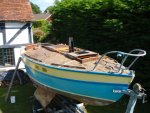
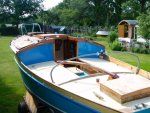
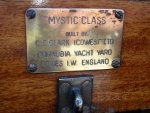
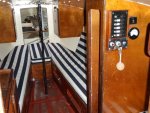
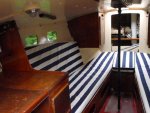
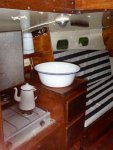
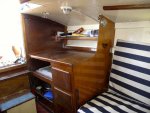
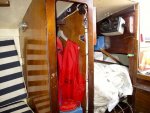
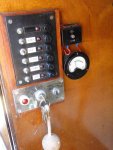
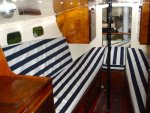
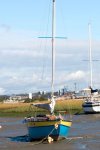
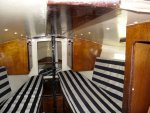
I've bought a 1963 Robert Tucker Mystic 21 in complete and solid condition with and inboard engine and lots of extras. It came with a fantastic trailer. She's just in need of LOTS of cleaning, TLC, a "boat load" (sorry) of sanding, painting and varnishing. It's a marine ply construction on solid wood beam.

You might think I'm mad, but I love her and it was a COMPLETE BARGAIN.

I've dragged her home to do the work. Maybe she'll get on the water this season. Maybe not. I picture self launching her in the spring and recovery in the autumn for maintenance and storage at home.

Here she is:
1013819_10152954863455007_481878755_n.jpg P2010011.jpg P2010024.jpg P2010025.jpg P2010026.jpg P2010030.jpg P2010033.jpg P2020008.jpg P2020010.jpg P2020017.jpg

My questions are:


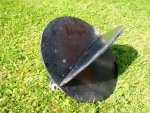
  • What is the black circular cross divice? (Pictured) It stores flat. I thought it might be a radar reflector but it's made of wood.
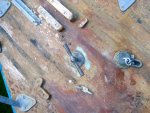
  • On the deck there are clear, square non slip areas under the varnish. They seem to be resin. They scrape off easily in some places and not so easily in others. Obviously before re-varnishing I need to get all the old stuff off including these non slip areas. When reapplying should I replace the non slip under or over the new varnish? What shall I use? Isn't there a product I can mix in with varnish/ paint to create non slip?
  • I am thinking about using International Original varnish. Any good? Any suggestions?

I've put all these Photobucket hosted links below incase you can't see this above images.


Attachments
  • IMG_3896-1.jpg
    IMG_3896-1.jpg
    60.4 KB · Views: 0
  • IMG_3900-1.jpg
    IMG_3900-1.jpg
    54.9 KB · Views: 0
  • IMG_3901-1.jpg
    IMG_3901-1.jpg
    60.4 KB · Views: 0
  • P2010032.jpg
    P2010032.jpg
    59.3 KB · Views: 0
  • P2020007.jpg
    P2020007.jpg
    65 KB · Views: 0
Last edited:
Can't help on your other questions, but the wooden cross is probably an anchor ball. You hoist it up your forestay (or somewhere conspicuous) when anchored during the day so that other vessels can see you're at anchor. Basically the same as an anchor light but for day use.
 
Congratulations - in the 1970s when I had a really well put together plywood Caprice Mk I.5 (Mk I hull/deck with Mk II keels) a good Mystic was on my look-out list as a next bigger boat.
 
HandmadeMatt,

the first boat I ever sailed was a Mystic, built by the renowed shipbuilders Whites of Cowes.

' Compass Capers ' was owned by the Atlantic Convoys veteran Charlie Solley; the boat would never make any speed records - I reckon Robert Tucker was a master of drag, reckon on an average 3 knots ! - but she's a very pretty boat and will always have a place in my heart.

Things to keep an eye on are the ageing ply construction and the keel bolts, Charlies' Mystic had a keel fall off on the mooring !

That being said I hope to see you out there...

Andy
 
Last edited:
HandmadeMatt,
Things to keep an eye on are the ageing ply construction and the keel attachmennts, Charlies' Mystic had a keel fall off on the mooring !

That being said I hope to see you out there...

Thanks Andy.
I'd never expect much speed! I ride a Royal Enfield motorcycle so it won't be a new experience for me in that regard!
The previous owner (of 20 years) was pretty meticulous and informed me that in the last few years the keel bolts were replaced with all new stainless steel ones. They can be seen from the inside and appear good. There are three on each keel so I'd be surprised if they fell off!
I've read some people talking about how ply only lasts twent five years but that is rubbish. This is all fifty years old and is as strong as ever. Back in the day when marine ply was marine ply. They had chemicals that we're not allowed anymore, ha! Anyway, this is for sure something for me to watch out for. I like to think if I keep on top of the varnish and paint then she'll last forever. :rolleyes:
 
Lovely design with quite a pedigree of long distance voyages. Read Tristan Jones' Incredible Voyage (but take it with a pinch of salt). Don't let it spend a winter under trees over winter, dead twigs lying in fresh water will kill it.
 
The deck looks like it has been varnished and a non slip agent, probably sand sprinkled over it when wet to provide a non slip surface. Needs a lot of maintenance to keep it looking good. You may want to consider stripping it back and using a purpose made deck paint such as International, but of course it will be pigmented in a choice of colours. It is cheap(ish) easy to apply and is good non slip without being too aggressive.

Agree with you about ply, having owned a boat built in the same year as yours for over 30 years. The vulnerable points are joints where fresh water can get in and a flush deck like yours (which seems to be solid wood rather than ply) eliminates a lot of the potential problem areas.

You can look forward to lots of fun out of a boat like that!
 
HandmadeMatt,

well the Mystic I sailed - which had a Seagull outboard in a well, the boat was very well made ( especially the furniture standard interior ) by Whites of East Cowes, famous for their WWII shipbuilding, there's a museum mentioning them just along from the chain ferry - she was built in the 1960's so was getting on when I sailed her, but completely sound; apart from the keels.

I would have a good look at the hull ply for delamination now though.

I mean this as a compliment, not being rude, when I say a Mystic should be in the Falmouth Maritime Museum !
 
I've carried out my first large repair. I cut away some soft wood and the hole ended up bigger than I thought, but all went well and it's solid now and ready for painting. I'm quite proud of it. I fiberglassed the inside first, then the outside. It's then made up of layers of filler and plenty of sanding.

P2050014_zpse3f1dbd5.jpg


P1130009_zps704b138d.jpg


P1130010_zpsc1542670.jpg
 
Last edited:
There will be a moment when you sit down at the tiller under sail for the first time that those of us who just stump up the wonga can never experience.

ENJOY!

Well Said TQA.

HandmateMatt,

the repair holes will always turn out bigger than expected, but remember the RAF ' row away factor ', how she looks and how your heart sings as you row away; there are few boats prettier than a Mystic for a million pounds, just treat her gently and enjoy yourselves.

Andy
 
Last edited:
You get stress point/lines and different flexing anyway unless you manage to get a good shallow scarf angle on a wood to wood joint. The important question is how good a bond did you get onto the wood. Hopefully the wood was completely dry? I'd have been tempted to overlap the mat onto the wood on the inside if possible. We used repair wooden gliders with modern materials (modern in the 1980's at least) and would flex the joint and patch by lifting up the nose and tail or or lifting on the wingtips and give it a thorough flight test - never saw one with problems nor heard of a catastrophic failure after years of flying.

What did you use for filler? I would have used resin and micro-balloons or similar but others will be fine no doubt. It certainly looks a nice tidy job from the photograph It's a gorgeous boat too...
 
Are you mad? Only joking! obviously an eccentric with too much money :D.

The production team from top gear would love to meet you. Some fantastic work on your web site, you've certainly got the background and patience for this project.

"Living the dream" springs to mind when looking though your photo's. Very jealous!

Good luck with the renovation and please keep a blog going of your progress.

Gareth
 
Last edited:
Looks like a great project and lift you will get when you finally get to sail her will be epic. I finally launched my 1974 30' grp boat (my first proper boat after lasers and ents) after 3 years of bring her back from the grave... the sail to her new mooring was unforgettable.

Not sure I can offer much advice, you appear pretty skilled, I was clueless at the start. Good luck.
 
Isn't there a product I can mix in with varnish/ paint to create non slip?

International certainly used to sell a non-slip additive. It was the same stuff they put in their own non-slip paint & came in little sachets which you poured in to the paint and stirred like mad.

Send them an e-mail to see if it is still available and suitable for use with varnish.

Low budget - you could even consider mixing in sand.
 
Fantastic project. I've just finished a 3 year refit of boat of similar age and size. For me that was a once in a lifetime experience. Loved every minute of it but I doubt I'll ever do it again. Now "all" I have to do is to learn to sail her in a way that does justice to her sea worthiness and ability and that is the plan for the next 10 years.

If you need plans try the classic boat museum in Cowes. I think that Andy said she may have been built IOW. If she was, ask around for the designer / builder names. Some of the old guys are still around and happy to chat about the boats they built. You may be able to find them through the various sailing clubs in Cowes or ask Barry the Harbour Master at Shepherds Wharf marina. He knows everyone and just about every type of boat built IOW for the last 60 years.

Varnish - I love Epifanes. Love the finish, feel and even the smell of it. I'm not going to tell you how to use it, looking at your website you are much more experienced than I am at practical stuff.

I would also engage with a surveyor fairly soon. The more the surveyor is involved in the project the easier it will be to get a full survey. It doesn't cost any more to let the surveyor in early and they are a useful source of information about what will be good and acceptable and what may have to be re-done to get a clean bill of health on the boat. Surveyors are not expensive but they are valuable.

Good luck with the project. My one regret is that I was so busy on the refit I didn't keep a photographic record. I have lots of notes of tools, techniques and tips noted, but no real album of photos. But I guess you know how to do all that, looking at your site.
 
Good fun repairing old boats.
The patch you have made looks a bit small. It doesn't look like you cut back much further than in the pic of the hole. I would have preferred to cut back to sound wood. It can be a bit disheartening. The ply needs drying really well, a few months at least. If it is delaminating you can recover some integrity by running a slow cure epoxy resin into the wood.
The boat doesn't look too bad though, if it's just a few odd patches it should be a great project. It's already very smart.
 
Top