Fire

Santana379

Well-Known Member
Joined
25 Nov 2004
Messages
603
Location
Wortham, Suffolk, UK
Visit site
Interesting new experience today.

After a fantastic three day weekend, in Burnham (very good supper at the Oyster Smack) and Brightlingsea (Kovalam, good as ever), we were motorsailing back into the Deben against the ebb after some excellent sailing back up the Wallet, and were abeam FFYC, when we saw smoke in the saloon.

The doors to the engine compartment were opened, smoke poured out, and flames were visible. At sea I would have hove-to and assisted with fighting the fire, but where we were I had to handle the boat. I had a great crew of three old friends aboard who calmly fought the fire successfully despite breathing difficulties, and I cut the engine and sailed back onto our mooring under mainsail which was reasonably challenging in itself, close to the Horse Sand Buoy with a strong wind blowing across the river. All the more challenging with a boat close hauled on starboard standing on as we approached the buoy. Fortunately I have a loud voice.

The boat, engine compartment, and bilge are now full of dry powder from the extinguisher, and I wait with trepidation for the electrician's assessment of the cause and fix tomorrow. Most importantly, I want to know if it could have happened whilst we were asleep at night, with potentially much more serious consequences.

A reminder, if one is needed, to make sure extinguishers are in the right place and in good working order.

I'm very glad indeed I wasn't single handing.
 
So sorry to hear about this, Bill, and relieved you are all OK. It was great to meet up with you again yesterday at Burnham, what a terrible shame your trip ended in such a way. Hope you get the boat sorted out soon.
 
Did you have a extinguisher in the engine bay?

We have an auto extinguisher in the engine bay, and manual ones at the companionway, by the forehatch, and in a cockpit locker so a fire in the cabin (in particular the galley) can be fought from outside.

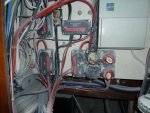
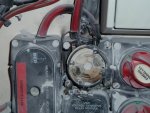
The auto extinguisher did not seem to have been activated, though I haven't even looked at it thus far - too much else to sort out. It is well aft of where the fire was, and is positioned to put out a fire around the engine itself, whereas the fire was effectively on the forward side of the front of the cockpit well where a lot of the electrical switching etc is fitted. There was a great deal of (unpleasant & acrid) smoke, presumably because it was plastics that were burning. A large part of one of the battery switches was seen to drip down to bilge as a molten blob. The actual fire was contained in a small area, though from my position at the wheel you wouldn't have thought so because of the amount of smoke pouring out.

Phil Munslow (electrician) is going out to look at it today, but has encouragingly said already in an email that "it's not likely to be as bad as it looks". I will post an update when I know more.
 
A nightmare experience for you. You have my sympathy and I hope things are as positive as electrician suggests. I think we could all learn from your conclusions.
 
Sorry to hear that, must have been a nasty shock.

I bet the clearing up will take a long time.

Just a point you may have thought of - but Powder ingested in the air intake of the engine can wreck it. Careful inspection required!
 
Elsewhere this could turn into an argument over which extinguisher works best, hopefully not here, so.
Having spent quite a few years in the electrical industry, and also as a volunteer fireman, my own personal choice would be CO2
Water mist is safe to use on low voltage fires, but runs the risk of water entering the engine intake and possibly also shorting out other electrics, it's also a bit messy, though easier to clean up than foam or powder. My concern over shorts applies more to any mains supply, obviously, but imagine the scenario of returning to port thinking all was well again, and plugging into shore power
Glad to hear you made it back safely, fires are scary, been there done that .....
 
The basic fire training we had at work stated AFFF could be used on high voltage fires, and is the standard extinguisher carried by our vehicles. I thought of putting one on the boat to go with the powder cabin extinguishers and halon replacement engine bay extinguisher.
Not saying this right but comment welcome?
Pete
 
I see that this thread is listed as:

Fire
Started by Barbican Bill, 18-08-13 21.39

To set the record straight, firstly the fire was started 18-08-13 at approx. 14.00, and secondly it wasn't started by me.

Phil Munslow has had a look. The damage is not extensive, and electrically it looks like replacing the battery switches and regulator, subject to testing, might be all that's necessary.

He has confirmed that it could just as easily have happened whilst we were sleeping at night. Very worrying.

Our electrical installation is fairly highly specified, and I had always understood it was more than man enough for the job. The trouble is that, much to Phil's surprise, the main fuse was also fairly highly specified. (He was not responsible for Santana's 2004 rewiring etc. under previous ownership.) Had it been less so, then it would have blown and prevented the fire. The replacement battery switches he's ordered will be capable of taking a higher load, whilst the replacement for the (still intact) main fuse certainly won't.

The repair can easily be done at the mooring, assuming everything tests OK, and we may well be back sailing in a week or two. The cosmetic repairs can wait until the winter, once we've cleared away the powder.

I find it hard to believe that such a small fire produced so much smoke.
 

Attachments

  • P1010266 (3).jpg
    P1010266 (3).jpg
    90.3 KB · Views: 0
Last edited:
Bill

What actually caused the fire? Did the alternator just put out more than the wiring could cope with and then the main fuse fail to blow? It's made me think as I don't actually have a single main fuse as such.
 
I'm guessing something shorting out caused excessive load hence the overheating and fire, is that burnt patch at the back of the battery switch or is it something else?

My boat has 200A fuses on the battery terminals of the domestic batteries, to be honest I think that's OTT and in the light of your issues I will look at reducing the fuse capacity. They are of this type http://www.bluesea.com/products/5191/MRBF_Terminal_Fuse_Block_-_30_to_300A

The Engine battery does not have any fuses but they would have to be so high to allow the starter to run not a lot of point.
 
Last edited:
Could have been much worse. This one was on the river today!!

Agreed!! Hence the point I made in my first post: "I had a great crew of three old friends aboard who calmly fought the fire successfully despite breathing difficulties". I am very grateful to them - all schoolfriends I met in 1969.

I attach a couple of pictures taken by Phil before he removed the switches. Strange thing, but when I look at the pics I can smell the fire very strongly!

P1010255.jpgP1010258.jpg
 
Last edited:
Top