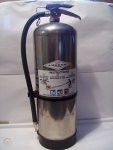
Fire Extinguishers

3 to 4 as follows;
1 auto burst bottle in the engine bay, one handheld dry powder in the main cabin, another small dry powder in the second cabin if required, AND a big stainless refillable water job, preferably an Amerex made in the USA. All of the extinguishers should have a pressure gauge.
Finally a fire blanket in the galley area.

Only the older version of the Amerex can be recharged by unscrewing the top nut to fill, and then using a good, (Preferably a twin barrel), car tyre foot pump. A good used one will cost at least half the price of a new one, which is 150 dollars, but you do get what you pay for.

You can use a water based extinguisher on diesel fuel fires that are not of the pool type by using a wide angle nozzle, rather than a long range jet. Amerex do sell spare parts, but I modified mine by fitting an adjustable brass nozzle. Don't forget the anti freeze if mounted outside, even in a box.

FireShield 1Kg Automatic Dry Powder Fire Extinguisher | 1 Kilogram Powder Automatic Fire Extinguisher FX1000PA (fireprotectionshop.co.uk)

UltraFire 2kg Powder Fire Extinguisher & Fire Blanket Special Offer | eBay
 

Attachments

  • 1982-amerex-water-fire-extinguisher_1_7e344584cb0ead85e4527ceae0f4ad01.jpg
    1982-amerex-water-fire-extinguisher_1_7e344584cb0ead85e4527ceae0f4ad01.jpg
    23.4 KB · Views: 1
Last edited:
3 to 4 as follows;
1 auto burst bottle in the engine bay, one handheld dry powder in the main cabin, another small dry powder in the second cabin if required, AND a big stainless refillable water job, preferably an Amerex made in the USA. All of the extinguishers should have a pressure gauge.
Finally a fire blanket in the galley area.

Only the older version of the Amerex can be recharged by unscrewing the top nut to fill, and then using a good, (Preferably a twin barrel), car tyre foot pump. A good used one will cost at least half the price of a new one, which is 150 dollars, but you do get what you pay for.

You can use a water based extinguisher on diesel fuel fires that are not of the pool type by using a wide angle nozzle, rather than a long range jet. Amerex do sell spare parts, but I modified mine by fitting an adjustable brass nozzle. Don't forget the anti freeze if mounted outside, even in a box.

FireShield 1Kg Automatic Dry Powder Fire Extinguisher | 1 Kilogram Powder Automatic Fire Extinguisher FX1000PA (fireprotectionshop.co.uk)

UltraFire 2kg Powder Fire Extinguisher & Fire Blanket Special Offer | eBay
It's funny how some of us have our 'favourite' extinguisher (says the man who's never used one in anger!) - mine is our shiny, stainless, refillable 2L AFFF!

But auto powder (as linked above) is an acknowledged risk to equipment in any machinery space. Worth considering what would happen if it activated and you subsequently needed the engine operational.
 
Any fire extinguisher used in a engine compartment is a danger to the engine.. Engines can bend a con rod if a foreign substance goes down the inlet.
Hopefully you've got an air filter on the air inlet to at least keep dust out, it will stop Foam and powder, and some water..

My choice having used extinguishers, Green Goddesses, Fire Landrovers and been trained fire crew as a secondary role for about 20 years of my life, is two dry powder extinguishers plus the fire blanket. Meeting the requirement of the 4 yearly BSS on the Norfolk Broads..
 
It's funny how some of us have our 'favourite' extinguisher (says the man who's never used one in anger!) - mine is our shiny, stainless, refillable 2L AFFF!

But auto powder (as linked above) is an acknowledged risk to equipment in any machinery space. Worth considering what would happen if it activated and you subsequently needed the engine operational.
Dry powder might make a mess, but it will not harm an engine. Foam will stop it starting again, but best of all is CO2, BUT CO2 is no good in the cabin and I've not seen a CO2 auto burst bottle. For some odd reason foam extinguishers are also difficult to find.
 
Yay, I found the PBO YouTube clip on fire extinguishers, back when PBO did useful stuff. Well worth a watch.


Very good clip, and glad I saw the link as I was not aware just how big an issue the loss of visibility is when you use a dry powder extinguisher in a confined area. One point missing is that all extinguishers should have a pressure gauge. The old foam one did not, which is why it was discovered to be useless.
 
I let off various extinguishers under controlled test conditions about 45+ years ago - in those days halon was impressively effective compared to everything else, but now banned. Powder worked reasonably but created a truly horrible mess, and if an engine is running may cause serious damage. It is however pretty much "all-purpose".

On own boat now have a Pyrogen auto engine extinguisher as just not enough space to put in a FE type (halon replacement) above the engine. Unusual and expensive but very compact and the RNLI uses some. Plus 5 other powder types in the cabins that I cross my fingers will never get used.

I once worked in a basement level area with an automatic Halon extinguisher system - and a very loud "get out quick" alarm prior to going off.

Complex UK web site, although this page might help figure out which one:
PYROinert-brochure.pdf (pyrogenfire.com)
 
Dry powder might make a mess, but it will not harm an engine. Foam will stop it starting again, but best of all is CO2, BUT CO2 is no good in the cabin and I've not seen a CO2 auto burst bottle. For some odd reason foam extinguishers are also difficult to find.
I don't think that's right - many people have stated that ingestion of dry powder can kill an engine, via a variety of routes. Just thinking about it, dry powder in the valve gear isn't going to do it any good, and dry powder reaching the cylinder could well end up seizing the piston. Marine engines frequently have relatively little air filtration; mine, for example, simply has an oily sponge that would probably block very quickly, but others simply have a baffle to silence the air intake. Dry powder in the engine space is very likely to reach valve gear and/or cylinders. After all, the air is being drawn from an area not exposed to dirt or spray, so there isn't much need for filtration.
 
...remember there's kilos of the stuff in the cylinder and not that much spare volume in the engine compartment!
 
I don't think that's right - many people have stated that ingestion of dry powder can kill an engine, via a variety of routes. Just thinking about it, dry powder in the valve gear isn't going to do it any good, and dry powder reaching the cylinder could well end up seizing the piston. Marine engines frequently have relatively little air filtration; mine, for example, simply has an oily sponge that would probably block very quickly, but others simply have a baffle to silence the air intake. Dry powder in the engine space is very likely to reach valve gear and/or cylinders. After all, the air is being drawn from an area not exposed to dirt or spray, so there isn't much need for filtration.
The powder forms fine Carbon when subject to heat in the cylinders. I'm used to looking at oil analysis results for diesels, and Carbon is only of interest if it starts to clump together and block the oil pump intake screen. At lower concentrations it acts as a lubricant. If they used ultra fine sand, rather than what is a type of Talcum powder, the result would be rather more interesting as you only need 30ppm of what is listed as Silicon, to result in long terms damage to the block's various bearings, rings and oil seals.
Most marine diesels do not have the same type of air filter as a modern car, they are normally foam or washable iron wool screens like the one in my old BMC 1500D. The reason for that is due to the intake air in a marine diesel being much cleaner in ultra fine sand particles than the air around a car engine, That's probably why the last UOA results for my beloved donkey were good.
One thing I would do in preventative maintenance terms if a dry powder extinguisher went off inside my engine bay, is to clean the air filter, AND wash the powder off the rest of the engine, as it can cause corrosion.
 
The powder forms fine Carbon when subject to heat in the cylinders. I'm used to looking at oil analysis results for diesels, and Carbon is only of interest if it starts to clump together and block the oil pump intake screen. At lower concentrations it acts as a lubricant. If they used ultra fine sand, rather than what is a type of Talcum powder, the result would be rather more interesting as you only need 30ppm of what is listed as Silicon, to result in long terms damage to the block's various bearings, rings and oil seals.
Most marine diesels do not have the same type of air filter as a modern car, they are normally foam or washable iron wool screens like the one in my old BMC 1500D. The reason for that is due to the intake air in a marine diesel being much cleaner in ultra fine sand particles than the air around a car engine, That's probably why the last UOA results for my beloved donkey were good.
One thing I would do in preventative maintenance terms if a dry powder extinguisher went off inside my engine bay, is to clean the air filter, AND wash the powder off the rest of the engine, as it can cause corrosion.
The powder in a type ABC dry powder extinguisher is monoammonium phosphate, which breaks down into Ammonia and Phosphoric acid at temperatures over 200 degrees C. There's no way it can produce carbon. Ammonia will attack aluminium; phosphoric acid is not nice stuff to have around, and I think it attacks iron.
The powder in a type BC extinguisher is likely to be Sodium or Potassium bicarbonate. Both break down into Sodium or potassium carbonate and CO2 when heated. Again, no carob is produced.
There are others, but they are less likely to be encountered. None will produce elemental carbon.
 
The powder in a type ABC dry powder extinguisher is monoammonium phosphate, which breaks down into Ammonia and Phosphoric acid at temperatures over 200 degrees C. There's no way it can produce carbon. Ammonia will attack aluminium; phosphoric acid is not nice stuff to have around, and I think it attacks iron.
The powder in a type BC extinguisher is likely to be Sodium or Potassium bicarbonate. Both break down into Sodium or potassium carbonate and CO2 when heated. Again, no carob is produced.
There are others, but they are less likely to be encountered. None will produce elemental carbon.
Potassium Bicarbonate contains Carbon, it might not list Carbon in the contents section, as it only forms in a fire or when heated up to a high temperature. The Carbon then forms CO2 which should stop the engine, IF it does not simply block up the intake. Phosphoric acid eats rust, it does not cause it, but Ammonia will degrade into what is in effect bleach, and that acts as a lubricant but does degrade the oil to a limited extent.

There is no aluminium in the main block of a diesel, just various types of steel or bronze. I think the Yanmar has an alloy air filter housing, and some outboards also use more alloy.

As I stated in my last post, wash the engine down, clean the air filter and around the main seals in particular to avoid a possible reaction between the chemicals in the dry powder and the oil seal itself. The front pulley bearing might be based around a torsional vibration damper and they include a type of rubber or similar synthetic compound that reacts badly with many chemicals, solvents in particular.
In reality you are far more likely to damage an engine by cleaning it incorrectly, rather than have it damaged by a dry powder or foam extinguisher. If you really do worry about using dry powder, buy an Amerex water rechargeable extinguisher for the cabin or deck area and use a CO2 bottle for engine of generator fires.
 
Last edited:
Top