Finding (not) coolant drain tap on Beta 30

Hi
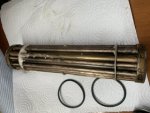
Have now managed to remove end plates and extract tube stack (through the front - exhaust in the way at rear). I definitely wouldn’t have managed this without all you guys help so huge thanks. And a phone conversation with Beta who are sending me new end cap gratis.
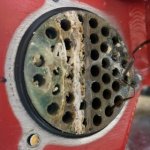
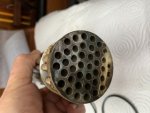
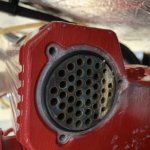
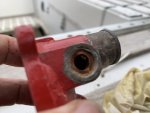
Surprised how much scale build up after 52 hours 41F6A425-1A4A-4252-B40E-7E0D93591BC5.jpeg17864953-F54F-4C4C-A03A-F7654CD50D3C.jpegEFEA6383-15A4-464F-AC87-54B80A69BC73.jpeg11768D52-740C-438D-8EC6-88962193912B.jpegE3C1E659-8DCB-4D87-A971-256D826221F7.jpeg
 

Attachments

  • B12A9F36-EECE-4BDD-955D-257DA5DA3EA5.jpeg
    B12A9F36-EECE-4BDD-955D-257DA5DA3EA5.jpeg
    31.6 KB · Views: 11
Hi
Have now managed to remove end plates and extract tube stack (through the front - exhaust in the way at rear). I definitely wouldn’t have managed this without all you guys help so huge thanks. And a phone conversation with Beta who are sending me new end cap gratis.
Surprised how much scale build up after 52 hours View attachment 94196View attachment 94197View attachment 94198View attachment 94199View attachment 94200
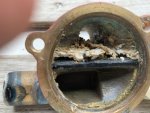
Is that crud in the seawater section of the exchanger or the fresh water section where the antifreeze was?
 
Mainly in the seawater section I think but there is some in the ends of the stack - but then my understanding of the circulation pattern is a bit hazy.
That's interesting. I'm an advocate of flushing with fresh water after each run, partly to reduce corrosion risk and extend the life of the anode but also to wash out the salt which would otherwise build up every time the sea water left behind dries out over time and doesn't necessarily dissolve in the next run. It finds little support on here but your photos show the effect of build-up.
 
As it’s truly impossible to get a container underneath will have to let it go into bilge and clean up can it damage anything eg engine mounts?
If it's the same as mine - and it looks it - there's a spigot on the underside for attaching a drain house.

gzoUH0w.jpg
 
I change it every 10 years, or less as the fancy takes me. In theory I could take it to a garage but when garages tell you that they have changed the coolant or the brake fluid, they haven't. :(

Richard
Quite so. Thus I fail to understand the need to change it in boats. If the water is pink not rusty it isn't corroding.
 
I'm an advocate of flushing with fresh water after each run, partly to reduce corrosion risk and extend the life of the anode but also to wash out the salt which would otherwise build up every time the sea water left behind dries out over time and doesn't necessarily dissolve in the next run.

So how exactly do you do this? Do you T-off somewhere between the seawater intake and the impeller pump; does this then plumb into your main water tank or just a bucket filled with tap-water?

You say "after each run" - do you mean every time you run the engine, even if only for a short time, or at the end of each day etc?
 
So how exactly do you do this? Do you T-off somewhere between the seawater intake and the impeller pump; does this then plumb into your main water tank or just a bucket filled with tap-water?

You say "after each run" - do you mean every time you run the engine, even if only for a short time, or at the end of each day etc?
I tee'd off the galley pump outputs to the cockpit shower (hot and cold separately) with hose, then to a length of 1/2" copper tube in which a cock is set, then into the seawater hose between the strainer and the engine water pump. Each time the engine is run, however briefly, before shutdown I open the cock, fresh water flow can be confirmed by holding the copper and feeling the temperature change because you can't hear the galley pump with the engine running . Close the seacock, let it run for about a minute to purge the heat exchanger and exhaust elbow of salt water (I originally tested to see how long was needed by tasting the outflow at the exhaust). Finally close the freshwater cock and immediately stop the engine with a pullcord connected to the engine stop lever. Timing is important. Stop the fresh water flow before stopping the engine or the 2 bar galley pump can cause damage - originally I split the plastic lid on the strainer and had to have a new one made.

EDIT When I say "however briefly" I mean "if it's not to be run again that day". I don't do it after each short run during the course of a trip, just at the end of the day. The aim is not to leave salt water in the system beyond a few hours.

It could be used to clear a blocked seacock though I didn't install it for that. If I were doing it again I'd tee into the seawater hose between the seacock and the strainer then add a 1" cock in front of the strainer. That way you could isolate the whole system and just blow pressurised fresh water down the seacock to clear a blockage without causing damage.

Everyone takes it for granted that outboards should be flushed after every run and I see no difference for an inboard engine just because we're not accustomed to doing it. No metal enjoys salt water.
 
Last edited:
Thx for the clear reply - and the rationale.

I'll look at my installation when I'm next aboard and see where I could adapt a similar, but simpler method. My domestic water is foot-pumped at the galley and the head's basins, so any 'pick-up' after the tee-junction is likely to just be an open hose into a bucket of fresh water manually obtained. I'd also only likely do it when putting the boat away at the end of a short or long cruise, and at the end of the season.
 
Thx for the clear reply - and the rationale.

I'll look at my installation when I'm next aboard and see where I could adapt a similar, but simpler method. My domestic water is foot-pumped at the galley and the head's basins, so any 'pick-up' after the tee-junction is likely to just be an open hose into a bucket of fresh water manually obtained. I'd also only likely do it when putting the boat away at the end of a short or long cruise, and at the end of the season.
I started out with that method but it was a bit of a chore heaving the bucket down to where I needed it without spilling.

One option you could consider is a direct feed from a water tank via a cock and let the engine water pump suck it in like it does for sea water. If the water levels are similar it should work.
 
Thx, will look at it the options.

My yacht is 27ft and of traditional layout with the whole front of the engine open when the companionway steps are lifted out, so easy direct access to the sea-water intake/filter/impeller-pump end of things. The water tanks are three flexible ones connected in series, the largest, lowest, aft-most one being right under the floor-boards just in front of the engine. It might still prove least hassle to employ a wondering-hose into a bucket or washing-up bowl - surely the water level isn't that important as the impeller-pump would be doing the pulling, but the diameter of hose is?

I'm also thinking of adding a calorifier at some stage, so the two 'plumbing' jobs - whilst separate systems - would be tackled at the same time.

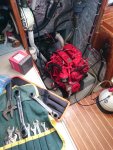
PS - the OP and others can see my 'custom-made' black coolant draining-hose (with red cock end-fitting) leading up from under the engine, past the Racor fuel filter, to its storage position cable-tied to the Blakes bilge-pump at top left of the photo.

Beta 25.jpeg
 
Top