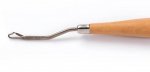
Fids for splicing dyneema

Neeves

Well-Known Member
Joined
20 Nov 2011
Messages
14,071
Location
Sydney, Australia.
Visit site
I have a need for some soft shackles and am sitting here with a really decent length of Liros 5mm dyneema, just braid, no cover. I have scoured the you tube threads, of which there are a lot, on making soft shackles - and it seems well within my capabilities :). I've put my task for this evening on hold pending the wisdom of the knowledgeable.

I've been playing round with the best way to feed the dyneema 'up inside itself' and there is a need for a fid. My own fids are too big for 5mm dyneema and I have fallen back on using the tube which contained a ball point pen, except this is nothing fancy just a Bic biro case. I find the end, or tip, of the biro to catch the fibres (much more easily than I would have thought) though when I touch the end of the biro its seems quite smooth.

What are the options - what do other people use or do.

I have thought of grinding the end of the biro and then polishing it with very fine wet and dry (which I'll try anyway).

Ideas would be welcome - its not meant to be that difficult.

Jonathan
 
I have a roll of piano wire in the workshop that I use to make a fid for most of the jobs I used to use Selma fids for, including making soft-shackles. Using piano wire, you can double it back on itself to make a 'puller' fid rather than a 'pusher' one, which is easier to get down the inside of a braid of any size than a traditional fid.

I have ended up making a lot of soft-shackles over the last couple of years. I've made them with diamond knots, button knots, and now with overhand knots. The overhand knot is my favourite as I don't have to check my notes for how to tie it, and the method is so easy that my 8 and 10 year olds made a couple for me when we were jury-rigging our lower-shrouds.

Here's a video tutorial of the overhand-knot soft-shackle:
 
Thanks for the quick 3 replies - they cover plenty of options

I don't have either piano nor wire - but I do have the inside of a Morse cable - and I'll try that tomorrow.

Jonathan
 
Thanks for the quick 3 replies - they cover plenty of options

I don't have either piano nor wire - but I do have the inside of a Morse cable - and I'll try that tomorrow.

Jonathan

Stainless or monel rigging wire. It can also help to taper the line, at least in part, before pulling it through (depends on the rope).

I have fids, but wire is better for this. Nothing fancy, just a length lightly pinched in the center with pliers, with a loop in the other end for tugging. Fids work for big rope, but wire is better for the small stuff.

Long Bury Splice
 
I just use the stub end of a pencil for this type of thing, and a bit of tape to secure it.

The fibres slide over the painted end.
 
Try wire, guys, much like the D-splicer but nearly free. You pull instead of push which is easy since the motion naturally bunches up the cover. Also, there is no tape to come loose and get lost inside.

I hardly use tube fids anymore, except for big stuff. A Swedish fid for 3-strand and length of wire for most of the rest. I did a double braid end-to-end splice last week with wire. Piece of cake.
 
I used the wire from the inside of a Morse cable which seems to be hard drawn stainless. Quite tough but crimped down with a pair of pliers and fitted 5mm 12 strand dyneema very well. I fed the 'fid' through and pulled the cord inside itself by retrieving the fid. I made the device quite long, its about 75cm (I have lots of wire - this Morse cable is around 9m long) which will allow me to make long shackles.

Thanks for the ideas - of which I incorporated many.

Next question - which is the best knot, not necessarily the easiest but the most effective? Diamond? And how do you finish off the knot - simply cut back and melt the ends into/onto the knot?

Is there a way of calculating how long a piece of dyneema you need to make a specific size of shackle (assuming you know how long is needed for the stopper knot) - or is it suck it and see.


I now understand why people are so keen on using them - they are satisfying devices to make but then you need to find uses. I have a specific use in mind - but now I'm looking at other novel applications.

A device looking to justify itself. :)

Jonathan
 
re Knot;

  • Diamond knot. Leave tails about 10mm protruding as the knot can tighten and draw them in. If trimmed close, and the knot does tighten, then it can fail. I usually pre-tension before trimming by tying a loop and using a winch to pull really hard. Then trim. I use a hot knife to melt the ends.
  • BRION TOSS BUTTON” KNOT - this is similar to the above however the tails come out in the same direction as the standing end and people spliced them into the "legs". I believe they test to higher breaking strain.
Videos;

This one from Snooks of YM parish shows the Diamond knot;
This is a good one of the Button knot on a high strength soft shackle;

I believe @roaringgirl has lots of great instructions on the Brion Toss knot. This is really good post showing different ones; Instructions for Tying the Brion Toss Button Knot & High Strength Soft Shackle - Cruisers & Sailing Forums

Re uses You can replace any steel shackle ... which could be many uses. eg. I use mine for attaching sails, lazy jacks and reefing lines. Helps prevent any metal to metal rubbing/ware. I avoid uses on sharp corners to not need to worry about chaffe.

In terms of length, this depends on width of rope. There are some guides online depending on which shackle you are making.
 
I now understand why people are so keen on using them - they are satisfying devices to make but then you need to find uses.
The soft shackle doesn't HAVE to be made from Dyneema, unless you need the strength.
I've made some up of various lengths from tubular cord (Paracord?) to use as rope / cable tidies and holding 'stuff'on poles, like you might use Velcro tidies.
Tip - A loop of something lighter (braided fishing line) sown onto the inner core an inch or so from the soft shackle eye and accessible at the eye allows the soft shackle eye to be pulled open easily and quickly.
 
I have tied shackles with diamond knots and button knots, but my favourite is the overhand knot with the looped tails - it is just as strong, but it's a little easier to tie and crucially it's easier to remember (I always have to check my notes for tying the other knots). The video I linked for you at the start of this thread shows how to tie the overhand knot shackle.

As for uses, on our boat:
Mainsheet attachment to boom tang
Mainsheet attachment to traveller
Genoa sheets attachment to clew
Jackstay attachment to pad eyes
Preventer block attachment to pad eyes
Mainsail luff attachment to car (we lost a shackle)
Anchor snubber attachment to chain
Bitter end anchor chain strop attachment to strongpoint
Fender attachment to chain for floating over coral
Attachment of blocks to leech of sail for reef-points
Attachment of turning blocks to genoa fairlead cars
 
Top