
Fibreglass repair in windvane water rudder

Actually if you want to get epoxy right into the crack I used the following trick when refurbishing the wooden mast on my last boat.
I drilled some holes ; in my case 10mm; into the split for 3/4 of the way through the mast, which was about 5 inches deep.. I then poured resin into the holes & using a wedge I opened the split as much as I could. It was surprising how much resin went into the split compared to earlier attempts to just fill the split from the surface.
Drill some holes with their centres on the crack line most of the way through. If you make a mistake like I did then stick duct tape on the opposite side it will be OK, infact it may be better on such a thin blade.

The holes have to be big enough to allow resin to flow into them freely (I suggest 6mm at 25-30mm centres) then using a small funnel, fill the holes, flex the rudder & keep filling the holes as the resin seeps along the crack from the inside at a deeper level than just the surface. You need to get to a point where closing the crack pushes resin out. If not much goes into the crack it will still have made little glue points in the crack
If you find 6mm a bit small then I would not go much bigger but drill them right through & once the holes fill up tape the other side. This removes any air from the bottom of the hole. Provided the hole is kept full the air will not be trapped & stop resin getting in. Agitate with a cherry stick
Let that go off then do the grooves for the splints

One final point- Keep a picture record of what you do & make a nice write up of your efforts . Send it to PBO & if they publish it you may find a nice cheque lands on the doormat . So far I have done about 10 such articles over the years. The last one was £ 50 ( Acrylic hood page 78 January isse) The best was £ 250-00. The idea of splints & the one about drilling holes is something others may use so it could make a 3/4 page write up & will more than pay for your efforts. You will be able to bin the blade & buy a new one !!!
 
Last edited:
.
My experience with GRP has been very limited. Let me try to summarise what folk are suggesting and ask a couple of questions:

~ Get some carbon fibre rod (say 4mm diameter)
~ Cut this into pieces say 15cm long
~ Use a router to cut slightly larger than 4mm grooves at right angles to the crack on each side, maybe 4 grooves
~ Mix epoxy resin to the normal proportions (ensuring ambient temp is >15C)
~ Pour epoxy into the grooves and lay carbon fibre rod in the 8 grooves (or do one side at a time?)
We haven't talked about what to actually mix into the epoxy. I'd want some thickener in there, if nothing else to make the sanding easier!
~ Leave to harden then sand/tidy up
BUT
Should the gap be there? You haven't lost material - so you effectively want to close the gap rather than fill it.
Will it close up say by putting a ratchet strap round it and 'clamping' it up?
I'd expect it would. I'd also be tempted to strip back say 1inch either side of the crack, say 2mm deep (you need to get below the gel). Then use some glass cloth / tape (2 inch wide)

So you'd
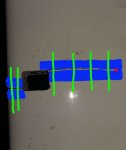
0. Drill the end of the crack to stop it spreading. (RED DOT)
1. After testing closing the gap - open out the gap - for the outer third of the depth each side.
2. Apply some masking tape to one side of the crack to contain any drips
3. Mix some epoxy with some short chopped strands to a paste about the same consistency as mayo
4. Put that into the crack and apply the ratchet strap to close the gap. The epoxy in the middle will behave like a direct glue, the epoxy further out will fill the gap. Leave to set.
5. Rout a set of 5mm wide grove, 7mm deep. (GREEN LINES) Then strip off the sides by 2mm ( leaving a 5mm deep groove ) (BLUE BANDS). Make the bands a logical size to fit the your cloth width (e.g. you can buy 50mm tape)
6. Glue in the carbon rods on one side.
7. Then epoxy & cloth on a layer or two of cloth to make up the layer. (By now you can probably remove the ratchet)
8. Use some epoxy and glass beads to build up the level over the rods where the cloth doesn't cover them to the same level as the new cloth
9. Apply gelcoat / flow coat over to build the surface up.
10. Sand and polish.
11. Turn over.
12. Fill the gap with some epoxy & chopped strands
13. Rout as step 5
13. Epoxy in the carbon rods etc as before...
navikcrack1 - Edited.jpg
 
This carbon rod approach would be lovely if we knew how thick the original laminate was before routing it - and if we had lots of time on our hands. I'd just abrade the surface about 150% of the chord above and below the cracks and then wrap it with layers of woven glass and epoxy (carbon if you like) until you've got to the same finished thickness as the original. Fill, fair and paint. Couple of hours.

ps. Cut the new laminate out over the access hole with a sharp knife as the epoxy is curing. If you time it right it's miles easier than sawing it later.
 
Last edited:
Wouldn't the carbon fibre arrow pieces be stressed in the wrong direction? I would guess they are designed to be strong longitudinally but not laterally - carbon fibre spinnaker poles break with lateral loads. I reckon a few wooden biscuits would be better.

Arrows have to be strong perpendicular to their length; they bend a lot when launched from a bow, so much so that there is quite an art to tuning the stiffness of the arrow to the draw-length and draw weight of a bow, such that the arrow actually bends round the grip of the bow when released. They'd buckle under the loads if they weren't pretty strong laterally as well as longitudinally.

I knew that having had archery as a hobby for a while would be useful sometime!
 
.
Well, I spoke to the bloke down the yard, and he recommended routing out a groove in the aft end and epoxying in a stainless steel rod, as this is the weakest bitr. He then recommended using a thinn stainless steel plate to cover the remaining crack, screwed on.

The stainless plate would change the profile/section of the blade at that point - does the team think this wojld be significant?

- W
 
Anything that spoils the aerodynamic shape of the foil will spoil the performance of the steering. Personally i believe that you need a repair that leaves you with a smooth surface as near to the original shape as possible.
If you put a steel plate on it will only be "bonded" where the screws enter the blade so that will not be as good as a continuous epoxied splice which will have a continuous bond
 
.
Well, I spoke to the bloke down the yard, and he recommended routing out a groove in the aft end and epoxying in a stainless steel rod, as this is the weakest bitr. He then recommended using a thinn stainless steel plate to cover the remaining crack, screwed on.
Thin plate. Probably answers the question. As said you would be getting load at the screws but not elsewhere. You could epoxy on the plate... but why.

Epoxy on stainless? I've only tried it once. It was stainless to stainless and it lasted 2 minutes. Perhaps it was the join I was doing (think weld with glue), or perhaps it was the fact it was polished stainless...

Stainless can still rust if you get crevices. If its perfectly smooth the epoxy wont work

A thick rod will be stronger than a thin carbon rod I expect. But the epoxy bond to the metal wont be I suspect, whereas the epoxy on a carbon rod etc will be overall very strong.

A plate may had any signs of movement.

screws into the GRP are unlikely to have huge strength.

I'm not thrilled by the proposal ;-)

Sounds like the solution my dad might offer up because he doesn't do resins and plastics. His fix would likely last. It would also look like it might belong on a 1950's MasseyFerguson!
 
.
Well, I spoke to the bloke down the yard, and he recommended routing out a groove in the aft end and epoxying in a stainless steel rod, as this is the weakest bitr. He then recommended using a thinn stainless steel plate to cover the remaining crack, screwed on.

The stainless plate would change the profile/section of the blade at that point - does the team think this wojld be significant?

- W

Rrriiight. So he thinks the weakest bit is the back where it hasn't broken? And that a stainless steel rod thin enough to bury into the trailing edge is actually going to help? And that a few screws through thin grp are not going to enlarge their holes in minutes? OK, carry on.
 
Top