Fenders

billyfish

Well-Known Member
Joined
6 Oct 2020
Messages
1,099
Visit site
Im moored up next to a large fishing boat and noticed his fenders when I asked what they were he said canal boat fenders. He prefers them as the boat is nearer the pontoon making loading and offloading easier and safer. They are rubber about 2" diameter about 18" long. Why don't yachts use them ? The stowage is minimum. If you had a sock they wouldn't mark. What difference would it make if your held off 2" or 6" .
 
Im moored up next to a large fishing boat and noticed his fenders when I asked what they were he said canal boat fenders. He prefers them as the boat is nearer the pontoon making loading and offloading easier and safer. They are rubber about 2" diameter about 18" long. Why don't yachts use them ? The stowage is minimum. If you had a sock they wouldn't mark. What difference would it make if your held off 2" or 6" .
They don’t spread the load like a big squashy inflatable. No good for us foam sandwich people.
 
I reckon they'd be fine for calm water, but canal boats don't get thrown against the harbour wall/pontoon when the wind gets up.

My normal fenders are around 8" diameter, which is fine for dealing with wake or normal weather, but they aren't up to the job when it gets seriously bumpy, so I have a few bigger ones for the times when there's no such thing as too many fenders,
 
I reckon they'd be fine for calm water, but canal boats don't get thrown against the harbour wall/pontoon when the wind gets up.

My normal fenders are around 8" diameter, which is fine for dealing with wake or normal weather, but they aren't up to the job when it gets seriously bumpy, so I have a few bigger ones for the times when there's no such thing as too many fenders,
Plus canal boats are steel not grp. Significantly more resilient to point loading.
 
Im moored up next to a large fishing boat and noticed his fenders when I asked what they were he said canal boat fenders. He prefers them as the boat is nearer the pontoon making loading and offloading easier and safer. They are rubber about 2" diameter about 18" long. Why don't yachts use them ? The stowage is minimum. If you had a sock they wouldn't mark. What difference would it make if your held off 2" or 6" .
I would not want him to come alongside me with those fenders! OK for a steel fishing boat alongside a quay.
 
Canal boats transiting locks don’t want soft, rolly fenders, but hard slippery one. I went thro’ Moselle locks on a cruise; fenders were 6”” thick slabs of , I think, PTFE. That allows steel hull to slide through the very narrow gap, and not burst an air filled fender.
 
Also in British narrow locks there can be only an inch or two more space than the beam of the boat so bigger fenders wouldn't fit and the boat could jam in the lock. If there was space, narrow boats might prefer bigger fenders for protection. If you look at their typical trad rope bow fenders they are big and thick.

Those thin hard fenders are no use for seagoing or even river boats.
 
Canal boats transiting locks don’t want soft, rolly fenders, but hard slippery one. I went thro’ Moselle locks on a cruise; fenders were 6”” thick slabs of , I think, PTFE. That allows steel hull to slide through the very narrow gap, and not burst an air filled fender.
I had plans to do the Britanny canals, but chickened out when I realised the narrowest lock was about 8 cm wider than Jazzcat. Cutting boards as fenders might just make it possible. Hmm, have to think about that.
 
I spent a week on a working canal barge in the French canals and some locks were too narrow to use car tyres as fenders, so we used wooden blocks instead. Quite impressive to see the skipper steer the barge (40 m long) into the lock without touching, and that was long before bow thrusters became common. 50 years of working the barge, so plenty of time to refine the art of steering.
 
I spent a week on a working canal barge in the French canals and some locks were too narrow to use car tyres as fenders, so we used wooden blocks instead. Quite impressive to see the skipper steer the barge (40 m long) into the lock without touching, and that was long before bow thrusters became common. 50 years of working the barge, so plenty of time to refine the art of steering.
Even with twin engines in Jazzcat, I reckon I'd be ricocheting down the lock but, in my defence, I've only a tenth of his experience with her.
 
I spent a week on a working canal barge in the French canals and some locks were too narrow to use car tyres as fenders, so we used wooden blocks instead. Quite impressive to see the skipper steer the barge (40 m long) into the lock without touching, and that was long before bow thrusters became common. 50 years of working the barge, so plenty of time to refine the art of steering.
I suppose one eventually grinds ones fenders to size.

I'm thinking, out in the wider world, I might try say 2L pop bottles, which I could also keep water in, I suppose they might just...er...pop, but they are pretty strong.
 
What difference would it make if your held off 2" or 6"
On top of everything else that people have said it also depends how “curvy” your boat is a straight sided dock with a straight sided boat is a different “packing problem” form a sweeping curve or any irregularity in the dock/harbour/pontoon wall.
 
On top of everything else that people have said it also depends how “curvy” your boat is a straight sided dock with a straight sided boat is a different “packing problem” form a sweeping curve or any irregularity in the dock/harbour/pontoon wall.
In the end though, even if you have a very straight boat, and none are straighter than ours, you still have to carry fat squashy fenders for those occasions when you’re rafted onto a curvy friend or neighbour. In a raft situation our aim is to raft onto a motor boat as we’re a better fit. Whilst we are talking about docks, having a curved one is less usual. More usual are hard rubber strips, usually with barnacles, necessitating fat fenders to hold you off. We carry a coupke of foam thin fenders for the mid boat part of a curvy boat raft, but rarely use them otherwise. I have heard of such fenders causing blisters in gel coat used long term. Permanently damp with rain water, I guess.
 
I had plans to do the Britanny canals, but chickened out when I realised the narrowest lock was about 8 cm wider than Jazzcat. Cutting boards as fenders might just make it possible. Hmm, have to think about that.

Many decades ago I sailed to Shotley, on the Orwell, in a friend's shiny new Fontaine-Pajot catamaran we hadn't long brought back from the manufacturer's in La Rochelle. (We'd visited Shotley before in his previous monohull.) As we motored up the approach channel it appeared impossible for the cat to fit in, despite previous advice by phone, so we turned round and radioed the lock keeper to check. He assured us we would, and indeed we did, but only without our fenders. Fortunately the lock has narrow floating plastic pontoons(?) to tie off on either side, so at least we weren't scraping his pride and joy up the wall!
 
Canal boats transiting locks don’t want soft, rolly fenders, but hard slippery one. I went thro’ Moselle locks on a cruise; fenders were 6”” thick slabs of , I think, PTFE. That allows steel hull to slide through the very narrow gap, and not burst an air filled fender.
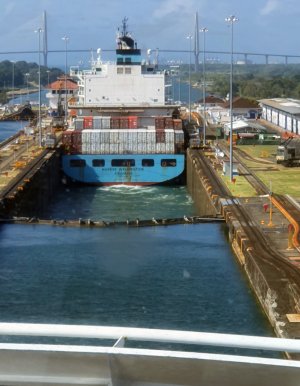
The container ship we followed through the old Panama Canal last month looked like it needed KY Jelly, not fenders!

panama.jpg
 
Im moored up next to a large fishing boat and noticed his fenders when I asked what they were he said canal boat fenders. He prefers them as the boat is nearer the pontoon making loading and offloading easier and safer. They are rubber about 2" diameter about 18" long. Why don't yachts use them ? The stowage is minimum. If you had a sock they wouldn't mark. What difference would it make if your held off 2" or 6" .
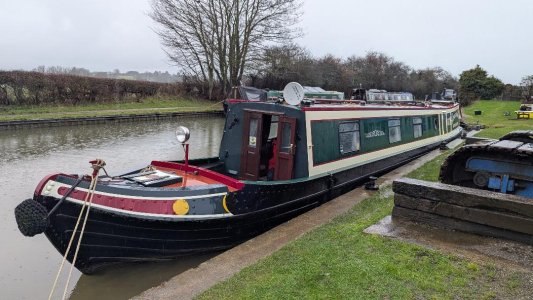
Got 'em on Duchess of Atoll, our 57 foot 20 ton steel narrowboat Bill. They are as solid as a brick, take no shocks at all.

Not a problem with a solidly built steel boat, all that is needed there is to stop the hull sides scraping the dock wall and keeping you awake.

A far different thing with relitively delicate GRP topsides.

One of the fenders you describe can be seen Port front in the above pic for those who are not aware of what they look like.
Duchess.jpg
 
In a raft situation our aim is to raft onto a motor boat as we’re a better fit.
To me it s the opposite, probably because you have very low freeboard on your amas. Over here many small/medium size leisure motorboats have a lot of flare on their sides, they often have fenders hanging from the rail which oscillate freely as they do not even touch the hull, which is a nightmare for other people stanchions at say 1-2m above water level. If their hulls are low on the water ok, otherwise their deck line is usually uncomfortably near our stanchions level, even a Polyform A4-A5 ball risks not being enough :( Or raft with a RIB, fender included :)
 
Top