Extracting Part From Flywheel Cover/Housing Without Removing Engine

Jokani

Well-Known Member
Joined
21 May 2014
Messages
840
Visit site
I fitted a new starter motor, and it failed in within 10 - 20 starts.

I removed the starter motor and found that a part had broken off and fallen to the bottom of the flywheel housing.

I believe this was due to the fact that the new starter motor had a slightly larger circumference than the original, only by a few millimeters, they both looked similar enough not to raise any alarms.

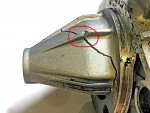
When fitted the engine turned over by hand without any noticeable problems, but whilst starting or running the gear ring must have caught on the starter motor housing causing it to break., the piece indicated by the red arrow:


broken-starter.jpg


I have since been refunded of the starter that broke and purchased a new OEM starter motor. Measuring with a micrometer the difference looks to be about 5mm, but I can't be more exact until I retrieve the broken piece.

Now I am not able fit the new starter (and get sailing) until I remove this broken piece, I suspect that there is no alternative but to remove the engine yet again to gain access. So far I have wasted 1.5 days tring to extract the piece with the engine in place, nothing has worked and I wish I had just invested the time in to removing the engine. But, the engine has been in and out a few times this year already ,and i am really loathe to do it again unless there really is no alternative.

I don't believe there is enough room at the rear of the engine bay to remove the housing whilst the engine is in place, and the housing is also the attachement point for the 2 rear engine mounts, So I cannot just disconnect the gearbox, unbolt the engine mounts from the bearers and slide forward as I also need to remove the engine mounts themselves.

The things I have tried so far, all by access through the hole where the starter motor would fit:

  1. Borrowing some small hands - the part is still just beyond finger tip reach
  2. Magnet - The part is an alloy and non-magnetic
  3. Flexible claw - Hard to see/feel, could not get a grip. Not enough space to use a clew and endoscope together so have to work blind
  4. Gaffa tape on the end of a bent piece of metal - Hard to precisely place the gaffa tape blind, not enough room to work with at the same time as an endocope
  5. Thick battery cable pushed round so that the broken piece can be pushed upwards towards the starter hole - There is a raised ridge at the bottom of the flywheel housing that prevents the cable passing this point.
  6. Gaffa tape moulded with ridges (like a flapper wheel) and stuck to the gear ring & flywheel - Anything of any thickness stops the engine rotating fully, I thing at the ridge mentioned above, and anything small enough to allow full rotation does not hit the broken piece and raise it as hoped.

Should I bite the bullet, give up, and just crack on with removing the engine?
 
I doubt whether the ring will be damaged as those teeth are much harder than the starter motor casing.

It seems that you've tried many good ideas but you have another option. Bind a piece of wire around the end of the endoscope and lead a short length forward so that a small loop can be formed in front of the camera but a small enough loop so you can see what the loop is touching.

You now have the possibility of sticking something sticky onto the loop and guiding that so that it touches the part and sticks to it. You could try double-sided tape or blu-tack as both these have worked for me. but it depends how heavy and how greasy the broken part is. However, the ultimate solution if these are not strong enough, is a piece of soft epoxy putty like Miliput or even a blob or something like Araldite or similar. You will need to rest this against the piece of alloy and then leave it to set for a few hours before extracting.

Richard
 
It's amazing what you can pick up with the right vacuum cleaner.
Try a nozzle of say 12mm bore hose taped to the regular nozzle.

But you get to a point where you want to have it apart and see what's really happened.
 
I don't want to be a harbinger of doom, but I'd a similar experience last year with a replacement starter motor, and it HAD damaged the ring gear I'm afraid. It was yesterday that I removed the engine and replaced the ring gear, a day of joy all around of course. The damaged ring had 4-5 teeth missing.
 
It's amazing what you can pick up with the right vacuum cleaner.
Try a nozzle of say 12mm bore hose taped to the regular nozzle.

Yes, I did that with the hoover nozzle, a hose and a load of duct tape a few months ago. It's a great idea in this case but unfortunately, it didn't work for me because the tiny bolt had fallen down through the car bulkhead to a place where it will never be seen again. :ambivalence:

Not a big deal as I just had to find another M5 bolt, cut it to length and paint it black.

Richard
 
Yes, I did that with the hoover nozzle, a hose and a load of duct tape a few months ago. It's a great idea in this case but unfortunately, it didn't work for me because the tiny bolt had fallen down through the car bulkhead to a place where it will never be seen again. :ambivalence:

Not a big deal as I just had to find another M5 bolt, cut it to length and paint it black.

Richard

And one more rattle won't notice......
:-)
 
I fitted a new starter motor, and it failed in within 10 - 20 starts.

I removed the starter motor and found that a part had broken off and fallen to the bottom of the flywheel housing.

I believe this was due to the fact that the new starter motor had a slightly larger circumference than the original, only by a few millimeters, they both looked similar enough not to raise any alarms.

When fitted the engine turned over by hand without any noticeable problems, but whilst starting or running the gear ring must have caught on the starter motor housing causing it to break., the piece indicated by the red arrow:

I have since been refunded of the starter that broke and purchased a new OEM starter motor. Measuring with a micrometer the difference looks to be about 5mm, but I can't be more exact until I retrieve the broken piece.

Now I am not able fit the new starter (and get sailing) until I remove this broken piece, I suspect that there is no alternative but to remove the engine yet again to gain access. So far I have wasted 1.5 days tring to extract the piece with the engine in place, nothing has worked and I wish I had just invested the time in to removing the engine. But, the engine has been in and out a few times this year already ,and i am really loathe to do it again unless there really is no alternative.

I don't believe there is enough room at the rear of the engine bay to remove the housing whilst the engine is in place, and the housing is also the attachement point for the 2 rear engine mounts, So I cannot just disconnect the gearbox, unbolt the engine mounts from the bearers and slide forward as I also need to remove the engine mounts themselves.

The things I have tried so far, all by access through the hole where the starter motor would fit:

  1. Borrowing some small hands - the part is still just beyond finger tip reach
  2. Magnet - The part is an alloy and non-magnetic
  3. Flexible claw - Hard to see/feel, could not get a grip. Not enough space to use a clew and endoscope together so have to work blind
  4. Gaffa tape on the end of a bent piece of metal - Hard to precisely place the gaffa tape blind, not enough room to work with at the same time as an endocope
  5. Thick battery cable pushed round so that the broken piece can be pushed upwards towards the starter hole - There is a raised ridge at the bottom of the flywheel housing that prevents the cable passing this point.
  6. Gaffa tape moulded with ridges (like a flapper wheel) and stuck to the gear ring & flywheel - Anything of any thickness stops the engine rotating fully, I thing at the ridge mentioned above, and anything small enough to allow full rotation does not hit the broken piece and raise it as hoped.

Should I bite the bullet, give up, and just crack on with removing the engine?

I have found one of these very good for retrieving small parts. I know the magnetic function is of no use to you but the claw on the end it excellent. https://www.halfords.com/workshop-tools/tools/hand-tools/rolson-led-claw-magnetic-pick-up-tool

Www.solocoastalsailing.co.uk
 
However, the ultimate solution if these are not strong enough, is a piece of soft epoxy putty like Miliput or even a blob or something like Araldite or similar. You will need to rest this against the piece of alloy and then leave it to set for a few hours before extracting.

This was my suggestion too Richard, i think quick drying Araldite (Toolstation pirate copy) would be the best adhesive, dries in a few minutes.
 
I fitted a new starter motor, and it failed in within 10 - 20 starts.

I removed the starter motor and found that a part had broken off and fallen to the bottom of the flywheel housing.

I believe this was due to the fact that the new starter motor had a slightly larger circumference than the original, only by a few millimeters, they both looked similar enough not to raise any alarms.

When fitted the engine turned over by hand without any noticeable problems, but whilst starting or running the gear ring must have caught on the starter motor housing causing it to break., the piece indicated by the red arrow:


broken-starter.jpg


I have since been refunded of the starter that broke and purchased a new OEM starter motor. Measuring with a micrometer the difference looks to be about 5mm, but I can't be more exact until I retrieve the broken piece.

Now I am not able fit the new starter (and get sailing) until I remove this broken piece, I suspect that there is no alternative but to remove the engine yet again to gain access. So far I have wasted 1.5 days tring to extract the piece with the engine in place, nothing has worked and I wish I had just invested the time in to removing the engine. But, the engine has been in and out a few times this year already ,and i am really loathe to do it again unless there really is no alternative.

I don't believe there is enough room at the rear of the engine bay to remove the housing whilst the engine is in place, and the housing is also the attachement point for the 2 rear engine mounts, So I cannot just disconnect the gearbox, unbolt the engine mounts from the bearers and slide forward as I also need to remove the engine mounts themselves.

The things I have tried so far, all by access through the hole where the starter motor would fit:

  1. Borrowing some small hands - the part is still just beyond finger tip reach
  2. Magnet - The part is an alloy and non-magnetic
  3. Flexible claw - Hard to see/feel, could not get a grip. Not enough space to use a clew and endoscope together so have to work blind
  4. Gaffa tape on the end of a bent piece of metal - Hard to precisely place the gaffa tape blind, not enough room to work with at the same time as an endocope
  5. Thick battery cable pushed round so that the broken piece can be pushed upwards towards the starter hole - There is a raised ridge at the bottom of the flywheel housing that prevents the cable passing this point.
  6. Gaffa tape moulded with ridges (like a flapper wheel) and stuck to the gear ring & flywheel - Anything of any thickness stops the engine rotating fully, I thing at the ridge mentioned above, and anything small enough to allow full rotation does not hit the broken piece and raise it as hoped.

Should I bite the bullet, give up, and just crack on with removing the engine?

I supported my much heavier MD22 with a block of wood and a wedge under the alloy sump when I changed the bearers so that could work for you. Other wise prop shaft off, 6 bolts in gearbox, that off, then maybe more access to the bits?
 
can you see the part?

bariatric laparoscopic artery forceps will reach 50cm

£50 quid but worth it

got a pair in Dumbarton if you are anywhere near??
 
After six and a half hours of frustration on Saturday, I finally got the part removed:


starter-5.jpg


Some scoring can be seen on the inside, and there looks like some impact damage on the exterior, allthough I can see how that can have been caused by the ring gear:


starter-4.jpg


There is some scoring on both parts that line up so i guess caused by the same thing, but the impact damage on the exterior is not on the same line:


starter-6.jpg


This is the second starter motor from the same source that has failed in exactly the same way, but now I am not so sure that interference with ring gear is the cause of the failure.

I have closely inspected the ring gear, all teeth present and in good condition.

I have inspected the inside of the flywheel housing carefully with and endoscope and (now the broken part has been removed) I can't see any evidence off any other foreign bodies that shouldn't be there, so pretty sure there isn't a nut or bolt flying around in there that shouldn't be.

There must be a logical explanation?

Thanks for all the advice on how to retrieve the part, I tried everything except the garden blower. At one point I think a had some silicone hose and the broken part all epoxied to the bottom of the flywheel casing :-) The method that suceeded was taping a claw device to and endoscope, geting a grip on it and very slowly easing it up and over the wheel, it needed quite a few attempts as the claw kept losing it's grip. In total abot 3 days wasted, but finally got there, almost tears of joy on Saturday.

I just hope that is the end of it, that the problem was the starter motor design, and that the new starter motor doesn't suffer the same issues.
 

Attachments

  • starter-4.jpg
    starter-4.jpg
    212.3 KB · Views: 0
Just make sure the motor is not running while you are extracting the part. (I know not to do that because I once bought a fan belt and on the packet was a printed warning
"DO NOT FIT BELT TO RUNNING MOTOR")
 
The exact same thing used to happen to Renaults years ago when the locating dowel came loose and wasn't put back when replacing the starter. So make sure that if there is a locating dowel fitted that it's still there. Lining up using only the bolts isn't accurate enough. Just check this out first, not sure if it should have one or not, but worth checking out.
 
Just make sure the motor is not running while you are extracting the part. (I know not to do that because I once bought a fan belt and on the packet was a printed warning
"DO NOT FIT BELT TO RUNNING MOTOR")

Here they steal hub caps while the car is still driving down the road.
 
Top