Exhaust system distance from water level

Gixer

Well-Known Member
Joined
29 Nov 2015
Messages
1,122
Visit site
I'm planning and engine replacement and am going though my current set up and seeing what I need to buy. I never spotted/realised this before but not only am I missing an anti-syphon device but I also have nothing like a gooseneck. The exhaust goes straight from the engine, though the water trap and out the transom.

It's been like this since the boat was built 30 odd years ago. Not wanting to waste money when fitting the new engine should I add an anti-syphon and gooseneck??

Could it be because the engine is high enough above the water line and the exhaust outlet is also high up?
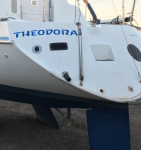
The exhaust is the one with the black pipe on it and you just can just make out the waterline on the antifoul paint. Excuse the state of her but shes been in a dusty yard for months and I've struggled to get down.
View album “Recents”.png
 
For the anti syphon, the information I worked on was:

- The point where the water injection meets the exhaust bend.................Should always be a minimum of 300mm above the waterline, ie even when fully heeled.

I think most small boats would need an anti-syphon if only for extreme conditions.


If your flexible pipe falls down steeply towards the outlet then you may get away without the gooseneck. I don't have one and it has been ok, so far. However in my case it would be difficult to fit, looking at your arrangement it might be easy, in which case, for seventy quid, I would have one.
The alternative might be one of these:

Vetus TRC40PV 40mm Transom Exhaust Connection

But ok the back pressure with the engine supplier.
 
When I fitted a new engine years ago, I fitted a Vetus gooseneck, blocked off the original exit which was below the waterline, and a new exit above the waterline as I do like to see water coming out from the transom. Also fitted an antisyphon, but with a leak off so there is a constant dribble of water - also out the transom.
 
So if I understand it correctly both the vetus and Beta say that if the engine exhaust mixing elbow is above the water line by over 15cm you don’t need an anti-siphon. Need to do some measuring when I get back down the boat. Thanks everyone.
 
So if I understand it correctly both the vetus and Beta say that if the engine exhaust mixing elbow is above the water line by over 15cm you don’t need an anti-siphon. Need to do some measuring when I get back down the boat. Thanks everyone.

But still good to have a gooseneck in the exhaust to stop waves/swell washing into the system (the gooseneck can be just a raised section of exhaust hose - doesn't have to be a special fitting), and ensure that the capacity of the water-lock is sufficient to accommodate the contents of the overall length of hose between the engine and top of the gooseneck (see Vetus catalogue for the relevant calculations).
 
So if I understand it correctly both the vetus and Beta say that if the engine exhaust mixing elbow is above the water line by over 15cm you don’t need an anti-siphon. Need to do some measuring when I get back down the boat. Thanks everyone.


Not quite, the information from post 3 was from Beta which specifies 300mm as a minimum:

OM 221 20031 HE REV17 0420

Though I see the reference to heeled water line has been removed in this up to date manual. At least that makes it easier to judge.

.
 
Just found this in a Beta manual that says 25cm, argh. Sod it I’m going to stick one in.
Sorry for the angle can’t work out how to change it on my phone.
E1AF7E23-EB22-4A76-B823-7C6709FD156A.jpeg
 
I'm planning and engine replacement and am going though my current set up and seeing what I need to buy. I never spotted/realised this before but not only am I missing an anti-syphon device but I also have nothing like a gooseneck. The exhaust goes straight from the engine, though the water trap and out the transom.

It's been like this since the boat was built 30 odd years ago. Not wanting to waste money when fitting the new engine should I add an anti-syphon and gooseneck??

Could it be because the engine is high enough above the water line and the exhaust outlet is also high up?
The exhaust is the one with the black pipe on it and you just can just make out the waterline on the antifoul paint. Excuse the state of her but shes been in a dusty yard for months and I've struggled to get down.

View attachment 92041
What's that tackle on the transom?
 
Actually if you read a current Beta manual online you will see that they have increased the minimum height - water injection point to WL - to 300 mm.
And if you draw the actual heeled waterline on a photo of your transom you will see why ,as said above,that many small yachts with engine mounted low down should go further and have a higher antisyphon loop with vent near the centreline.
 
Last edited:
bluerm166 - you are right, it does look like they've increased the minimum distance. I think I'll put this down to my boat will 'probably' be ok without, but it is worth adding an anti-syphon for piece of mind. This infact is why i'm replacing the 30 year old engine.

Spirit - I think its called a running backstay, I'm able to adjust the the mast rake by pulling on the tackle.
 
bluerm166 - you are right, it does look like they've increased the minimum distance. I think I'll put this down to my boat will 'probably' be ok without, but it is worth adding an anti-syphon for piece of mind. This infact is why i'm replacing the 30 year old engine.

Spirit - I think its called a running backstay, I'm able to adjust the the mast rake by pulling on the tackle.
It's a backstay tensioner. A running backstay is something else entirely.
 
Top