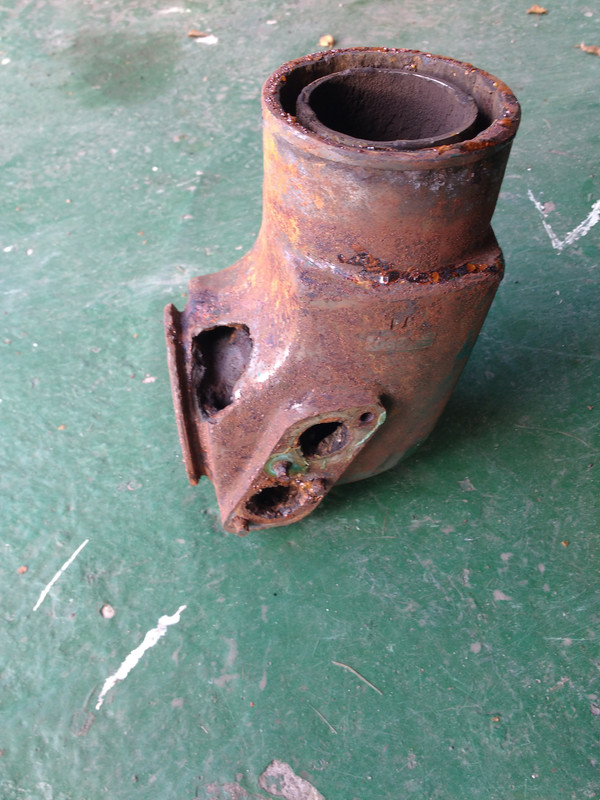
Exhaust elbows

Seastoke

Well-Known Member
Joined
20 Sep 2011
Messages
13,372
Visit site
OK although we have o issues with ours ,they are 13 years old now ,so what can you do to check or test for piece of mind .

 
Are these on VP d series engines?

Without having to take them off , you can Check for water leaks where the raw water feed pipes connect to the elbow.

If you take them off then you can have a look for how clogged up they look and how thick the internal wall that separates exhaust gas from raw water .

Based on my elbow on a 15 year old d series engine, that yours at 13 years old are going to need replacing soon.
 
Doubt that the engine hours run makes any major difference to the life of the risers.
If the standard cast iron units, either genuine VP or after market, they will start to rust and corrode immediately on contact with salt water.
Risers on the smaller VP engines ie. 40 and 41 seem to collapse faster than the bigger risers on 60 and 70 series of engine.
It might be the case that risers on engines with higher hours will fail earlier, due to the number of times the riser has expanded and contracted.
First signs of failure are usually rust stains around clamps or on bilge floor.
40A.

41B about 700 hours on engine. Casting marks suggest this a genuine VP unit which the previous owner had fitted a few years previously.

Both of these looked structurally sound until removed, they then fell to bits.
Probably the least considered bit of the engine but one of the most vital. Shame but they are real pig to change and its no suprise that nobody wants to do the job.
Added complication is that with outdrives the rubber exhaust hose reacts with the alloy of the exhaust horn and the top of the horn crumbles.
There is a little kit you can buy to fix this.The condition of the riser on the 41B only came to light when a bolt securing the clamp turbo to the riser failed and the riser blew off. :).

Do know Skippers have cleaned out risers on 60 series engines with some success.
 
Last edited:
At 2 hours per year….he’s got plenty of time before they need changing

You only need them if you run your engine. He's fine. A good day out for Roy is humming and bubbling his lips , poking his chartplotter, all while making exaggerated imaginery steering wheel movements on the flybridge and waving to the punters sitting al fresco at the Mulberry Pub
 
Did mine this afternoon, (KAD43’s) my conscience was pricked by this forum
I thought it didn’t look too bad after 20 years and only 500 hrs.
It might have cleaned up ok but I treated it to a Keypart (read Chinese) new one.
5-A3-C5-D1-F-F5-CE-49-DC-8964-1-A2069-EBFF34.jpg
 
Last edited:
This is one water injection bend on my Volvo Penta 63p engines, it was actually the steel bend before the injection bend that failed in year 13 in 2013.

I replaced both steel bends, the Volvo Penta Injection bends and the rubber silicone hose that goes from the injection bend to the stainless exhaust hull fitting about 16 inches long that runs out of the boat under water.

The injection bend was on the outside was fine with no leaks, on the inside I reckon i was constricting the water flow to 50% and therefore the back pressure and the seawater cooling flow.

The injection bends are not massive money and in my thoughts its like worn out tyres on a car they are not going to get any beeter and if they fail it will be only when you are using the boat and you will lose a month or so of the season.

Now in 2022 I am having the stainless exhaust hull fitting about 16 inches long re-manufactured and replaced on both sides at 21 years old as they have corrosion pin holes starting.

I work in a boatyard and I have seen many where they fail or the outer cast casing fails and its makes a hell of a mess of the engine room.

So 12 to 14 years take them off and inspect. If you see any water leaks, engine fumes leaks or soot investigate and inspect and repair.

Equally I have seen Halyard Stainless steel injection bends on Volvo Penta D12's being replaced at 6 years we replaced two sets six years apart on the same boat. Stainless steel is not the answer to all your prayers and in many cases it just has a new set of problems to solve.

Preventative maintenance is the answer.

IMG_4884 (Large).JPG

IMG_4889 (Large).JPGIMG_4895 (Large) (1).JPG
 
This is one water injection bend on my Volvo Penta 63p engines, it was actually the steel bend before the injection bend that failed in year 13 in 2013.

I replaced both steel bends, the Volvo Penta Injection bends and the rubber silicone hose that goes from the injection bend to the stainless exhaust hull fitting about 16 inches long that runs out of the boat under water.

The injection bend was on the outside was fine with no leaks, on the inside I reckon i was constricting the water flow to 50% and therefore the back pressure and the seawater cooling flow.

The injection bends are not massive money and in my thoughts its like worn out tyres on a car they are not going to get any beeter and if they fail it will be only when you are using the boat and you will lose a month or so of the season.

Now in 2022 I am having the stainless exhaust hull fitting about 16 inches long re-manufactured and replaced on both sides at 21 years old as they have corrosion pin holes starting.

I work in a boatyard and I have seen many where they fail or the outer cast casing fails and its makes a hell of a mess of the engine room.

So 12 to 14 years take them off and inspect. If you see any water leaks, engine fumes leaks or soot investigate and inspect and repair.

Equally I have seen Halyard Stainless steel injection bends on Volvo Penta D12's being replaced at 6 years we replaced two sets six years apart on the same boat. Stainless steel is not the answer to all your prayers and in many cases it just has a new set of problems to solve.

Preventative maintenance is the answer.

View attachment 131432

View attachment 131433View attachment 131434
Excellent advice. Yes, stainless steel elbows do not last as well as the cast iron ones do. I had been keeping an eye on mine (TAMD41p) and although I gave it an internal clean a few years ago decided that after 22 years I would fit a new one for peace of mind. The old one was still working and was not affecting performance so have kept it as a spare. On another boat (Vetus engine) the elbow is bronze and I inspected it again last year and it is amazingly clean after 18 years having never needed to clean it
 
TAMD 41B.
Replaced the exhaust hose a while ago, assured by "pontoon experts" that it needed to be done. Some cosmetic cracking on external rubber coating .
A filthy PITA to remove. and internally it proved to be as good as the day it was installed.
Did reveal some corrosion on the stainless steel elbow where it came in contact with the rubber hose connecting exhaust to glassfibre hull moulding, couple of pin holes.
Repaired with chemical metal and used a smear of CT1 to ensure gas tight seal on all joints.
 
I’ve just replaced mine on a 63P and got them from SAL Marine as slightly cheaper than others on web. There seems no aftermarket parts made in my research. They were 23 years old so not unexpected.
 
The manual for my D6 (outdrive) says to remove the rubber hose in the exhaust line and check for corrosion every year. How on earth are you meant to get the hose off?
 
On my AD41-P engines I had to release it from the turbo and pry and pull to break the rubber seal. Cleaned the elbows inside, replaced the rubbers and the long hose connected to the elbow. Repainted and fitted back on. Then did a chemical flush through the raw water side.
 
I eventually got the hose loose but it won't go up because of the raw water pipe into the exhaust. It goes down far enough to just about clear the pipe it is over but not enough to clear the inner pipe.
 
Top