EV technology for your next boat ???

My tank holds about 8 gallons and gets filled only a couple of times a season - and I can cross the channel on less than 1L of diesel :)

I think a "diesel electric" installation would work very well - I only need 5 to 10 minutes power in and out of the berth and starting / warming up the diesel for that is very inefficient.
As you described it, you don’t need diesel electric..just electric
 
I don’t have 500l of petrol. So what’s that got to do with it?

Lots of boats do have 500l of petrol though.

My point is that you are no more likely to suffer a fire on an electric boat than a diesel boat. In fact, an electric boat is probably statistically much less likely to catch fire.
 
I'm not actually in the market for a HGV but it appears that Pepsi (second link in my first post) and many others have done so:

Here are all the companies buying Tesla's electric semi truck
At the moment it’s only suitable for large corporations who want to project their green credentials and deliver from one in-house facility to another…where they will have charging facilities.
When there are truck chargers on all main arterial routes…plus a little government interference…they will be suitable as an almost complete alternative to diesel…the road trains crossing the Australian outback are one exception
 
At the moment it’s only suitable for large corporations who want to project their green credentials and deliver from one in-house facility to another…where they will have charging facilities.
When there are truck chargers on all main arterial routes…plus a little government interference…they will be suitable as an almost complete alternative to diesel…the road trains crossing the Australian outback are one exception

This is the Tesla difference! People said this when they launched their first cars, but they rolled out an extensive super-charger network that has allowed me (and many others) to drive extensively in our Teslas without ever having to worry about where to charge.

Tesla are now doing the same with their 'V4' chargers, which are being rolled out across the US and later Europe. It's true that the larger retailers and 3PLs are the first to adopt, as they have the capital to do so and can take the (to them) limited risk. Nevertheless, I expect that this will disrupt the industry, just as they have done for cars.
 
This is the Tesla difference! People said this when they launched their first cars, but they rolled out an extensive super-charger network that has allowed me (and many others) to drive extensively in our Teslas without ever having to worry about where to charge.

Tesla are now doing the same with their 'V4' chargers, which are being rolled out across the US and later Europe. It's true that the larger retailers and 3PLs are the first to adopt, as they have the capital to do so and can take the (to them) limited risk. Nevertheless, I expect that this will disrupt the industry, just as they have done for cars.
And typically Tesla, they took their time to get it right..even though delays could have hurt..all the while truck manufacturers have been electrifying existing ice chassis with off the shelf parts creating electric trucks with limited range and functionality
 
I'm not actually in the market for a HGV but it appears that Pepsi (second link in my first post) and many others have done so:

Here are all the companies buying Tesla's electric semi truck
Volvo trucks have sold a lot more. There is a belief that the big 44 ton trucks drive 1000 miles a day every day. The vast majority do not. They load up and do a round, filling supermarkets, dropping off specific loads, carrying big but largely empty cargo like coke cans etc etc. Most "big" trucks are not pulling 44 tons - most times a lot less, just physically big. So there is a lot of room for "big" trucks using batteries that do the same or similar routes year in year out.

At the moment there are few or possibly any in the UK suitably big chargers. However that does not mean they do not exist or that it is not possible. The Pepsi Tesla trucks are working out of a series of depots, doing a set route and end up back at the depot. Where they now have big chargers to "fill" them up again
 
Lots of boats do have 500l of petrol though.

My point is that you are no more likely to suffer a fire on an electric boat than a diesel boat. In fact, an electric boat is probably statistically much less likely to catch fire.
Fires in electric boats are statistically insignificant so you can only be talking rubbish.
 
This is the Tesla difference! People said this when they launched their first cars, but they rolled out an extensive super-charger network that has allowed me (and many others) to drive extensively in our Teslas without ever having to worry about where to charge.

Tesla are now doing the same with their 'V4' chargers, which are being rolled out across the US and later Europe. It's true that the larger retailers and 3PLs are the first to adopt, as they have the capital to do so and can take the (to them) limited risk. Nevertheless, I expect that this will disrupt the industry, just as they have done for cars.
Which bit of “the grid does not have the capacity” did you fail to understand?
 
Less than twenty years ago Elon invested in Tesla and changed the world…if you don’t believe me then stick your head out of the window and you will see a Tesla…it’s a revolution that is gaining traction at an ever increasing rate…electricity is future, there are electric planes and boats and there can only ever be more
 
Already using some ev technology on my current yacht. It’s amazing what a little 1003 torqeedo auxiliary can do in low/no wind conditions. With a 12-24v vitron converter and a decent solar array to provide some addition charge whilst in use it provides an effective quiet means of propulsion to my 28 foot cruising yacht/crossover.
I also use solar recharged lithium power packs for induction cooking, refrigeration, hotwater production, torqeedo battery recharging and a variety of other 240v occasional uses. Whilst also fairly new technology these are also rapidly improving.
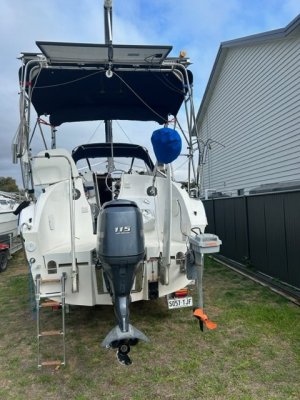
Using the torqeedo beats running the huge ice outboard for tranquility and fuel consumption ( significantly extending our cruising range) and also nicely assists sailing upwind in light conditions which makes up for my unusual trailerable cruising yacht’s planing under motor compromised upwind hull form.
With a remote throttle on my wheel steering binnacle and steering via the rudders it is a very nice addition that doubles up as my dingy outboard as well.
Due to it’s light weight without battery it also carry’s nicely on a push-pit mounted plate for trailering and heavy weather conditions.
Costs and constraints for larger versions are still prohibitive so I don’t think the big ice outboard will be replaced any time soon.
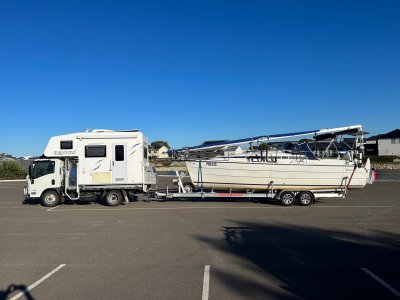
Nor do I think my tow tug will be quickly replaced by an electric equivalent when many of my towing distances involve thousands of kilometres.
IMG_0907.jpegIMG_0723.jpeg
 
As you described it, you don’t need diesel electric..just electric
Until the wind drops when I am half way across the channel....

Or I need to make way to windward in a F9.

It is important that I have the ability to motor for say 12 hours but I very rarely need to,
 
Top