Epoxy Putty for filling Screw Holes in Fibreglass?

Foxglove

New Member
Joined
8 Jun 2022
Messages
12
Visit site
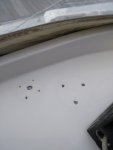
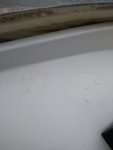
Hi All - I have a couple of small-ish (5mm?) screw holes I need to fill in my fibreglass fore-hatch. I've not dealt with epoxy/resin/thickeners etc before and the videos I've watched all make it look rather complicated.

Just wondering if any of you have used Epoxy Putty? I found something called 'PC Products 25567 Marine Epoxy Putty' which seems like it would be perfect - and it cures to an off-white finish, which would mean I probably wouldn't need to paint/gelcoat.

Anyone tried it? Or have any similar recommendations?
 
Hi All - I have a couple of small-ish (5mm?) screw holes I need to fill in my fibreglass fore-hatch. I've not dealt with epoxy/resin/thickeners etc before and the videos I've watched all make it look rather complicated.

Just wondering if any of you have used Epoxy Putty? I found something called 'PC Products 25567 Marine Epoxy Putty' which seems like it would be perfect - and it cures to an off-white finish, which would mean I probably wouldn't need to paint/gelcoat.

Anyone tried it? Or have any similar recommendations?
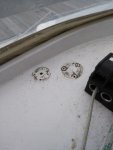
If it's only 5mm this is what I do:

- With a Dremel bevel the edges of the hole and clean with acetone
- If you can't get to the back of the hole stuff a bit of tissue paper into it to stop everything falling through. If you can use some tape.
- Get some flowcoat and mix in some short chopped glass strands (or whatever your favourite thickener/filler is) and fill the hole
- When cured grind the contents of the now filled hole back to just below the level of the surface
- Blob in some flowcoat so it's just above the surface
- When cured sand back level finishing with 800 grit
- Polish with Farecla compound until it's so shiny you can see a reflection of your fizzog in it
- Stand back and despair about how this new super shiny bit makes everywhere else look dull and old
- Spend the rest of the summer polishing everywhere else until it all glints so the repair doesn't show

Steps 1 to 8 will take a couple of hours. The last step will take flippin' ages.

IMG_20200307_125133897.jpgIMG_20200307_125526112.jpgIMG_20200307_130728052.jpgIMG_20200307_131419912.jpgIMG_20200307_131430588.jpgIMG_20200307_151015020.jpg
 
Last edited:
I use Milliput for many such applications. I owned an old motorsailer with traditional timber capping pieces that had been attached using galvanised bolts and nuts, most of which had corroded, damaging and enlarging the holes in the wood. After replacing the bolts with stainless steel I filled all the holes with Milliput, stained to match the wood. Very effective for a low value vessel.
 
If it's only 5mm this is what I do:

- With a Dremel bevel the edges of the hole and clean with acetone
- If you can't get to the back of the hole stuff a bit of tissue paper into it to stop everything falling through. If you can use some tape.
- Get some flowcoat and mix in some short chopped glass strands (or whatever your favourite thickener/filler is) and fill the hole
- When cured grind the contents of the now filled hole back to just below the level of the surface
- Blob in some flowcoat so it's just above the surface
- When cured sand back level finishing with 800 grit
- Polish with Farecla compound until it's so shiny you can see a reflection of your fizzog in it
- Stand back and despair about how this new super shiny bit makes everywhere else look dull and old
- Spend the rest of the summer polishing everywhere else until it all glints so the repair doesn't show

Steps 1 to 8 will take a couple of hours. The last step will take flippin' ages.

View attachment 139102View attachment 139103View attachment 139104View attachment 139105View attachment 139106View attachment 139107

This is fantastic, Angus - many thanks. Couple of questions:

- Can I use rubbing alcohol instead of acetone? (I just happen to already have a bottle of it, that's all)

- Did you have to add a white pigment to the flowcoat?

- I don't (yet) have a favourite thickener. Would you go for chopped glass strands even for a repair this small? What would the alternative thickener options be? Excuse my ignorance.
 
This is fantastic, Angus - many thanks. Couple of questions:

- Can I use rubbing alcohol instead of acetone? (I just happen to already have a bottle of it, that's all)

- Did you have to add a white pigment to the flowcoat?

- I don't (yet) have a favourite thickener. Would you go for chopped glass strands even for a repair this small? What would the alternative thickener options be? Excuse my ignorance.

1) I don't know. I'm not an expert. You can buy small bottles of acetone on ebay for not much.
2) No. I buy pre-tinted. If your boat is recent you may know the gelcoat colour code (i.e. RAL code) and for common colours you can buy it ready mixed. If the boat is old you may not have a colour code.
3) I stick them in because I have them. You can make your own by chopping up a bit of chopped strand mat with scissors.

The best people to ask are East Coast Fibreglass Supplies. They have always been happy to answer my numpty questions...

ECF - East Coast Fibreglass Supplies

Here are their pre-mixed flowcoat colours...

Flowcoat/Topcoat RAL Colours (inc catalyst)- East Coast Fibreglass Supplies

The whites are on page 4.
 
This is fantastic, Angus - many thanks. Couple of questions:

- Can I use rubbing alcohol instead of acetone? (I just happen to already have a bottle of it, that's all)

- Did you have to add a white pigment to the flowcoat?

- I don't (yet) have a favourite thickener. Would you go for chopped glass strands even for a repair this small? What would the alternative thickener options be? Excuse my ignorance.
Acetone is essential. It is a much better solvent for grease and oils, which will prevent epoxy from adhering. West Epoxy makes powdered fillers, but I found that they come in larger jars than you would need for many small repairs. A bit of glass mat chopped up with scissors might do well.
 
Nail varnish remover to clean - it also softens the resin ready for filler .... but make sure its all evaoprated before filling .... then fill with Repair Gelcoat ..... Plastic Padding do a Marine Gelcoat version just for this job.

No need to create a mountain job out of it ....

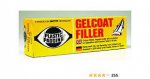
I have various chips / pops in my cabin top gelcoat ... I use Gelcoat filler ... then sand back .... simple ...
 
Acetone is nail varnish remover - you can get it from your wife's dressing table or Boots / Superdrug etc.
You can also get stronger acetone from the chandlers if you have one locally.

No it isn't it may be a component but it is mostly other ketones.

Acetone is a volatile non oily solvent very good at dissolving lots of organic materials and oils. When used as first a solvent and then a wash it will leave an area clean and dry. It's not to say that nail varnish remover won't do the same but there is a chance that it will both degrade surrounding GRP and also may not evaporate as well as acetone. Unless chemistry has changed significantly in the last 50 years acetone is acetone and doesn't come in different strengths.
 
Last edited:
Acetone is nail varnish remover - you can get it from your wife's dressing table or Boots / Superdrug etc.

It may contain acetone, but the problem is all the other guff that goes in some of them - colours, flavours, and the random mushed together words stuff that marketing thinks appeals to their target audience...

SEAL-Nails-Cutex%20Care%20Nourishing%20Nail%20Polish%20Remover.jpg


I suspect that botanical oil blend is not the best thing to ensure a good bond.

One can get a small bottle of pure acetone on ebay for £3 delivered.
 
Last edited:
...and as the father of girls I have found a lot of nail varnish is sold as "acetone free" these days so make sure you check the label... to be honest, for the job described I'd go Miliput as well, or this stuff...

index.jpg
 
No it isn't it may be a component but it is mostly other ketones.

Acetone is a volatile non oily solvent very good at dissolving lots of organic materials and oils. When used as first a solvent and then a wash it will leave an area clean and dry. It's not to say that nail varnish remover won't do the same but there is a chance that it will both degrade surrounding GRP and also may not evaporate as well as acetone. Unless chemistry has changed significantly in the last 50 years acetone is acetone and doesn't come in different strengths.

Easy to read label.

I buy large bottles of Nail Polish Remover for cleaning my 3D print beds. I check that it has high % acetone and no oils.
 
Hi All - I have a couple of small-ish (5mm?) screw holes I need to fill in my fibreglass fore-hatch. I've not dealt with epoxy/resin/thickeners etc before and the videos I've watched all make it look rather complicated.

Just wondering if any of you have used Epoxy Putty? I found something called 'PC Products 25567 Marine Epoxy Putty' which seems like it would be perfect - and it cures to an off-white finish, which would mean I probably wouldn't need to paint/gelcoat.

Anyone tried it? Or have any similar recommendations?
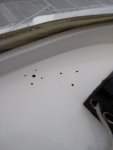
I've used this recently and it works well Teroson UP 620 Gelcoat Filler 241g (formally called Plastic Padding) it comes as white and is a close match to the typical white gelcoat (fairly close to the Beneteau gelcoat I just used it on). The mix ratio is not too critical. It is polyester, same as common gelcoat, not epoxy. Epoxy fillers, such as Milliput, are very good but deteriorate and change colour from uv exposure unless painted over. The white Milliput epoxy putty I used a year ago was a close colour match but now looks darker and is very noticable.

Www.solocoastalsailing.co.uk
 
Top