Enormous rogue waves explained

The hull and basic structure of a yacht would PROBABLY be OK - the mast and rigging not. A yacht is far stronger in relation to the stresses imposed on it than a ship is. So if there was sufficient warning, I'd be getting into as small a space within the cabin as possible (to avoid being thrown around) and close all hatches as well as possible. I think that would give the best chances of survival, but it wouldn't be a sure thing!
So who’s helming?
 
So who’s helming?
No-one. I don't think it would matter how such a wave struck - either the boat is strong enough to withstand it or it isn't. You could anticipate that the rig would be lost, and the rudder must be at risk, but hopefully the hull and topsides would be strong enough; as I noted, they are far stronger size for size than a ship (lower bending forces, material stronger in relation to unsupported spans). But a wave of that magnitude is certainly not survivable by an unprotected person.

In practice, I suspect you wouldn't get enough warning to do anything useful.
 
I think suggestions that a yacht will survive a rogue wave are bullshit. Waves that rip chunks off hulls, smash open structural beams on semisubmersible drilling rigs, that drop with a force of 80’ of breaking water, you can hedge your bets that the yacht and crew will not survive.

Sure, there will be exceptions.
 
And I'm the other way - in the field of image analysis, I can't understand why people do things badly in the space domain when they're easy and accurate in the frequency domain! And switching between the two has been dead easy since the Cooley-Tukey algorithm was devised.
Ah, those endless tropical night watches pondering life, the universe and the Cooley-Turkey algorithm

:)
 
I always think it's rather unhelpful to label them 'rogue' waves.

Very large or enormous waves are a routine, though infrequent, natural phenomenon. We don't call a family with triplet children a 'rogue family', or a big win on the National Lottery a 'rogue result'.

The problem with the 'rogue' label is that it confuses two different ideas - that the wave isn't a pleasant thing to meet (true) and that the wave is contrary to nature because it doesn't follow the normal rules of physics (false). The enormous wave isn't the Loch Ness monster or a yeti.
As I understand it, rogue waves don’t obey the statistical predictions that were current until very recently. In this sense, which Antarctic Pilot will understand much better than me, they are indeed ‘rogues’. I’ve seen their presence likened to the similar improbabilities that occur in phenomena such as quantum tunnelling, though clearly only classical physics needs to be involved.
 
As I understand it, rogue waves don’t obey the statistical predictions that were current until very recently. In this sense, which Antarctic Pilot will understand much better than me, they are indeed ‘rogues’. I’ve seen their presence likened to the similar improbabilities that occur in phenomena such as quantum tunnelling, though clearly only classical physics needs to be involved.
Yes - basically the statistical distribution of wave heights isn't a standard Gaussian distribution, but one with a much longer "tail' of extreme values. And if extrema from two wave trains happen to coincide, you get isolated "rogue" waves.

But I'm no oceanographer! I've worked with people who are, though, and learned enough to have an intelligent conversation with them.
 
I think suggestions that a yacht will survive a rogue wave are bullshit. Waves that rip chunks off hulls, smash open structural beams on semisubmersible drilling rigs, that drop with a force of 80’ of breaking water, you can hedge your bets that the yacht and crew will not survive.

Sure, there will be exceptions.
A lot would depend on whether the wave was breaking or not. It was 'rogue waves' that did for Tzu Hang not once but twice west of Chilean Patagonia. The boat survived but lost its rig.
My interesting experience in a small boat was about 2 weeks out of NZ bound Chile 9 and a half years ago. A very confused sea got up just after dawn, I had just come on watch when we found ourselves perched atop a very high peak and you could see for miles and xxxxing miles.
Then suddenly we had no visible means of support and just dropped into this hole where the peak had been seconds before. I saw 17 knots on the GPS but not sure of this was sideeways, downeeways or what. Then everything was back to almost normal- just like that. No heavy water came aboard, no light water either, but the self steerer went west as it had 'barn doored' against the sideways movement.
A few hours later the sea was settled enough to decant 20 fuel bidones into the tank.

As I say, it depends.
 
Last edited:
This is turning into an interesting discussion from people with more knowledge and experience than I have. The worst waves I have ever seen were entering Scapa Flow western entrance during my round Britain trip. Rather than repeat myself, I have linked my report written at the time. I was never frightened in those conditions, but now well aware at how dangerous they could have been and why the lifeboat was sent out to me. Would I do it again, yes but with a way of capturing it on a video.

Round Britain day 43
 
There were images a few years ago of the ferry going in there. Pretty frightening. Flat calm when I used it.
 
This is turning into an interesting discussion from people with more knowledge and experience than I have. The worst waves I have ever seen were entering Scapa Flow western entrance during my round Britain trip. Rather than repeat myself, I have linked my report written at the time. I was never frightened in those conditions, but now well aware at how dangerous they could have been and why the lifeboat was sent out to me. Would I do it again, yes but with a way of capturing it on a video.

Round Britain day 43
Don't knock your experience, some of the worst seas can be coastal. Short and steep can be lots more dangerous than a southern ocean greybeard ( which for the record I have never seen). I've been through the Merry Men of May once, just over exactly 62 years ago (July?) as a newly minted cadet. Told how bad it would be , reality must have been slack water, no wind, nice sunny day, flat sea, golly that was exciting.
 
My grandfather's croft was at Gills Bay. Used to see the white water between Mey and Stroma. Huge at their height.

I also remember all the light looms you could see up there.
 
Maybe time to put in a reef?
Know you know why ther are fewxor no windows oncthe front of offshore handling boats incthevNorthcsea and often a wave deflector at wheelhouse floor level.

I was once sent out on an experience trip to witness the process of replacing rig anchor chains on location .cWe sat increasing such as those shown and worse. Our 3 day job finished up lasting nearly 14 days so a few unhappy faces on board.

As soon as the job was done and in weather possibly even more severe than seen here, we turned around and headed back to Montrose. The telegraph was put to full ahead and I must admit the trip through the night was exilerating . In conditions which we would reduce speed in our cargo ships we were punching into solid water. Those North sea tugs and anchor handlers are certainly well built and well manned.
 
Quite common in the late 60's/early 70s off Port Shepstone/ Poet St Johns. May have been what did for the Waratah in 1909(?) and an RN cruiser experienced an 'event' there in WW2. Also the mail steamer 'Edinburgh Castle' shipped water back to the accomodation front in the early 60s.
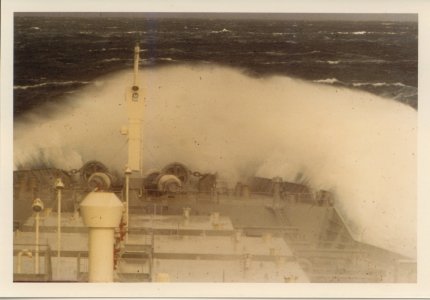
My event was in 1971, loaded 100,000 dwt OBO so maybe 120,000 tons of oil and steel. On watch on the afternoon 12 to 4 , slow steaming down the coast at about 7 knots. Not a remarkably big sea running. All of a sudden I beheld a missing wave, just a quite remarkable hole in the sea. Down down down went the bow and then the frd half of the ship disappeared, speed dropped on the instant to somewhere between 0 and 2 knots.
Then up she came again and we continued as if nothing had happened.
Having been built for Norwegian owners she had an enclosed crows' nest on the foremast with a window and clear view screen , when loaded that was about 70 feet above the waterline. Discovered that this frd facing window was smashed and the foremast was set back maybe 5 degrees with the deck plating just in front of it cracked over about a metre.
While looking for something else entirely I came across this pic. Taken early in the 12 to 4 maybe an hour or two before everything you can see in this pic disappeared into a GBFW. You have a clear view of the clearview screen in the crow's nest that wasn't there at end of watch.Tanker bow.jpeg
 
Top