Engine starting current

Ross D

Well-Known Member
Joined
26 Jul 2010
Messages
268
Location
Cornwall
Visit site
I'm planning to fit a battery fuse to my electrical system this winter as part of a complete re-wire. Does anyone know the starting current of a Volvo MD7A?

Cheers

Ross
 
Hi Ross,

Why would you like to install a battery fuse? Remember the highest current may not be your starter but could be your alernator charging current.

I have a 75amp alternator fitted and if i had flat battery this could potentially be running through the battery leads for a short time.

Normally there is no requirment to fit a fuse here.

Looking at the MD7 Manual the starter is either 0.8kW, this would give a charging current (on a 12 volt system) of 66.6A.

http://www.capedory.org/manuals/VolvoMD7AIB.pdf

There is also a standard wiring diagram on the above manual.

John
 
Looking at the MD7 Manual the starter is either 0.8kW, this would give a charging current (on a 12 volt system) of 66.6A.
The figure of 0.8kw (1.1hp) given for the starter motor is the the mechanical power it delivers the electrical power it consumes will be greater.

I do not know precisely what motor is fitted to the MD7A, the workshop manual does not say, but for a 1.1hp Bosch GF motor I have the following

Unloaded: 30 - 50 amps at 11.5 volts
loaded: 185 - 220 amps at 9 volts
locked: 400 - 490 amps at 7 volts

On that basis you might just get away with a 250 amp fuse but there is a risk that the initial current could blow it.
Maybe a 300 amp fuse will be adequate but a 400 amp one would be a safer bet.

By the time you have reached those sorts of values I wonder if there is any merit in fitting one at all.
 
Last edited:
Fuses

The fuse is fitted to stop the wiring getting too hot in the case of a short circuit. So fuse rating should relate to the capacity of the wiring to take a short circuit current without melting causing a fire before the fuse blows. The actual current that might flow through the wiring in the case of a short circuit is limited by the wiring resistance and also the internal resistance of the battery. Capability of the battery to supply current.
It is all a bit difficult. a small car battery might be rated at 350 CCA cold cranking amps which might indicate the max current likely to flow in a short circuit. The wiring resistance may reduce this a little. However if you are starting using a big battery or batteries in parallel there might be a lot more current capability.
Then of course we have your question how much current does the starter draw. And although you haven't asked, how long does it draw the high current and how does that time relate to the blow time for the fuse.


A starter of course draws initially a very high current which reduces as the starter begins to turn.
As said most of these kind of circuits are not fused in a car for instance.
If however if you do want to connect a large battery for starting then perhaps there is more reason to fuse the circuit. I suspect the only way to decide on fuse rating is to fit one about 250 or 300 amps and see if it blows on normal starts. Possibly a 150 amp would also survive and would give more safety.

So it is all very difficult. The only really conservative way would be to fit a 350Amp or more and then ensure that all the starter wiring is really heavy so it will not melt at this current.
However some engine manufacturers I believe have warned against large batteries and heavy wiring because it can mean the starter starts with an excessively high current which can then damage brushes and commutator. In other words the starter is designed to expect only 8 volts or less on start. The 8volts being the result of wiring and battery volt drop.

good luck olewill
 
I'm planning to fit a battery fuse to my electrical system this winter as part of a complete re-wire. Does anyone know the starting current of a Volvo MD7A?

Battery fuse is a good idea.

Where battery fuses are fitted, I believe it is common practice to take the starter connection from the battery side of the fuse, so that the starting current doesn't flow through the fuse.

If you fit a fuse rated to carry starting current, then it's not going to offer any meaningful protection to the rest of the wiring unless you fit a second, smaller fuse for that.

It can be argued that the run of cable to the starter is usually short, and can be protected from damage by careful routing. Then there's the argument that if you're trying to start a reluctant engine in extremis, it's better to have the starter cables get hot (starter cable & motor are usually only rated for intermittent operation, anyway, so the usual cable sizing rules get bent) than a fuse blow, so it's really only the fuse protecting 'everything else' that is required. The standard on wiring for boats (either ISO, or ABYA - I can't remember which one I read, but I believe both are consistent) allows for the starter circuit to be un-fused.

Even a small lead acid battery will be capable of supplying several thousand amps into a short circuit - the CCA rating is taken against a set voltage (8V?) rather than a short circuit. The point about needing a certain resistance in the starting circuit in (petrol) cars is to stop the starter motor pulling the battery voltage so low that the ignition circuit doesn't work. I don't believe it's relevant to diesel engines (electronic injection etc. excepted).

0.02p

Andy
 
Even a small lead acid battery will be capable of supplying several thousand amps into a short circuit - the CCA rating is taken against a set voltage (8V?) rather than a short circuit. The point about needing a certain resistance in the starting circuit in (petrol) cars is to stop the starter motor pulling the battery voltage so low that the ignition circuit doesn't work. I don't believe it's relevant to diesel engines (electronic injection etc. excepted).

where in the starting circuit do they fit this resister?
 
As far as I know it's usually resistance wire in the wiring loom on the feed to the ignition circuit which gets bypassed when starting.

Andy
 
Coil ignition

I believe that the resistor being quoted is on the coil, some cars have a lower voltage coil maybe 8 volts. During normal running the coil is fed through a resistor to drop the extra 4 volts from the 12 volt system. When starting the engine, a wire from the starter solenoid is led direct to the coil, other side of the resistor effectively shorting the resistor, thereby giving a boost to the spark produced.
 
no need to fuse starter

Putting a fuse in-line with the starter is pointless, you are trying to protect against an almost negligible risk. The risks introduced by this strategy far out way any risks that you have reduced. Connections are the enemy of high current 12V devices and you have just increases the number of connections by 100%.

By all means add a fuse but make sure the starter is on the battery side. Cars have been crucified by health and safety directives and I can't think of any which have fuses on the starter circuit. Normal practice as mentioned before is to fit an isolation switch and fuse/protect individual circuits.

Sometimes if you are the only person doing it then it is wrong. Sometimes the risk associated with the solution is far greater than the original risks. I personally have not heard of electrical fires caused by shorts on starter circuits.

Try doing a hazid, list all the risks if you leave as is and rank them 1>5, estimate likely hood of risk occurring 1>5, 1= lowest risk/likelihood. Multiply these figures together and you have a figure that helps define the magnitude of the risk.
A risk that is very high (5) but is very unlikely to ever occur (1) would score the same as an event that is low risk (1) but very likely (5) to occur.

Its often the risks that we perceive to be low but are likely to occur that are the ones which give you value for money in sorting out.
 
I personally have not heard of electrical fires caused by shorts on starter circuits.

No comment either way, although I have had personal experience of an electrical fire on a start circuit.

Not on a boat but on a car, the dealer was trying to find out why the starter motor wasn't working. When he had finished he gave me the keys. I drove back home about a mile and could smell burning plastic. I stopped the car, lifted the bonnet to found that the dealer had re-routed the starter cable across the exhaust manifold. It had melted the insulation and the cable was glowing. I quickly disconnected the battery ...

Keep the cable short and away from sources of heat, make sure that it is protected against chemicals, corrosion and chafe.
 
The idea of a battery fuse is in case of a damaged wire/terminal on the main battery cabling. It has happened to me previously on my last boat luckily the wire on which the terminal failed was the negative so when it waggled around in the engine bay it did no damage, had it been a positive terminal which failed and dropped the wire on to the engine it would have directly shorted the battery probably causing an insulation fire. Something similar happend to my dad in his car shorting and setting fire to the starter motor lead he was fortunate and could stop the car and get out.

A 200A fuse or similar would simply stop a fire in the event of a short circuit on the stater cabling.
 
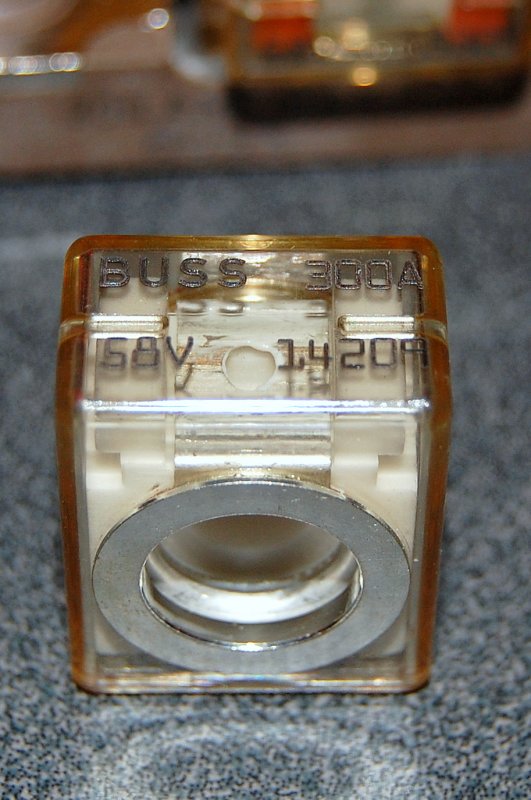
I regularly fuse the starting circuit on boats. Were the battery to come adfift or the positive wire chafe through without the fuse there could be a fire without one. There have been instances of fires caused bychafing of the positive starter cable. True ABYC doesn't require fusing the starter circuit but better safe than sorry. Fuse sizing is not critical as you are fusing for short circuit protection and not overload. The fuse can be anywhere from the cable's capacity to 150% of its capacity. If you use a fuse like Blue Seas ANL type fuses there is no reason for it to blow during starting and I have never had an issue with this. For example a 200 amp ANL fuse will blow at 380 amp load after 500 seconds. Your starter is usually on for 10 or 15 seconds at most and that is well within the capabilities of the fuse. Here's the link to the chart on fuse blow points about halfway down the page.
http://bluesea.com/viewresource/95
 
Putting a fuse in-line with the starter is pointless, you are trying to protect against an almost negligible risk. The risks introduced by this strategy far out way any risks that you have reduced.

As a boat owner, ABYC member and ABYC trained installer I would have to disagree with this.

In 2005 I purchased a brand new 31 foot Catalina. Because ABYC only requires a fuse on the house bank builders only supply ONE fuse. My system from the factory was two identical 4D batteries to a 1/2/BOTH/OFF switch, which one is house? Either bank could have been considered the house bank or start for that matter.

Because of my background, before commissioning the vessel I installed a second ANL fuse on the second bank. Seven weeks later I blew the 200 amp fuse.:mad: The factory had cut the wire for the starter just a tad to short and with the motor loaded in forward it chafed through in a dead short causing a nice burn to the motor mount and a blown 200 amp ANL fuse. The wire was on a side of the engine that was nearly impossible to see and if felt by fingers, which I had during survey, seemed to have plenty of clearance but diesel engines vibrate and move some on soft mounts and chafe happens.
If I had not had that fuse I am fairly confident that would have had a serious boat fire possibly totaling a brand new vessel.

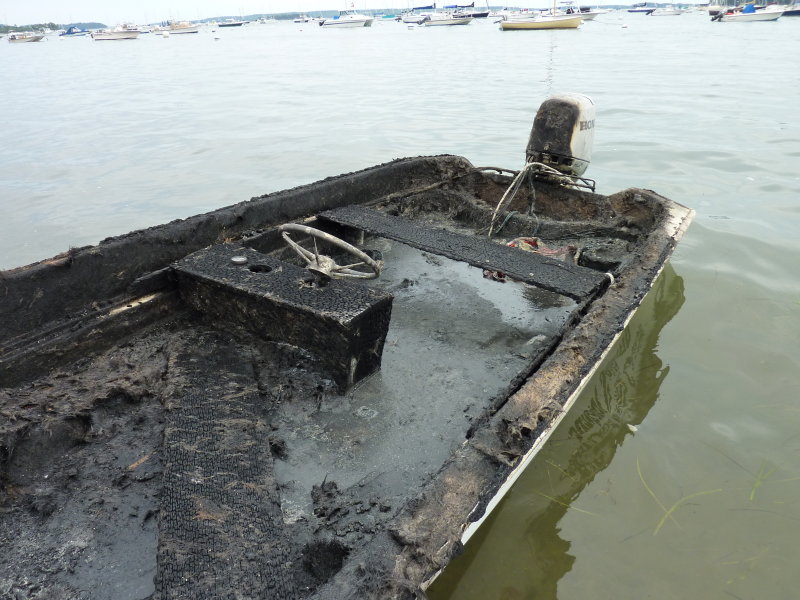
Just three weeks ago we lost one of our junior sailing program Boston Whalers when a dead short burned the boat to the waterline. We came darn close to loosing a whole dock full of 420's and multiple other boats. A simple fuse would have stopped this. The club will be installing battery fuses on all of our vessels before next spring.

A $30.00 fuse could have saved this Boston Whaler:
128377865.jpg


If installing a fuse it should be first sized for the wire and also to the AIC (Amperes Interrupt Current) for what the battery or bank can supply based on CCA rating of the bank though I prefer to use the MCA as most boats are used in warmer temps and batteries can supply more current when warm.

If your wire can't take say a 250 amp fuse then you'll need to go smaller and size to the max current carrying capability of the wire. The AIC rating is the amount of current your batteries could supply if shorted. I know my bank can supply 3000 CA at 65 -70 degrees therefor I use ANL fuses with a 6000 AIC interrupt rating. This means you would need 6000 amps to "jump" across the fuse in the event of a short. With an AIC lower than the bank can supply you could literally blow the fuse but current could still be "jumping" and continue to flow which could be dangerous.

Keep in mind that ANL fuses can far exceed their "rating" for short durations before blowing. A 200 A ANL can do about 5 seconds at 200% of it's rating and up to 500 seconds at about 150% of its rating. ANL (LINK)

Most of the time for battery large banks you'll want fuses with a 5000 AIC or more depending upon the CCA of the entire bank. For a start battery a 5000 AIC may not be necessary.

This is a good chart to show various AIC ratings:
21736.jpg


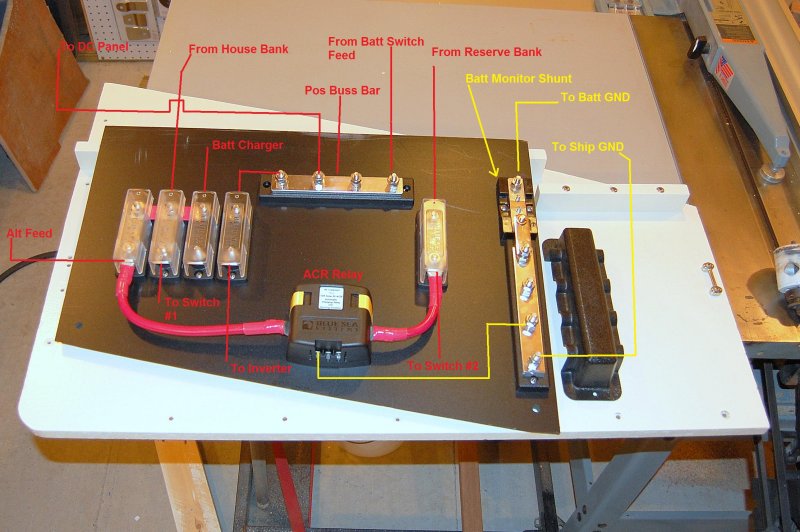
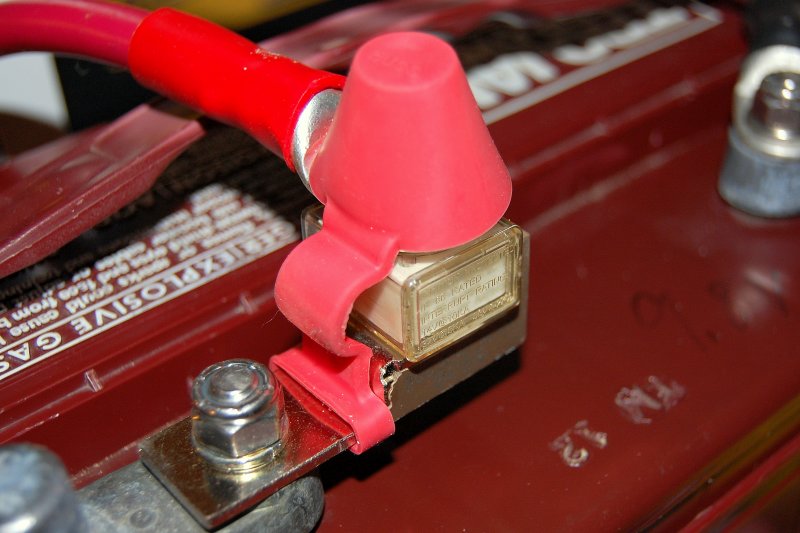
I use the Blue Seas MRBF's quite a bit. They are easy and quick and reasonably priced. Been fusing start batteries on diesels to about 250 HP for many years and never once had an issue with them blowing pre-maturely.
124282535.jpg

124282534.jpg


I also like to use ANL's:
124379068.jpg


On engines to large for a fuse I run the start cabling in conduit the entire length, which is another good option. In short electrical boat fires happen and I have seen chafed battery cables on many occasions. The potential outcome of this, as above, can be devastating.

Starting a small sailboat aux really does not take as much as folks assume it does..

What Happens When I Start My Engine (VIDEO LINK)
 
Last edited:
Top