Engine spares (and tools)- how much do you carry?

Kelpie

Well-Known Member
Joined
15 May 2005
Messages
7,766
Location
Afloat
Visit site
As we inch closer to our goal of becoming full time cruisers, I am starting to consider what stock of engine parts I should take with me. There are so many horror stories about people getting stuck in an invariably horrible and expensive harbour whilst they await delivery of components which are hard to source, overpriced, subject to customs fees and bribes, and might turn out not to fit. All part of the fun I'm sure but it seems sensible to avoid all that trauma if possible.

Obviously I already carry basic spares- filters, belts, impeller, fluids, anodes, and the tools required to fit them. But I am thinking of adding a few other parts that are likely to require replacement over the course of say a five year cruise.

Would it be sensible or paranoid to carry a spare of the following:?
- exhaust elbow
- raw water pump
- alternator
- morse cables
- starter motor

Anything else to consider?
 
Attempt no 2 and moving beyond just engine spares:
Two reels of tinned electrical wire, one red, one black. Maybe even several gauges.
A HUGE box of electrical connectors
Outboard spares, including a propeller.
A HUGE assortment of nuts, bolts, washers and screws.
Drill bits, both metric and imperial, for wood and steel

TOOLS
Impact driver
Tap and dye set.
 
Stayloc fittings to repair a broken rigging wire. One for each size of wire on the mast plus 30m of plain 4mm dyneema core for lashings. You dont need to carry any spare wire if your stayloc has a ring on the end you can lash to.
A sewing machine! You wouldnt believe how much stuff we have made and repaired whilst away. Make sure you carry some spare sunbrella to match your sprayhood colour. Its easy to forget how hot it is in the Tropics when you are freezing in the UK. We have covers for the hatches, outboard engines, winches, engine console, fuel cans. We also have a a suncover that goes over the boom to provide shade for the sprayhood and cockpit. If your sprayhood is a dark colour it will be unbearable to sit under as it will get very hot. Even light coloured biminis can be hot beneath. If you can carry lots of sunbrella type fabric and a singer 201k sewing machine, you wont regret it.
Spare gas bottle regulators and I would also invest in a kit to allow you to fill your own bottle from the American type bottles. In the Caribbean you can get the American bottles filled but not always the UK ones so easily. Buy a Plastic American type bottle when you get here then you are covered for gas.
Lots of spare red ensigns. We destroy about three per season. They turn in to pink ensigns first then rip to shreds.
If you have led lights buy spare bulbs at home. They are a total rip off to buy in the Caribbean. A £3 bulb at home will cost you $20 here!
 
Obviously, the engine consumables you've already mentioned but don't forget outboard spares as well. Electrical spares such as bulbs, switches and wire, assorted A4 nuts, bolts, washers, self tappers, shackles etc. My toolkit is fairly comprehensive, enough to strip and rebuild the engine, which I had to do one time. Rings, gaskets etc. were ordered from UK Monday morning and arrived in Portugal via courier, before 12 noon the next day so I'm not too worried about getting spares not to hand locally. Although others do so, I don't bother carrying spares such as alternator or starter, they can usually be fixed locally, where repair rather than replacement is often the norm. Prop and shaft anodes can be hard to find, particularly anything imperial rather than metric. Morse cables are the same anywhere, main differences being length. Although labour charges can be far cheaper than UK, it's best to get the boat equipped for hot and cold weather with bimini, fans, good fridge, cockpit tent, before leaving, same with gantry, solar and new batteries.
 
Our spares load is somewhat over the top, but only because we got the opportunity to buy a complete and working spare engine in Trinidad for $500 - everything you could strip off the block, we now carry.
Based on what we've used and couldn't have lived without/worked around for a while, the only items that I'd perhap add to the OP's main engine list is a fuel lift pump, before getting another Yanmar one with the Trini engine, we carried an inline electrical one.
Also perhaps some spare water/exhaust hose and for immediate repairs to same, short lengths of suitably sized steel/copper/plastic pipes along with jubilee clips to allow leaks to be cut out and the pipes spliced back together.
Not really 'spares' more a modification/extra which has eased the stress more than once is that we've a well secured jerry jug with an extra cap that's got a small hole through it, along with 8' of fuel hose complete with fuel union, copper washers and union bolt; in the event of the engine stopping, we can connect a gravity feed from a known 'clean' supply direct to the engine and bleed it through in <5 minutes.
 
Last edited:
Firstly I like to say you can bet you bottom dollar no matter how much you carry it be the one thing you haven't got that will go wrong :)
Personally I think how much spares other then the normal spare you carry on board really depend where your cruising , in Northern Europe and right across the Med I been able to buy most stuff , and what I couldn't , I ordered
We had our course computer go this year , who carry a spare course computer?, I guess someone here will say they do , anyway got one on the internet , had it sent to Sardinia. It took five days . We also had our wind instrument vane break , no we don't carry one of them , again ebay and we received it in a week ,
My point carry a spare fuel pump, injectors , steering cables so on and you probably find the day you sell up they still be in a compartment some where .
On the other hand if you plain to cruise some out of the way country where spares are hard to come by , that's a different thing .
 
Last edited:
.
Looking at these lists I have to say I see issues for those of us planning to get away on boats under 30ft and with cruising budgets under 25k per annum.

Maybe a 'sailing on a shoestring' forum?


- W
 
Would it be sensible or paranoid to carry a spare of the following:?
- exhaust elbow
- raw water pump
- alternator
- morse cables
- starter motor
Slightly, but only slightly, paranoid. My list when long-term cruising included morse cables, thermostat, a couple of bearers, flexible coupling, and a head gasket set, all of which got used at some point over 17 years; also a spare injector, which wasn't. Along of course with the basic spares you list which should include enough oil for a full change.

It depends a bit on what engine you have. Spares for a Perkins 4108 will be (or used to be) obtainable almost everywhere, even in remote Pacific islands. If it's an old Thornycroft you have then I'd add the starter motor. You'd be surprised how good local engineers are at knocking up something like an exhaust elbow.
 
Sod's Law operates.

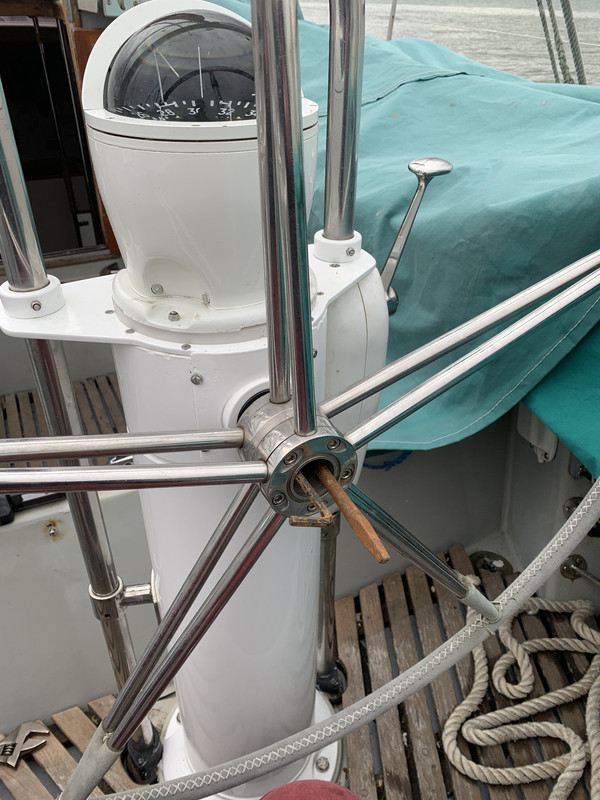
Since converting to plastic I have been acquiring spanners, etc. at a rate of knots. I have an absolutely vast socket set... the nut on the wheel of a Whitlock Mamba is a 5/8" UNF thread with a 3/16" Woodruff key... and a 10mm - yes, you read that right screwed bore down the middle to take the brake (don't start me...) Do I have a 5/8" UNF socket? Nope! (Does anyone?) Guess which bit chose to unscrew itself at sea...
 
Last edited:
Sod's Law operates.

Since converting to plastic I have been acquiring spanners, etc. at a rate of knots. I have an absolutely vast socket set... the nut on the wheel of a Whitlock Mamba is a 5/8" UNF thread with a 3/16" Woodruff key... and a 10mm - yes, you read that right screwed bore down the middle to take the brake (don't start me...) Do I have a 5/8" UNF socket? Nope! (Does anyone?) Guess which bit chose to unscrew itself at sea...
What you need is a metric adjustable spanner :encouragement:
 
>Obviously I already carry basic spares- filters, belts, impeller, fluids, anodes, and the tools required to fit them. But I am thinking of adding a few other parts that are likely to require replacement over the course of say a five year cruise.

We carried those but not the ones below. Everything on a boat is made for weekend and holiday sailors, except electronics, everything will break more than once, as we found. We carried two spare parts for everything and exploded diagrams. What I did when fixing things was to lay the parts out in a line so I could be certain how to put it back together. One thing is spannners we carried ring and open ones.
 
Everything on a boat is made for weekend and holiday sailors, except electronics, everything will break more than once, as we found.

Where do you get that idea? Many liveaboards do less sailing than weekend sailors, particularly racers. We no longer day sail, the boat moves when we're going somewhere. I can not think of anything mechanical, electrical or rig, which has broken due to longer passages rather than sailing around the Irish Sea with far more challenging sea state and weather.
 
Depends on your engine. Most boat engine models are old enough to have well known weaknesses, so it's those you provide for. In case of our MD22, that's the raw water pump, or at least a seal kit for it, the starter motor (because the raw water pump is stupidly locate above it and when the seals fail the starter gets drenched), alternator and pump belts. This year we'll add the exhaust injector (entire elbow not required on the MD22) and coolant hoses. We also carry a full change of coolant, oil and empty containers (to hold the old). Morse cable spares are zip-tied in place (with corks on the ends). Should probably have a spare morse control mechanism too, but never found a fairly priced one yet.

Other than that, lots of generic spares, such as metal epoxy, enough pre-filters to survive a tank infestation (and pump to bring up any water/dirt that should find its way down there) and of course a comprehensive set of tools. And that's just the engine stuff :)

On the upside, we only had one thing break this season that we had to go ashore and buy a part for. Another boat we met had their raw water pump seals fail and ended up motoring a long way at 3.5 knots top speed (any faster and the pump was squirting too much water) to try and find spares, which they did not succeed at, only to have them flown in by visiting friends weeks later.
 
Top