Engine soundproofing

Graham_Wright

Well-Known Member
Joined
30 Dec 2002
Messages
8,184
Location
Gloucestershire
www.mastaclimba.com
Is there any reason why an engine should not be covered with an insulating blanket rather than sound-proofing the whole space?

I accept that the engine becomes hot during operation but is not the water cooling within the engine sufficient to keep it sufficiently cool?

Just wondering.
 
It also needs airflow for cooling, round the exhaust tubes from the block to the water cooled manifold and round the water injection bend and around the turbo, if fitted. Boxing it into a sound insulated, well ventilated box is a safer idea.
 
It also needs airflow for cooling, round the exhaust tubes from the block to the water cooled manifold and round the water injection bend and around the turbo, if fitted. Boxing it into a sound insulated, well ventilated box is a safer idea.

But very much more difficult.

We are told that sound-proofing needs to be air tight to be effective. That in an engine space full of ancillaries is not easy.

The exhaust stub is very short and could be left exposed. I don't think turbos had been invented when my engine was manufactured!
 
Not quite true. There must be not direct lines of "sight" at the joints so and sound trying to escape gets blocked by and lips in adjacent panels.

Sorry, that is what I should have said. Sound proofing my engine compartment would/will be very difficult due to its volume.

Access (fortunately!) is excellent but exacerbates the linings required.
 
Sorry, that is what I should have said. Sound proofing my engine compartment would/will be very difficult due to its volume.

Access (fortunately!) is excellent but exacerbates the linings required.

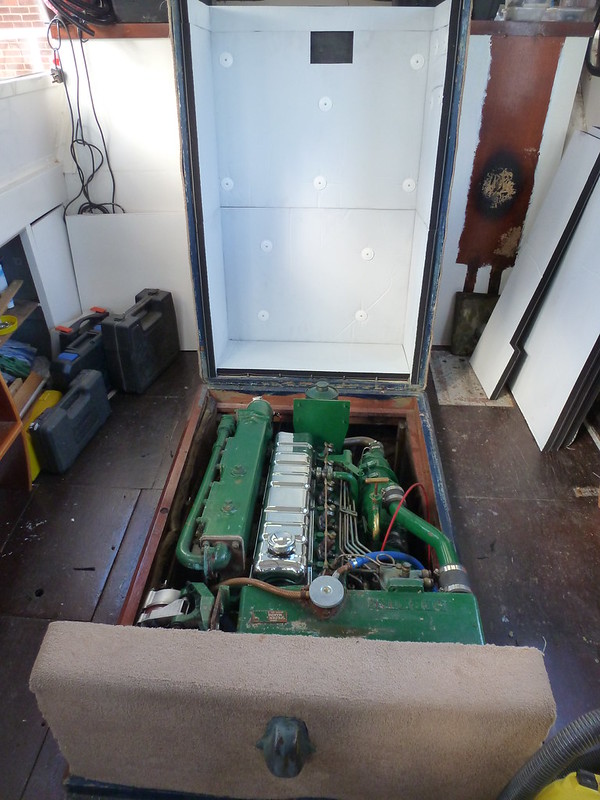
Ok I did have that issue but reduced the volume of my engine space and I could lift the engine up to get inside to fit the sound insulation.

36086189075_b94398dbbd_b.jpg


Access from top front and back.
 
These people don't share your view:

https://www.nkgroup.co.uk/product/vehicle-acoustic-engine-blankets/

I don't have any experience of their blankets, but I used their lead/foam/foil sheet to line my engine bay in the traditional way and it was very effective.

Pete

Peter
What you are saying is not relevant to a boat engine room. They are used on a motor vehicle moving along at 50kph (?) and plenty of ventilation from the front of the vehicle and underneath.
 
Peter
What you are saying is not relevant to a boat engine room. They are used on a motor vehicle moving along at 50kph (?) and plenty of ventilation from the front of the vehicle and underneath.

I am looking to sound insulate my genset-it is an open model, no sound box.

Two seasons since installation, no probs. so far. But it is noisy-bloody noisy.

There is a Marine engine blanket, states up tp 50% improvement. They build to your drawing, including cut outs for cables and exhaust.

For a simple and hassle free improvement for my application it is under 300 quid.

Got their details, but on the boat. Pretty sure it is the NK group.
 
Is there any reason why an engine should not be covered with an insulating blanket
What happens on a cold winter's night? You reach for a thicker duvet.

What happens when you open the hatch and touch the engine? Mine is hot to the touch. If there were any advantages to "insulated engines" I am quite sure all the manufacturers would be selling them with 100mm of insulation on them.
 
Soundproofing on my other boat:

P1040721 by Roger Gaspar, on Flickr

Obviously that was taken last winter with other work progressing. In use there has been no hint of heating problems. Recent 6 hour passage on a warm day the temp gauge didn't move at all. The shell in the from is an air vent and obviously provides some noise but it doesn't seem to cause any undue noise.
 
We are told that sound-proofing needs to be air tight to be effective.

Sound-proofing is virtually impossible, what is wanted is sound reduction, which is a case of every little helps.
The idea is not to trap it so it cant get out, but to kill it as it tries.

The reason for the "air tight" misconception is all down the marvel that is our hearing. We have such a wide dynamic range of audible sound pressure level, with auto level control, that without measurement instruments it is hard to spot long term changes in level.
Sometimes the only way to distinguish between very loud, loud and "I can still hear that" is the lack of sore throat and headache after a long conversation.
 
I am looking to sound insulate my genset-it is an open model, no sound box.
Two seasons since installation, no probs. so far. But it is noisy-bloody noisy.

There is a Marine engine blanket, states up tp 50% improvement. They build to your drawing, including cut outs for cables and exhaust.
For a simple and hassle free improvement for my application it is under 300 quid.

Got their details, but on the boat. Pretty sure it is the NK group.

rotrax

I just did a search and there are stacks of articles on soundproofing generators as well as using blankets. Whatever you use you will have to leave adequate holes in the insulation for cooling as well air for running the motor (2 cu m/minute?)

My intuition tells me the gen set would be a lot noisier on a steel deck than a wooden deck so maybe run it on a mat?

If it was my gen-set I'd make up insulated panels (ali or f/g) that could be removed
 
They do them for boat engines and generators and they make a big difference.
The heat all goes out through the exhaust, not metal to air in a hot engine bay.

Not all heat goes out the exhaust (that's why you need an oil cooler) Engine blocks get hot. Alternators get hot.

My engine room has a blower to remove hot air and provide positive pressure for the motor.
 
Last edited:
rotrax

I just did a search and there are stacks of articles on soundproofing generators as well as using blankets. Whatever you use you will have to leave adequate holes in the insulation for cooling as well air for running the motor (2 cu m/minute?)

My intuition tells me the gen set would be a lot noisier on a steel deck than a wooden deck so maybe run it on a mat?

If it was my gen-set I'd make up insulated panels (ali or f/g) that could be removed

It is an 8KW Westerbeke powered by a 3 cylinder 1500 RPM diesel in a dedicated generator garage. It is already on new rubber mounts and has a large-oversize in fact-Halyard silencer. Freshwater cooled, so not too worried about the CFM of air available as long as its enough for combustion.

Looked a making a sound box, just as expensive and far more time consuming.

Been using it for an hour most mornings to supply a tank of hot water and give the batteries a kick when on the hook or alongside without power.

As its been just about acceptable for two five month seasons a sound reducing blanket offering 40 to 50% noise reduction at under 300 quid ready made sounds OK to me.

You are bang on re putting a portable genny on a mat. We had a Kipor 2600 which was far quieter used so. I would put it downwind to avoid exhaust fumes and place a pair of rubber backed mats under it. About 20% quieter, but purely subjective testing.

Years ago we were invited for evening drinks on a really big Nauticat. I had the mans tour, First Mate the ladies tour.

We were in the upper rear cockpit enjoying the sunset when I said " You must have a big genny on this. "

" Yes " he replied and reached down to touch the GRP of the cockpit" its running now "

You could not hear anything mechanical or exhaust at all, but he could feel a shiver of vibration.

My ebay bargain basement 8KW Westerbeke owes me 1600 quid installed. That covers its purchase, renovation, van and hoist hire and getting the yard to crane it onto the rear cockpit where my mate Ivor and I had pre-fabricated a wheeled trolley on a track plus a scaffold tube mounted on heavy timber frames to support the genset on its block and tackle before it was used to lower it into its space.

As a new one installed on the South Coast is not far short of £17,000 I am quite happy to add a bit of soundproofing.
 
Not all heat goes out the exhaust (that's why you need an oil cooler) Engine blocks get hot. Alternators get hot.

My engine room has a blower to remove hot air and provide positive pressure for the motor.

I completely agree with your observation about alternators. If it's anything more that 30 or 40 amps then there has to be some way of getting the heat away from the front of the alternator after it has been drawn by the pulley fan through the alternator body.

My engines use blower ventilation although they are rather noisy so I've modified the fan belt cowling to increase alternator air throughput and allow the fans to be switched off. Two of my cars also have large alternators and employ special ducting to enable cool air to be directed to the inlet end of the alternator.

If a blanket stifles cool air getting to, or hot air leaving, a powerful alternator, there will be unintended consequences. :ambivalence:

Richard
 
My engines use blower ventilation although they are rather noisy so I've modified the fan belt cowling to increase alternator air throughput and allow the fans to be switched off. Two of my cars also have large alternators and employ special ducting to enable cool air to be directed to the inlet end of the alternator.

The ideal is perhaps to have an extractor fan taking hot air from the top of the engine compartment, plus a ducted supply of cooler outside air (which can usually be arranged so that it allows the cool incoming air to blow on the alternator).

As for fan noise, my boat has a factory-fitted extractor fan which intriguingly is a 24v fan running on a 12v supply. It's quiet!
 
Top