Engine operation at lower revs - damaging or not?

Irish Rover

Well-Known Member
Joined
5 Feb 2017
Messages
8,213
Location
Türkiye
Visit site
I see a lot of comments about under-working diesel engines being harmful to the engines. My Yanmar 8lv320's max at around 3,600 rpm but I operate at around 1,350 rpm almost all of the time. I do give them a few blasts at max revs in neutral before I switch off, to minimise sooting. On longer runs, of a couple of hours or more, I run close to max for 10 minutes or so towards the end of the journey. At 1,350 revs the engines reach a max temp of 76⁰ after around 10 - 15 minutes. If I push the revs above 2,500 the temp goes to 78⁰. My cat will comfortàbly do 20kts+ but 7 -8 suits me, and I don't want to change. Is there any more I should be doing to show them my love?
 
It’s something we keep getting told that we don’t work the engines hard enough. We have an hour sail to the larger canal with a higher speed limit, once I get to there I open up one engine at a time to get it up into its operating temp, once I have done that the engines smoke less.
 
I see a lot of comments about under-working diesel engines being harmful to the engines. My Yanmar 8lv320's max at around 3,600 rpm but I operate at around 1,350 rpm almost all of the time. I do give them a few blasts at max revs in neutral before I switch off, to minimise sooting. On longer runs, of a couple of hours or more, I run close to max for 10 minutes or so towards the end of the journey. At 1,350 revs the engines reach a max temp of 76⁰ after around 10 - 15 minutes. If I push the revs above 2,500 the temp goes to 78⁰. My cat will comfortàbly do 20kts+ but 7 -8 suits me, and I don't want to change. Is there any more I should be doing to show them my love?
I think engine wear/load comments were true with older engine designs with old mineral oils. Poor loading in old engine designs etc encourages carbon build up, which may bung up the piston rings reducing cylinder lubrication etc etc. I was recently reading up on modern synthetic lubrication oils as I want to do the best thing with my 40 year old petrols. I assumed old fashioned minerals would be the way to go. But apparently not, A good synthetic will work better, last longer and minimise further carbon build up and may help get rid of old deposits trapped in oil control rings.

The way you use your engines sounds absolutely fine to me. Yanmar know what boat they are in and wouldn't have signed them off if they were not happy.
But I definitely would NOT give them a few blasts at max revs before shut down. I would leave them to idle whilst doing the ropes etc, then turn them off. By the time you end your journey/return to the marina the engines and especially the turbos will be cooling down as you do slow manoeuvres and this will make sure there has been plenty of oil running through the turbo charger bearings cooling it down. I am told the worst thing you can do with a turbo charged engine is just turn it off after a good run. Better to let it idle for a minute or two to cool the turbo bearings. Otherwise the oil trapped in a very hot turbo, post shut down, can cook and turn into tar, reducing lubrication area and if it happens a lot restricting oil flow through the turbo. Synthetics resist this problem better as well.
 
Last edited:
Revving it in neutral, then switching off isn't a good idea IMO.

First of all high revs with no load does nothing for your engine - it needs to work. Not neccessarily at highest rpm, but where the turbos are on (high torque). High revs for a moment will create soot when turbos kick in and the potential heat that needs to be transferred to the cooling jacket and heat exchanger is prevented from doping so, when you switch off.

Many owner manuals specifically advise against this procedure - and, if running it hard, to leave it idling for a few minutes before switching off.

The "close to max for 10 minutes or so" habit is better. I'd make it 20 minutes...

The temperature observation is ok but merely tells you that the cooling system works ok.

I sent oil samples off for analysis which gave me a perfect indication of oil- and filter change intervals. Peace of mind, also re. what oil to use (the successor to the originally recommended, now obsolete API CD 15W40, variant), ie. API CF, CI-4, CJ-4, or CK-4 in same viscosity.
 
Last edited:
I posted this once before but will again as its relevant to this post. We had a customer with Sealine with two Volvo D4 engines, he complained of excessive oil consumption, we monitored the consumption over several weeks and they did use more oil than you would expect for a 1yr old boat. When we asked him how he used the boat he told us he would invite some friends and cruise the fjords all day at idle speed, the result he had glazed the cylinders as the engines were never worked hard.
All engines need cylinder pressure to push the rings out so they form a good seal, when I worked on aircraft it was standard procedure with overhauled engines to run them at high rpm to get the rings to push out against the cylinder wall and bed in, otherwise they would not seal and there would be oil consumption problems.
I know it used to be rule of thum to run engines in gently but not anymore, Mercruiser have a run in procedure for new engines requiring that you run the boat at varying rpm for a few minutes all the way up to max so that the parts wear in at all rpm and frequencies in the engine.
 
I had a Toyota Landcruiser that had the 4.2 turbo diesel, same engine was/is used by Yanmar, we were told to let the turbo cool off with gentle driving and idle before shutting down. In Australia there was a device that got fitted to the 4.2 Landcruiser called the Turbo Timer that after turning off the ignition the timer counted down for a few minutes keeping the engine running at idle then shutting the engine off.

I put over 100k trouble free miles on the Landcruiser in a year, it was my company car, I was changing jobs and the company gave the LC to another employee, within a week he had cracked the exhaust manifold from thrashing the car and not giving it a cooling off time at the end of a run.

The engines in my boat are old, 47years or so, in the manual it recommends that after hard work to let the engine idle for more than 2 minutes before shutting down, it lets the heat dissipate from the turbo and exhaust manifold.
 
Very interesting. I had a complete engine rebuild a few years ago and was advised to keep the revs below 2500 for the first 15 hours iirc which I was careful to do. End result is this engine uses noticeably more oil than is 2300 hour twin brother. I am not bothered but feel I deserved better for the thousands I spent.
 
This is something I wonder as well. Since we've been on the canal the engines have been running at just a little above tickover for most of the time with 1100rpm equating to the canal limit of 8km/hr.
Not using any oil and it looks as fresh as it was when it started. Using around 18lph fuel compared to 45 when we were doing ~ 20kts around the coast. Interestingly there is very little difference only running one engine.
 
This is something I wonder as well. Since we've been on the canal the engines have been running at just a little above tickover for most of the time with 1100rpm equating to the canal limit of 8km/hr.
Not using any oil and it looks as fresh as it was when it started. Using around 18lph fuel compared to 45 when we were doing ~ 20kts around the coast. Interestingly there is very little difference only running one engine.
An idle speed of 550rpm gives us 8.3km/h on two engines, one engine is 7.6km/h, 1200rpm and we are doing around 15km/h those speeds are speed over ground, we are using around 6l/h for both engines at those kind of speeds, 31 l/h per engine at WOT.

Normally we are doing about 900rpm on the larger canals here but depends on the amount of flow on the canal, it can flow at up to 3km/h and it is more the wash that reaches the banks that is our limiting speed, we are allowed up to 30cm of wake reaching the bank.

During the last service the technician borescoped the cylinders while the injectors were out for cleaning, no glazing and you can see the cross-hatching from when the engines were last honed, the heads look dirty and the valves are all carbonised so at the end of the season we will get the head off and get the valves done, still the engine runs and produces good power, both do, and she can reach the advertised speed for those engines when the boat was new back in 1978.
 
I don't think it's an exact science for all diesel engines. Some seem to respond differently. The more general conclusions I have come to are (and this is not advice):
- with new engines or freshly rebuilt engines with new rings etc, they they need some hard work to bed the rings in. So with an aforementioned engine, I won't idle or leave the engine under light load for too long, at least until the bedding in time has been finished.
- I avoid very long idle times - period. And running the engines for a prolonged time out of gear (no load).
- Don't run the engines up out out of gear periodically to circulate the oil, if not using the boat. Every bit of advice i've been given is that it's very unlikely to get the oil up to operating temperature and will just promote engine wear
- Running at reasonable low revs on a well used engine (My max rpm is 2800, Max torque around 1700), I run between 1400 and 1700, is unlikely to upset anything, but the occasional high load run for half an hour or so on a run isn't too painful on the fuel and clears the tubes of the engine..Also the extra load seems to show up any leaks etc which may be hidden at lower rpm levels (in my experience).

Other than that, use oil equal or above the spec from the manufacturer and don't skip maintenance schedules..

Personally, I can't see you going too far wrong with those basic steps..
 
Plenty of the boats around me are sea boats based on a speed restricted river and some never do get to go on a fast run.
Some like me get a fast run on salty water maybe once or twice a year.
I am not aware of any resulting engine issues although the boats that never do go fast may well have undetected faults.

Since the boat is in a marina we naturally are going dead slow for a few minutes then like to get the boat tied up before switching off the engines. I am sure that applies at every mooring regardless of location.

In the winter sometimes hear people starting engine revving the nuts off them and then going home. One guy I met thought this ''running up'' was the was a method of servicing the engines.
 
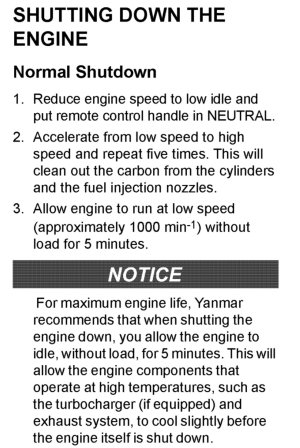
From the Yanmar manual ..

Screenshot_20250629_224238_Dropbox.jpg

I did a Sea Start diesel engine course earlier this year. They said 75-80% of max rpm should be used as cruising power.

This post from donkey's years ago also mentioned it Max revs and cruising revs

It is a bit of a generalisation but most diesel engines are designed to run continuously at between 75% and 80% of their max power. If your Perkins 225's have max 2500rpm then I would suggest 1900-2000 rpm for long continuous running (ie fast cruising). From memory the 225's were a modification of the original 135hp engines, rebored with turbo added to bring them up to 225 hp. So to generate 225hp at 2500rpm they are working quite hard already. Running at above 80% for prolonged periods may stress older engines more than necessary.
 
From the Yanmar manual ..

Screenshot_20250629_224238_Dropbox.jpg
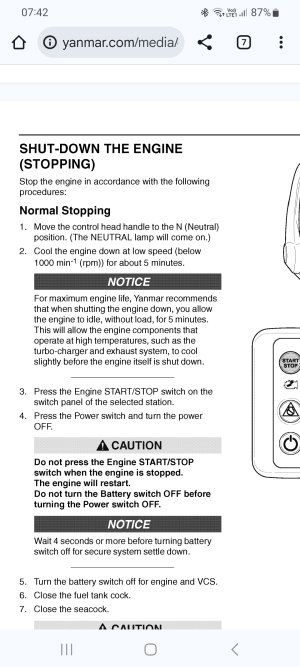
The "Shutting Down" procedure above was what was recommended for the 4JH3TE engines on my previous boat.and I've still been following it on my current boat with 8lv320 engines. However, having now checked the manual I see that step 2 no longer applies so I'll be omitting that in future. I'm sure I read that section of the manual a few times but I don't know why I missed that. Age?
 

Attachments

  • Screenshot_20250630_074220_Chrome.jpg
    Screenshot_20250630_074220_Chrome.jpg
    655.8 KB · Views: 5
6 to 8 thousand boats registered on the upper Thames.
Many of them diesels, many twins and many somewhat over powered for that max 8k speed limit.
Suspect thousands of hours run over many decades.
Boat builders getting rich on tales of engine rebuilds ?
Corrosion and lack of care, even lack of use far more likely to lead to the demise of any engine.

Very rarely do you spot a smoky diesel on the upper Thames.
On the other other hand , spend any time in coastal ports and watch a few boats do a cold start. ?
 
6 to 8 thousand boats registered on the upper Thames.
Many of them diesels, many twins and many somewhat over powered for that max 8k speed limit.
Suspect thousands of hours run over many decades.
Boat builders getting rich on tales of engine rebuilds ?
Corrosion and lack of care, even lack of use far more likely to lead to the demise of any engine.

Very rarely do you spot a smoky diesel on the upper Thames.
On the other other hand , spend any time in coastal ports and watch a few boats do a cold start. ?
Sitting on the fence here, since I've been in both environments and at one time with an engine at least 10x the necessary power for the inland waterways, but I would say two overpowered boats I had on the speed limited rivers, ran like a dream, however.........when I then ran them under high load on coastal waters, they showed up issues that had been hidden at low RPM..

So I do agree there is a lot of alarmist info out there about low rpm running, but it's not entirely cut n dry because the overall engine health may not present itself until that day when the engine is unleashed in its natural habitat.
 
I see a lot of comments about under-working diesel engines being harmful to the engines. My Yanmar 8lv320's max at around 3,600 rpm but I operate at around 1,350 rpm almost all of the time. I do give them a few blasts at max revs in neutral before I switch off, to minimise sooting. On longer runs, of a couple of hours or more, I run close to max for 10 minutes or so towards the end of the journey. At 1,350 revs the engines reach a max temp of 76⁰ after around 10 - 15 minutes. If I push the revs above 2,500 the temp goes to 78⁰. My cat will comfortàbly do 20kts+ but 7 -8 suits me, and I don't want to change. Is there any more I should be doing to show them my love?
I have read most replies - I believe the question is how much is low Rpm? My old VP61 I usually ran st ard 14-1500. After some years I stopped giving them a blast niw and then. When w sold they performed perfect (I did 2300 hrs)
Present mans i run at ard 1100. Only once in two years I was running 1800 for a while. If you want engines to run under more load then why full wot?? What about 80 pct
?
 
The Thames was and possible still is regarded by the denizens of the Mudway as a handy source of 1980 to 1990s mid range range boats, if the asking prices are a tad daft by those not residing in the streets paved in gold of the Thames valley ie. Henley and Windsor etc.
Usually with 40/41 or 60 series engines.
Have assisted in bringing not a few boats round from "Gods Personal Pond" to the "There be Dragons" of the Thames estuary.
Cannot recall any later problems ever regards bore glazing .
Do recall attempting to get a Thames based Fairline Brava 36 on the plane mid trip several times, fitted with a pair of those God awfull banshee wailing horrors Kad 42** *? , did try a the gentle up on the plane approach but finally floored the throttles and after some coughs and spluttering and enough black smoke to emulate a destroyer orf we went.
A dreadful engine for the upper Thames, at 8 knots its usually s series of lurches as the super chargers cut in and out.

Conking out mid voyage due to the sheer lack of filters last being changed sometime before Nelson or cooling systems clogged solid.....Yes

***Screeching electromagnetic clutches usually on their last legs entirely optional. :)
 
Last edited:
Couple of friends of mine (both mechs) had this debate in a pub years ago (albeit about cars) they both ended up agreeing that a cool down period is a good thing and spanking the engine from day one was also a good thing (at varying rpm)

Years later I watched a (top gear style) motoring show on Youtube that tested the running in thing! They got two brand new diesel cars, spanked one and carefully ran in the other. The one they spanked ran better and made more horsepower on the Dyno.

Wish I could remember the channel!

I have ridden motorbikes all my life and have given them the beans (full RPM on track) from day one and have never has an issue.

Has anyone here heard of an “Italian tune up” There is something in that too.
 
Couple of friends of mine (both mechs) had this debate in a pub years ago (albeit about cars) they both ended up agreeing that a cool down period is a good thing and spanking the engine from day one was also a good thing (at varying rpm)

Years later I watched a (top gear style) motoring show on Youtube that tested the running in thing! They got two brand new diesel cars, spanked one and carefully ran in the other. The one they spanked ran better and made more horsepower on the Dyno.

Wish I could remember the channel!

I have ridden motorbikes all my life and have given them the beans (full RPM on track) from day one and have never has an issue.

Has anyone here heard of an “Italian tune up” There is something in that too.
..........and one of them is still running . wonder which one :) ?
 
Top