
Engine on, battery isolator open

John67

New Member
Joined
25 Jul 2021
Messages
3
Visit site
Hi all,

Long time reader, first time poster here.

The wife and I were sailing in Scotland a few weeks ago on an old Westerly Fulmar.

Anyway to cut a long story short, we'd been crusing with the engine on for about an hour when I realised that the engine battery isolator switch had been set to open. I don't know when this occured as neither I nor the Mrs remember doing it.

I set it back to closed and the ignition panel lit back up and I was able to stop and start the engine a few times so there didn't appear to be any major issues, but I was wondering what potential fallout there could have been had I not caught it earlier.

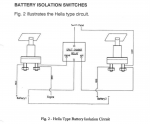
A diagram of the switch circuit is attached for reference, though my one o level in technical drawing isn't too much help to me here.

Could the alternator have been damaged (though it would still have been working to charge the domestic battery). Could I have been in danger of running the engine battery dry somehow?

Looking forward to hearing your thoughts.
Screenshot_20210725-192646.png
 
If both batteries had been disconnected from the alternator while the engine was running the alternator diodes might have been blown.
But while the split charge relay remained closed the services battery would have been connected and would have prevented any damage.
 
Hi all,

Long time reader, first time poster here.

The wife and I were sailing in Scotland a few weeks ago on an old Westerly Fulmar.

Anyway to cut a long story short, we'd been crusing with the engine on for about an hour when I realised that the engine battery isolator switch had been set to open. I don't know when this occured as neither I nor the Mrs remember doing it.

I set it back to closed and the ignition panel lit back up and I was able to stop and start the engine a few times so there didn't appear to be any major issues, but I was wondering what potential fallout there could have been had I not caught it earlier.

A diagram of the switch circuit is attached for reference, though my one o level in technical drawing isn't too much help to me here.

Could the alternator have been damaged (though it would still have been working to charge the domestic battery). Could I have been in danger of running the engine battery dry somehow?

Looking forward to hearing your thoughts.

View attachment 119519

Looking at diagram it is the original set-up, Powercentre ? We have come across your problem with isolator's mounted on battery box face under chart table seat, owners caught them with wet weather gear getting into or out of the seat, flipping one or both switches off. As the engine is running the split charge relay will be engaged, so the alternator is running connected to the service battery, so no problem.

Brian
 
With no battery connected to alternator which is spinning,essentially you will get no generating because there is no current available for the initial excitation. However in some cases the residual magnetism in the rotor can generate some output which is able to then supply proper current through the regulator to get to full charging. The regulator should then throttle back the field current and generation because there is no load.
This probably won't happen. Light aircraft with alternator had a placard saying "do not turn alternator off in flight except in emergency" They had a separate alternator switch (to field supply). The reason is that if turned off in flight the battery can be discharged to the point where you can not get alternator to charge again. So self excitation was considered unlikely.
As I read your circuit diagram the second battery will not be connected because it only connects via the VSR which will be open.
So no concerns if alternator seems to charge OK now. ol'will
 
Thanks for the replies so far!

I have a follow up question. My understanding is that once the engine battery was isolated and the ignition panel went off, there would have been nothing operating to discharge the battery.

However let's say there was and it was drained during this period. When the battery was reconnected the alternator would try to charge it but I'm under the impression that you can't charge a totally flat battery with an alternator.

I read 14.1 Volts across both the engine and domestic battery when both switches were closed which indicates to me that the alternator was working, however wouldn't I read that even if one of the batteries was flat and not charging up?
 
With no battery connected to alternator which is spinning,essentially you will get no generating because there is no current available for the initial excitation. However in some cases the residual magnetism in the rotor can generate some output which is able to then supply proper current through the regulator to get to full charging. The regulator should then throttle back the field current and generation because there is no load.
This probably won't happen. Light aircraft with alternator had a placard saying "do not turn alternator off in flight except in emergency" They had a separate alternator switch (to field supply). The reason is that if turned off in flight the battery can be discharged to the point where you can not get alternator to charge again. So self excitation was considered unlikely.
As I read your circuit diagram the second battery will not be connected because it only connects via the VSR which will be open.
So no concerns if alternator seems to charge OK now. ol'will

The switch must have been on initially, or the OP would not have been able to start the engine. This obviously means there was an initial excitation, the alternator was charging, the VSR was closed, but no damage would have been done (as others have said) because the domestic batteries would have been taking the charge.
 
Thanks for the replies so far!

I have a follow up question. My understanding is that once the engine battery was isolated and the ignition panel went off, there would have been nothing operating to discharge the battery.

However let's say there was and it was drained during this period. When the battery was reconnected the alternator would try to charge it but I'm under the impression that you can't charge a totally flat battery with an alternator.

I read 14.1 Volts across both the engine and domestic battery when both switches were closed which indicates to me that the alternator was working, however wouldn't I read that even if one of the batteries was flat and not charging up?

Question, how did the engine panel go off ? did it go off ?

It should have been supplied via split charge relay and aux battery.

If you had turned the isolator back on without stopping the engine, the alternator would have recharged the battery, ignoring deep discharge problem.

Brian
 
Question, how did the engine panel go off ? did it go off ?

It should have been supplied via split charge relay and aux battery.

If you had turned the isolator back on without stopping the engine, the alternator would have recharged the battery, ignoring deep discharge problem.

Brian

If the engine battery isolator was off, the panel would be off too.
 
In post #1 the Op states "I set it back to closed and the ignition panel lit back up" so the relay is either not working, or it is not wired to the load sides of the switches.

If you look at #1 the OP supplied a wiring diagram, engine and split charge relay module to output side of battery switch, this is how I told Westerly to wire it.

Therefore with relay engaged and engine running the control panel should be live via split charge relay. If it was dead as OP said then he has a wiring fault, iteeds looking into, the statement and diagram do not match, hense my comment.

Brian
 
I can confirm the panel was blank. It's what prompted me to go down and check the batteries.

It's possible the wiring has been changed from the original, but if so the po wasn't aware of it.
 
I can confirm the panel was blank. It's what prompted me to go down and check the batteries.

It's possible the wiring has been changed from the original, but if so the po wasn't aware of it.

Needs looking into, it could be wired to the battery side, which means it's perminently live 24/7, plus it cannot be isolated in a problem, electric fire in engine bay for example.

Let me know if you need the operating notes and wireing diagram for switch panel, assumming Powercentre.

Brian
 
Top