Engine battery charging from shore power. Or not…

Phil_boat

Well-Known Member
Joined
6 Jul 2025
Messages
102
Visit site
The charger on our boat was suspect (making funny noises, clicking on & off) so I’ve bought a new one to replace it.

My plan at the moment is to only leave the domestic battery plugged in on the charger long term.

My thought process is that a good battery with nothing discharging it should last for years with only alternator charging.

If I permanently leave the engine battery charging then the boat will always start BUT after say a night away from the marina with no shore power or even a day with a couple of different stops, then it might not start if the battery is getting suspect. And all that leaving it permanently charging will do is mask a weak battery.

Am I over thinking it?
What’s the usual way of doing things?

Cheers!
 
The charger on our boat was suspect (making funny noises, clicking on & off) so I’ve bought a new one to replace it.

My plan at the moment is to only leave the domestic battery plugged in on the charger long term.

My thought process is that a good battery with nothing discharging it should last for years with only alternator charging.

If I permanently leave the engine battery charging then the boat will always start BUT after say a night away from the marina with no shore power or even a day with a couple of different stops, then it might not start if the battery is getting suspect. And all that leaving it permanently charging will do is mask a weak battery.

Am I over thinking it?
What’s the usual way of doing things?

Cheers!
More common to have the engine battery on charge, lead acid batteries like to be kept charge. A battery can fail at any time, however it's charged, so have an alternate way of starting the engine. What boat do you have and what isolator switches.
 
More common to have the engine battery on charge, lead acid batteries like to be kept charge. A battery can fail at any time, however it's charged, so have an alternate way of starting the engine. What boat do you have and what isolator switches.

It’s a Merry Fisher 755 with a Suzuki outboard. I have a lithium jump pack kept on the boat just in case.

The isolators are a switch for common negative then 1 for engine & 1 for domestic.

I’d happily put another charger in for the engine battery if that’s the best way to do things. The other option would be to use the split charge VSR to do the job (once I’ve worked out how it’s wired).

Charge the domestics but have a combining switch so that if your engine battery weakens you can connect both and start

I had thought about this. Or just carry a short jump lead.
 
Last edited:
It’s a Merry Fisher 755 with a Suzuki outboard. I have a lithium jump pack kept on the boat just in case.

The isolators are a switch for common negative then 1 for engine & 1 for domestic.
The jump pack should get you out of trouble. You can also take all of the connections off of the negative switch and join them together with a terminal post, then connect a cable from the load side of the engine switch to the black switch and another from the load side of the domestic switch to the other terminal on the black switch. Paint the black switch or wrap it in tape, yellow is a good colour choice, put a label on it "emergency only".
I’d happily put another charger in for the engine battery if that’s the best way to do things. The other option would be to use the split charge VSR to do the job (once I’ve worked out how it’s wired).
If you have a VSR it should be charging both batteries, not matter what charging source you are using. But double check, in case its an older, single sense VSR. You can check using a multimeter, measure the voltage at each battery with no charging on, the switch the shore charger on and measure the voltages again, if the both rise the charger is charging both batteries, do the same check with the engine running and the charger off.
 
Why not just have a dual outut charger like I finally succumbed to ... Victron ?

I have both banks charged from mains .. they swap from charge to absorption to float .. etc ... fit and forget !

I have one one boat with the old 1-2-off switch .. works fine ... another on a boat with a relay that combines banks when engine running ... works fine ... another boat where I just have two batts with isolator switches each and no combine .. works fine ...
 
You can also take all of the connections off of the negative switch and join them together with a terminal post, then connect a cable from the load side of the engine switch to the black switch and another from the load side of the domestic switch to the other terminal on the black switch. Paint the black switch or wrap it in tape, yellow is a good colour choice, put a label on it "emergency only".

Had to read this a couple of times but I think you essentially mean permanently connect all the negative cables together as there's no need for them to be isolated and use the now redundant switch as the emergency? Possibly something for the future as I'd like to sort this mess out a bit at some point.

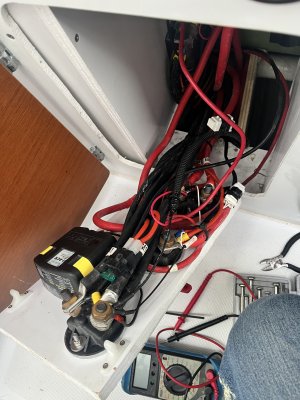
There's no fuses (that I've found yet) between the batteries and these isolators on a cable run of 2m+, so I think that's the first job.


IMG_5762.jpeg


If you have a VSR it should be charging both batteries, not matter what charging source you are using. But double check, in case its an older, single sense VSR. You can check using a multimeter, measure the voltage at each battery with no charging on, the switch the shore charger on and measure the voltages again, if the both rise the charger is charging both batteries, do the same check with the engine running and the charger off.

I did a bit of testing. Yes it charges both batteries when the domestic is being charged but only with the isolators switched on so it must be wired to the load side of the isolators. With the engine isolator off the batteries don't get combined.

It charges as expected with the engine running.
 
Why not just have a dual outut charger like I finally succumbed to ... Victron ?

I have both banks charged from mains .. they swap from charge to absorption to float .. etc ... fit and forget !

I have one one boat with the old 1-2-off switch .. works fine ... another on a boat with a relay that combines banks when engine running ... works fine ... another boat where I just have two batts with isolator switches each and no combine .. works fine ...

I've just added a Victron charger but I just went single as at some point I'll likely swap the domestic battery to Lithium so the dual output wouldn't work with mixed chemistries.

(I'll have to change the "dumb" VSR too).
 
Had to read this a couple of times but I think you essentially mean permanently connect all the negative cables together as there's no need for them to be isolated and use the now redundant switch as the emergency? Possibly something for the future as I'd like to sort this mess out a bit at some point.
Yes, exactly what i meant.
There's no fuses (that I've found yet) between the batteries and these isolators on a cable run of 2m+, so I think that's the first job.
Yes, fusing would be good.
I did a bit of testing. Yes it charges both batteries when the domestic is being charged but only with the isolators switched on so it must be wired to the load side of the isolators. With the engine isolator off the batteries don't get combined.

It charges as expected with the engine running.
I'd move it to the battery side of the isolators.
 
I once unexpectedly had a flat engine battery after demonstrating something to a visitor and forgetting to switch back to using the leisure battery. And yet we were on mains hookup with a charger that took care of engine and leisure battery. Investigating further I found that the leisure battery charges whenever we are plugged into mains and on the leisure battery setting on the 1-2-both-0 switch. The engine battery charged from mains only when the battery switch was set to both or leisure only.

I already had a NASA BM2 battery indictor on the leisure battery and really found it useful. To avoid further surprises with the engine battery I installed a Victron Smart Shunt. No cables and easy to install. Now `I check the engine battery from time to time and am reassured. One surprise was to find how quickly the engine battery charged after a start.

In summary, do consider adding a Smart Shunt so you know exactly what is young on.
 
In summary, do consider adding a Smart Shunt so you know exactly what is young on.

I have considered it. I'm trying to keep things as simple as possible and not get carried away with keep adding kit. I am easily persuaded.

I've got a BMV and other Victron kit in my van and it's great to keep an eye on things but we use a lot more power in the van. The boat has a fridge, 3 led lights and a stereo on the domestic side and apart from leaving the ignition on I shouldn't use any power from the engine battery.
 
I once unexpectedly had a flat engine battery after demonstrating something to a visitor and forgetting to switch back to using the leisure battery. And yet we were on mains hookup with a charger that took care of engine and leisure battery. Investigating further I found that the leisure battery charges whenever we are plugged into mains and on the leisure battery setting on the 1-2-both-0 switch. The engine battery charged from mains only when the battery switch was set to both or leisure only.

I already had a NASA BM2 battery indictor on the leisure battery and really found it useful. To avoid further surprises with the engine battery I installed a Victron Smart Shunt. No cables and easy to install. Now `I check the engine battery from time to time and am reassured. One surprise was to find how quickly the engine battery charged after a start.

In summary, do consider adding a Smart Shunt so you know exactly what is young on.

????

If you are on the old 1-2-both-off switch - why isn't the mains charger charging the battery that is switched on ? Seems strange to charge engine batt when BOTH or Leisure batt on ...

To be honest with the old 1-2-both-off switch - I prefer to have mains charger via a splitter that directs charge to whichever battery needs it .. regardless of the 1-2-Both switch. There are plenty of such splitters such as the KEMO online for small money.
To have to switch ON a battery isolator to get charge from the mains charger seems a bit wrong to me ..
 
Last edited:
????

If you are on the old 1-2-both-off switch - why isn't the mains charger charging the battery that is switched on ? Seems strange to charge engine batt when BOTH or Leisure batt on ...

To be honest with the old 1-2-both-off switch - I prefer to have mains charger via a splitter that directs charge to whichever battery needs it .. regardless of the 1-2-Both switch. There are plenty of such splitters such as the KEMO online for small money.
To have to switch ON a battery isolator to get charge from the mains charger seems a bit wrong to me ..
I agree, mains or solar charging should go straight to the batteries.
 
Phil-boat - your thinking sounds right to me.

The engine battery should stay charged providing there is nothing taking current. I leave mine (with its own isolator switch turned off) and it reads 12.7-12.8V after 2+ months at rest. The domestic batteries (no load but for the bilge pump) are left on a Smart Sterling charger. This tops them up, floats and then shuts down until their voltage drops. Most of the time the charger is off and monitoring. I can switch it to charge the engine battery alone if wanted. I will change the engine battery if it stops holding its voltage - last one lasted nearly 20 years.

I added a Victron battery monitor which shows me the voltage of the engine and domestic banks. I wish I had gone for the bluetooth model which captures history.
 
????

If you are on the old 1-2-both-off switch - why isn't the mains charger charging the battery that is switched on ? Seems strange to charge engine batt when BOTH or Leisure batt on ...

To be honest with the old 1-2-both-off switch - I prefer to have mains charger via a splitter that directs charge to whichever battery needs it .. regardless of the 1-2-Both switch. There are plenty of such splitters such as the KEMO online for small money.
To have to switch ON a battery isolator to get charge from the mains charger seems a bit wrong to me ..
Yes it is confusing and a strange setup. The combined mains distribution and charger unit was installed for me a very long time ago. It has charging outputs for two batteries I don’t know why the leisure battery charges in any switch position including off and the engine battery only charges when selected or on both. The thing is, it was only a problem once in over twenty years of use and now I can see what both batteries are doing.
 
Top