Engine descaling

Paul I use what is available anywhere called pool acid which is 30 % concentration hydrochloric acid here it's as cheap as chips don't know cost and availability in the UK

I us this for derusting steel and the removal of limescale on my prop etc

Correct ifi and wrong Rydlyme has 10% HCI and needs diluting 4 : Rydlyme do the pool acid would need diluting 12 :1
 
Last edited:
Paul, don't get too hung up about the concentration. Highly diluted HCl will descale but might take a little longer. Most domestic use HCl is 6% w/w (weight of acid in weight of water) and this will fizz scale off in about 5 minutes. When I do my toilet there is probably as much water in there as the 6% acid I use and it works rapidly with plenty of CO2 coming off.
 
Paul, don't get too hung up about the concentration. Highly diluted HCl will descale but might take a little longer. Most domestic use HCl is 6% w/w (weight of acid in weight of water) and this will fizz scale off in about 5 minutes. When I do my toilet there is probably as much water in there as the 6% acid I use and it works rapidly with plenty of CO2 coming off.
Thanks Vyv.
 
Thanks to all who replied. I've decided tyo go with the brick acid, found some online for £599 inc VAT for 5l.

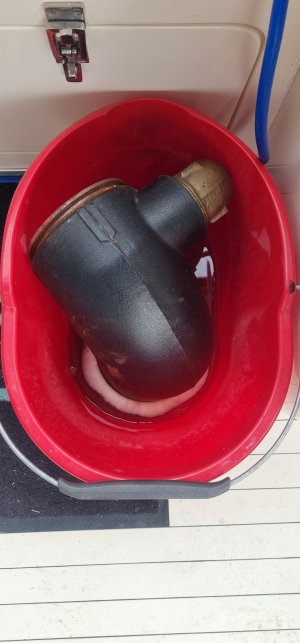
Had some in the locker for heads cleaning etc, so mixed some in a bucket to clean an exhaust elbow, the pic below is about 2:1 and it's fizzing well. Added some more water, to about 3:1 and it still fizzes well.

20240125_105101.jpg
 
I used vinegar to descale my engine - admittedly it was not in situ and partly stripped down, head being off. Blocked up all the water inlets/outlets to block & head and filled up with vinegar. Flushed out afterwards and it worked a treat
 
I used vinegar to descale my engine - admittedly it was not in situ and partly stripped down, head being off. Blocked up all the water inlets/outlets to block & head and filled up with vinegar. Flushed out afterwards and it worked a treat
Vinegar and other organic acids will work but take perhaps 50 times longer than HCl. We used to clean rust off metallurgical specimens with citric acid - it took all night.
 
Spirit of salts ( its usually around 20% hydrochloric acid ) also works wonders.
And extremely potent even when diluted . Should always be added to water and not the the other way around.
Really must be kept well out of the reach of children.
 
My raw-water cooled BUKH DV10 is 42 years old and I have owned it for 27 years.

I have never flushed it out, when laying up, with anything except fresh water.

Here is an extract from the Owner's Manual, and it makes no mention of any need to flush with any kind of acid. Nether does the Workshop Manual.

So I don't.

Can anyone explain to me why I should?


View attachment 171222
My DV20 is 46 years old. Over the past few years, flushing the cold water circuit with DS3 has become necessary - maybe once every 5 years. This to allow full throttle while keeping the coolant temperature below 70 C. The thermostats (I have a spare that gets swapped in every now and then) are supposed to regulate the coolant to 60 C but my motor runs a little higher. The only reason for the furring up that occurs to me is that this slightly higher running temperature is leading to deposits in the cylinder head and exhaust manifold that obstruct water flow. I don't use the flushing preservative oil, but I do flush with fresh water at lay-up and then drain down the system.
 
My DV20 is 46 years old. Over the past few years, flushing the cold water circuit with DS3 has become necessary - maybe once every 5 years. This to allow full throttle while keeping the coolant temperature below 70 C. The thermostats (I have a spare that gets swapped in every now and then) are supposed to regulate the coolant to 60 C but my motor runs a little higher. The only reason for the furring up that occurs to me is that this slightly higher running temperature is leading to deposits in the cylinder head and exhaust manifold that obstruct water flow. I don't use the flushing preservative oil, but I do flush with fresh water at lay-up and then drain down the system.

Why don't you fit a lower temp thermostat ??

When the 4-107 was put in replacement of my 4-99 - I elected to lose the heat exchanger as it had a small leak and I could see it failing even if leak repaired ...
So the Diesel Fitter and I agreed to take the thermostat out and run it colder ... luckily the 4-107 still pushes the water round the water channels unlike Yanmar which needs thermostat in place to control the bypass.
The engine was hose tested before fit .. and that was back about 2003 ... I have never descaled it - even though its age is pension age !! She runs like a sewing machine and pumps water like its going out of fashion ....
 
To hijack Paul's thread - any tips on how to circulate Ford Sabre engines as the makers forgot to add any useful high level attachments or fittings to assist with the flushing process. I routinely use sulphamic acid, but happy to use HCL brick cleaner.
 
My raw-water cooled BUKH DV10 is 42 years old and I have owned it for 27 years.

I have never flushed it out, when laying up, with anything except fresh water.

Here is an extract from the Owner's Manual, and it makes no mention of any need to flush with any kind of acid. Nether does the Workshop Manual.

So I don't.

Can anyone explain to me why I should?


View attachment 171222
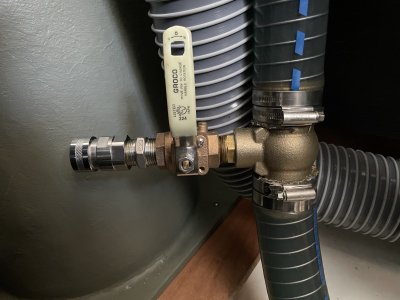
I agree with the freshwater flush approach, and have one of these valves installed between the raw water filter and pump to make it easy to leave it sat in freshwater rather than salt water..

2010679E-10EB-4581-85CF-0EC941925975.jpeg

More info here…

 
My home port is on a river, several miles upstream of the sea lock, in fresh water.

When I come in from sea, the engine gets an hour or so of flushing with fresh water from the river.

When I lay the boat up ashore I flush through with clean fresh water from a shore supply.

This is very easily done on my boat because all I have to do is unscrew the top of the Vetus strainer and pour water from the hose into it while the engine is running.
 
My home port is on a river, several miles upstream of the sea lock, in fresh water.

When I come in from sea, the engine gets an hour or so of flushing with fresh water from the river.

When I lay the boat up ashore I flush through with clean fresh water from a shore supply.

This is very easily done on my boat because all I have to do is unscrew the top of the Vetus strainer and pour water from the hose into it while the engine is running.

Opening top of water inlet when valve closed - is how I flush mine as well ... no need for buckets / pumps etc.
 
Forgive my ignorance but surely these acids cannot do the seals any good in the heat exchangers?
I have several charts and tables showing the degree of attack on elastomers and plastics by a huge range of chemicals. All agree that nitrile, EPDM and neoprene are not even slightly attacked by dilute hydrochloric acid. Prolonged immersion in the concentrated acid would be harmful but this is not going to happen.

Equally, very few metals are attacked by weak hydrochloric acid, zinc being the obvious exception. Just to be on the safe side it is better to avoid long exposure but the reaction between scale and acid is completed within a few minutes.
 
Top