Engine Beds - What Wood?

Is this on a GRP boat?
GRP over a foam core would be my choice, to get a mounting integral with the hull, with a no-maintenance wipe-clean surface.
Either bolt-on angle to take the engine mounts, or encapsulate a tapped ss plate.
 
Is this on a GRP boat?
GRP over a foam core would be my choice, to get a mounting integral with the hull, with a no-maintenance wipe-clean surface.
Either bolt-on angle to take the engine mounts, or encapsulate a tapped ss plate.

It is only a little lightweight 7hp and ply will be fine with mounts either screwed down or through bolted.
 
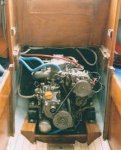
Photo of 1GM10 in Co26. An old photo before I added the SS strips to the top of the bearers. Most of the wood was planed away to get the 1GM10 coupling low enough for the existing prop shaft. The steps were moved forward about 110mm and I added the cross bracing at the front of the bearers in 18mm ply. All still good and solid after 25 years.
Engine.jpg
 
Photo of 1GM10 in Co26. An old photo before I added the SS strips to the top of the bearers. Most of the wood was planed away to get the 1GM10 coupling low enough for the existing prop shaft. The steps were moved forward about 110mm and I added the cross bracing at the front of the bearers in 18mm ply. All still good and solid after 25 years.
View attachment 74914

That's nice but ideally:
1) a wipe clean surface that doesn't retain any oil, no gaps for oil to sneak into, is a good thing. A clean shiny engine bay makes leaks obvious, reduces the smell of oil and diesel etc. That's why I suggested GRP not ply.
2) that piece across the front stops you taking the sump off the motor to clean it out, and stops you putting a tray under the engine when working on it to catch any spills. You can't have too much access to an engine?

OTOH, a little 'bulkhead that stops engine fallout from running into the main bilge is a great idea. Also one behind the engine, so any drips from the stern gland don't run under the engine, means you're wiping up three drops of oil, not half a cup of oily water.
 
Have been watching this thread with interest as am currently re-installing my Nanni N2.10 at present as it was not done particularly well the first time around, I am building up the beds with Iroko and capping them with stainless steel plate (wish I`d thought of the box idea, that Beta looks very smart) I'm going to nut and bolt the flexible mounts through the stainless by cutting small channels through the Iroko so I can get a spanner on the nuts.
The original bed are 1 2/4 inch marine ply glassed to the hull so the Iroko will be bolted on to them using stainless

Will keep you posted on how it all goes
 
Have been watching this thread with interest as am currently re-installing my Nanni N2.10 at present as it was not done particularly well the first time around, I am building up the beds with Iroko and capping them with stainless steel plate (wish I`d thought of the box idea, that Beta looks very smart) I'm going to nut and bolt the flexible mounts through the stainless by cutting small channels through the Iroko so I can get a spanner on the nuts.
The original bed are 1 2/4 inch marine ply glassed to the hull so the Iroko will be bolted on to them using stainless

Will keep you posted on how it all goes

See post#6. Much easier to use M10 stainless hex head lag bolts screwed into wood than use bolts. You just need to bore the pilot holes correctly and the screw portion cuts its own thread. Completely secure and easy to remove if necessary. Not sure of the value of a stainless plate capping. What are you trying to achieve with that?
 
See post#6. Much easier to use M10 stainless hex head lag bolts screwed into wood than use bolts. You just need to bore the pilot holes correctly and the screw portion cuts its own thread. Completely secure and easy to remove if necessary. Not sure of the value of a stainless plate capping. What are you trying to achieve with that?

+1. That's a perfectly adequate solution. There's nothing to be gained by over-complicating things.
 
Hi, tbh I'm quite happy with how I'm going to do it, when the mounts need changing it will be a doddle, she did originally have coach sxrews but they weren't stainless and if the wood thread strips as did happen with one of them its a pain, I know the stainless capping is a bit OTT but on larger commercial boats I've worked on the beds have always been capped with metal to spread the load so wanted to do the same but with no rust to worry about.
Was just posting to give the OP some more ideas.
 
Elm is not stable and will twist and warp with variable moisure. It is not very rot resistant unless kept very dry or contantly submerged (some wooden boats have elm planking below the waterline but not above.)

Www.solocoastalsailing.co.uk


Yep, as a teenager (early '70s) one of my jobs when working part-time in the yards in Burnham and Maldon was to keep certain boats wet when they were pulled out of the water. I'd been doing it for a while before I thought to ask why it was only certain boats and it was explained to me that some woods don't like drying out - elm was one of them. In fairness the other reason was that dodgy caulking might not like drying out and that turned a quick job that should last a few days out of the water at the most into a nightmare.
 
Right gentlemen, I'm shaping-up the new bearers which are two pieces of 18mm marine ply glued/screwed together and I have a plan of how this will sit in the boat.

Quick question though please; woven rovens or chopped mat for construction? I'm leaning towards the former as it looks stronger in its pre-wetted form but I don't really know.

Thanks for all your input. :)
 
Last edited:
CSM in my experience.

+1.
CSM is good for coping with awkward shapes.
Woven stuff is good for best strength on big simple areas.
Just get a good amount of glass in there.
Several layers of light cloth might be a bit neater, at a bit more cost.
Whatever you find easier to work with TBH, but heavy rovings will not be ideal IMHO.
 
Not sure why you need to glass them in at all. Just firmly attach them to the existing beds (I would use thickened epoxy and screws). Then coat the exposed ply with epoxy, particularly the edges. Slathering on GRP adds nothing.
 
FWiW when I built a FV, 8 metre 80HP, for the SFIA I had to use BS1088 WBP, totally encapsulated in GRP. OTOH, when I used it unclad for deck it wore away but never delaminated, the Marine ply did.
 
I have a steel subframe bolted to steel embedded the glass. I have seen several "installations" where coach bolts have been used to secure the engine mountings. In every case the coach bolts rotted and the wooden subframe was compromised. Mind you we are talking about OLD boats, here: ~ 30yrs+
 
Mine is 1976, the beds as far as I know are ply. The engine (135hp) was changed from four to six cyl in 1988, it is secured by large, say 16mm bolts, the beds are drilled with round horizontal holes in which are short pieces of round bar about 25mm dia, drilled and tapped across the diameter. I have no idea if this is original, I think not, but it remained secure through 26 years of my tenure and one engine change. The builder would normally have originally made foam beds with tapped steel on top glassed over.
 
I have a steel subframe bolted to steel embedded the glass. I have seen several "installations" where coach bolts have been used to secure the engine mountings. In every case the coach bolts rotted and the wooden subframe was compromised. Mind you we are talking about OLD boats, here: ~ 30yrs+

My boat is 53 years old and the engine is held down with M10 stainless coach screws through ply packing into oak. Totally secure and no sign of rot.
 
Thanks again, appreciate the suggestions. :)

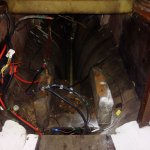
Here's a murky pic of half-stripped compartment. The existing beds will be cut down and the new ply sections epoxied/screwed down on to them. They'll extend outwards to the hull and so the CSM is to glass them up against the inner skin and make it all look neat. Tranona is correct though, the existing beds will take the majority of the weight.

IMG_20190105_120606.jpg
 
Thanks again, appreciate the suggestions. :)

Here's a murky pic of half-stripped compartment. The existing beds will be cut down and the new ply sections epoxied/screwed down on to them. They'll extend outwards to the hull and so the CSM is to glass them up against the inner skin and make it all look neat. Tranona is correct though, the existing beds will take the majority of the weight.

View attachment 75117

A superb wood for rot resistance, cheapness and availabilty is Keruing. It is used on the back of flat bed lorries due to its durabilty and load carrying capabilities. We made keel shoes for a catamaran from it. In 11 years of use there was no rot in the wood even though it had been underwater for most of that time. Experiments by a friend in a boat yard concluded it was the best wood for the job. Oak rotted out quickly in his tests. From my own experience even the best hardwood plywood isnt immune to rot.
 

Nice to see a photo.

I am sure you will be fine there. Now is a good time to inspect the existing bond at the root and add some mat if it looks iffy.

A tray under the engine is one of the best things you can add to an old boat, it can be as easy as splitting a 5 gall plastic oil drum or a more elaborate fabrication of timber and GRP. Worth thinking about.
 
Top