
Engine Bay Automatic Fire Extinguisher?

Tim Good

Well-Known Member
Joined
26 Feb 2010
Messages
2,888
Location
Bristol
Visit site
In the photos is HFC Hydrofluorocarbon fire extinguisher in my engine bay. It’s old but the pressure is still there. Assuming it may still work.

Looking to update. Would a like for like replacement still be the modern solution or are there other types which would be preferable?

The wires on it I assume are for a manual 12v activation but they’ve never been connected since I’ve had the boat.
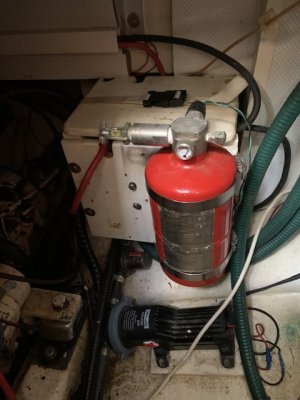
IMG_9326.jpeg
 
There are many types of safe agent fore extinguishers for engine spaces available. I fitted automatically activated bulb type safe agent extinguishers. It is important to select the correct bulb as they come with different temperature ratings i.e. if sailing in hot environments where temperatures are always high, go for the higher bursts point bulb.

When mine expire, I will be replacing with a mixed auto, manual trip clean agent extinguisher. If you don't go for the manual feature, then having the access port to poke a fire extinguisher hose through is a good idea. It is also a good idea, the hole, if the clean agent fails to extinguish the fire.

Basically, a google search will give you lots of options.
 
The wires on it I assume are for a manual 12v activation but they’ve never been connected since I’ve had the boat.

The wires on my engine fire extinguisher are not for manual activation, but (a) to switch on a warning light to let you know the fire extinguisher has been discharged (otherwise you might remain unaware); and (b) to stop the engine when the fire extinguisher goes off to avoid damage to the engine (my extinguisher is a dry powder type).
 
In the photos is HFC Hydrofluorocarbon fire extinguisher in my engine bay. It’s old but the pressure is still there. Assuming it may still work.

Looking to update. Would a like for like replacement still be the modern solution or are there other types which would be preferable?

The wires on it I assume are for a manual 12v activation but they’ve never been connected since I’ve had the boat.

View attachment 164161
This is what I bought a year ago FX1500GA
 
Hi,

The wires are for wiring to a halon cut out on an engine or indicator system for telling if the system has discharged.

Furthermore, if wired up it can be used to cut power to solinoids to stop fuel and air supply's as well as stop the engine.

For many it's a layer of complication they don't want, but it's often used in the American market.

The cylinder is good for 10 years, with annual Inspections, after that if would usually be more economical to replace rather than inspect or refill. It's probobly got more life in it than that though but you won't have a ticket for it if that matters to you.
 
If it is an HFC rather than Halon it remains perfectly legal - HFC 227EA is like most HFCs being phased down, but to have this in your current system is perfectly fine.

It is important to weigh the cylinder rather than relay upon the gauge. The fluid is a refrigerant in a saturated liquid with saturated gas under pressure, where it sits at its saturated temperature, or boiling point. Even if the cylinder were 95% empty if any liquid remains so would the relative pressure above the liquid, which is a function of its temperature rather than volume filled as liquid.

Whereas AFFF will effectively extinguish a fire if directed at the fire itself, gaseous extinguishers work by literally pyrolising around the flame, by actually burning and in doing so they immediately starve the flame of the oxygen it requires to sustain its fire. This is why these agents are far more effective as fire extinguishing agents. They just need to be in the space above a certain %, rather than finding the base of the fire directly.

They do produce some very nasty side products when pyrolised, and if the burnt product is drawn in to the engine they do not do that any good either. But they are very very effective in their primary role.
 
Top