Engine access importance?

slawosz

Well-Known Member
Joined
26 Sep 2018
Messages
625
Location
London
Visit site
Hi,
my Sadler has GM10 engine fully under cockpit floor. The access is terrible, there is removable panel on the side hatch (below cockpit wall) and around 20cm round access hatch in the cockpit floor. I know some boats has removable floor to access to the engine.
I wonder how important is good access to the engine? I wonder if I should remove the floor with epoxy laminated marine ply in the future so the access will be much better, especially underway?
 
I have occasionally needed to gain access to the engine while under way and there are some boats which would have put me in a fix if this had happened. I think that improving access if it can be done without compromising waterproofing or structure could be a good idea. I don’t know your boat but my Sadler 29 was fairly awkward, needing the removal of a heavy moulding for the steps to gain access. The upside was that the Volvo 2002 had all its service points at the front. My current boat is easier in this respect as the steps come in sections, and I can get to the water filter and dip the oil just by lifting a hinged step, but the sides of the engine are tight to bulkheads. I envy those with all-round access to engines, which they tend to get with centre cockpits on larger boats.
 
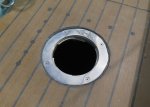
Most of the time as long as you can access oil filter, fuel filter, air filter, oil and water filler caps, oils and water drains this should be sufficient, My Sadler (25) has similar access, I have just installed a stainless steel circular waterproof hatch about the same size as yours in the cockpit floor, this has improved access to the air filter and gearbox without having to climb into the Port cockpit locker and reach through the side panel.
At some point (probably when changing the engine to a Beta 14), the previous owner had cut a larger hole in the cockpit floor and then fixed a 4mm thick aluminium plate to replace the cutaway GRP. The waterproof hatch I have installed is in the aluminium plate.
 
It's important. It's also the biggest weakness on my Catalac, as the engines are fairly tight against the saloon bulkhead, tucked under the battery box one side and the gas locker on the other, with a small access panel to just about get to the impellor. At least I can get to the couplings and stern glands easily. Lying on top of the engine, working at arm's length was pretty uncomfortable on my old Snapdragon.
 
What do you need to access underway? Can you remove the steps for front access?
The alternator belt and water pump are at the front so should be OK for access. The fuel filter is a bit of a stretch but with the correct C spanner you should be able to do it blind. If you have a good pre-filter the one on the engine should never get blocked.
Air filters on a small engine like that will never get blocked. Mine disintegrated and must have been consumed by the engine - now replaced with a non Yanmar one which should be better quality.
You would probably only check the gearbox oil once a season. When did you last check your car gearbox oil level?
That just leaves the stern gland and shaft coupling which may well give trouble underway. I think access to them is important if the only other way is to remove the engine.
I would be reluctant to cut any more access holes unless you are sure they can be made absolutely waterproof.
 
It is possible to instal remote filters and/or move existing filters so that their location is more accessible. Our MD2020s, we have 2, are located in the hulls of our cat and the hulls are very narrow. To change the filters I had to lie on top of the engine, as Stemar says - uncomfortable - and work 'upside down' - which meant when changing the filters it was very messy. I bought fittings, used in saloon car racing, to allow the oil filters to be remotely located. They are a simple spin on fitting (for the engine) with two fittings, to take spigots (as part of the casting) to accept extended hoses. As part of the kit you need another fitting for the filter itself (which I bolted to a bracket I made up from a piece of stainless to the side of the engine - there are lots of location to instal studs). You can do the same with the primary diesel filter, the one with the water trap, (as it is remote anyway). A place to start looking for the fittings for moving your oil filter might be Halfords (or equivalent) and I sourced the hoses from a chain of professional retail hydraulic hose suppliers. The threads for the fittings the same threads as for the filters themselves are pretty standard. It was not an expensive fix.

I wanted to have all my filters slung on a 'sort of' big bracket with a drip tray underneath - I never realised that ambition - but no longer need to lie on top of the engine for a prolonged period of time.

As mentioned you should really not have need to access anything else at sea - if you replace your impeller as soon as you see wear, and the air filter and belt should last for a long time. Checking the oil dip stick for both engine and sail drive is not difficult - even if a bit of a stretch.

Your most likely problem is stirring up gunge in the primary fuel filter in rough water.

Keep on top of regular servicing when the yacht is at rest - change oil and filters - and you should not have worries.

I don't know the GM10 but your water pump may eventually leak - if so you will need to replace seals - there have been a number of threads on Volvo water pump access, or lack of. But maybe the GM 10 is different.

Jonathan
 
The 1GM10 has quite good for access if you can get to the front easily.
Changing the oil filter is messy because the oil leaks out as you unscrew it.
The water pump is partly hidden behind the crankshaft pulley but accessible with a 7mm spanner for the cover plate. The Speedseal used to be a popular conversion when it was available.
1652282357542.png
 
One of the deciding points, apart from the excellent service one gets from Beta and their good reputation for reliability, for me choosing a Beta Marine engine when I re- engined my previous boat was the easy access to the water pump, although even then I changed the cover to a Speedseal, it also helped to make my decision to buy my present boat which is fitted with a Beta engine.
It seems to me to be a ’cardinal sin’ to have the water pump in an inaccessible position, the water pump on thecGM10 looks fiddly, but reasonably accessible.
 
Good access is important.

You need to be able to get at all the routine and predictable bits like filters, fillers, pump, heat exchanger etc. whether in harbour or at sea. But also for those investigative or one off checks and repairs like tracing an oil leak or checking gearbox linkage or oil level. Poor access makes it more likely that you or previous owners will put off doing checks and servicing.

Would I cut a hole to make it better? Yes if the access was truly poor and I could do it properly without compromising safety or interior finish.
 
In answer to the original question, our Sadler 32 has excellent access to the rear of the engine through the screwed down liferaft locker under the cockpit sole.

It has enabled me to service a leaking stern gland seal whilst dried out between tides, attend to the output shaft seal on the gearbox which had popped out as a result of the prop hitting some debris mid-Channel and dumping gearbox oil into the bilge, access and adjust the control cables to the gearbox following an engine change, and most recently, diagnose a bad connection to the engine stop solenoid.

Just off the top of my head...

Not all at the same time of course.
 
Thanks. Regular servicing is not an issue. Although changing engine fuel filter was a bit tricky. Its more about asking more experienced people about improvements I could make. I think I will as a surveyor after layup in the autumn.
 
Thanks. Regular servicing is not an issue. Although changing engine fuel filter was a bit tricky. Its more about asking more experienced people about improvements I could make. I think I will as a surveyor after layup in the autumn.
The Sadler 29 had almost the whole cockpit sole removable, with actually a cunning stowage for a dinghy, and full access to the rear of the engine, but not something you would want to do at sea. It is really the need to get a good view of the engine, sump, electrics, and cooling passages that you are likely to need on passage. I don’t know your Sadler 26(?) well enough but I would have thought that it was adequate in these respects, but access to the rear would be very useful if, for example, you wanted to deal with the prop shaft r, as we did on the 29, fit a Volvo stern seal.
 
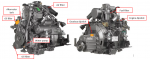
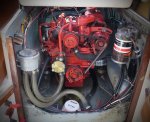
The attached photo’s show the Beta 14 engine access on my Sadler 25, as can be seen from the engine image the impeller housing is very easy access, the oil filter is also fairly accessible, the oil sump pump can be seen on the stbd side and reached from the front as can the fuel filter which is not totally visible behind the sump pump, the air filter is accessible from the front but not easy which is why I fitted the s/s access hatch. (S/S Hatch 1/2)
The photo S/S Hatch 3 gives an idea of the additional access gained, which simplifies air filter access as well as the gearbox dip stick and filler.

Engine Installation .jpg S:S Hatch 1.jpg S:S:Hatch 2.jpg S:S Hatch 3.jpg
 
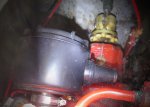
Thanks @Praxinoscope. What is this device on the left, that is connected between seacock and water pump?
I like the idea of having seacock close to the engine. In my case, its under the starboard bunk.
 
Hi slawosz
The grey plastic thingy is a Vetus water filter, it’s a good idea to have a raw water filter in the system, you never know what can enter the system through the raw water inlet, there are several types on the market, the Vetus one sees popular, my only criticism of it is the screw on ‘lid’ can be a swine to unscrew if you want to clean the filter. Silicon grease on the threads helps but unscrewing the lid seems to a common problem.
 
That is a water filter. Very useful - for example you can run the engine ashore by shutting the seacock and pouring water into the filter with the cap off, Even better if you can site it immediately above the secock so that you can rod through if it gets blocked - the filter bowl is above the waterline. not always possible but when I re-engined my boat with a 1GM I managed to achieve that.
 
My last boat had a massively oversized raw water filter with a glass cover secured with 6 set screws. (The previous owner had a mate who worked for Sunseeker). It was a bit OTT but there was no problem unscrewing the lid!
 
1GM on a Trapper, OK from the front, but a pig with anything aft. Cut a hatch in the quarter berth to access the g/box and anything on the port side. Cockpit locker gave access to stb side, but not comfortable at all. Swopped it for a 1GM10 because of bore corrosion in the1GM.

I did get a call from someone that I had serviced an engine for. Drifting near Lisbon and engine wouldn't start in his Westerly. I gave him how to jump it direct to the starter. But he couldn't reach it in the tight engine bay. VP unit with an odd earth cable to the alternator that let go. Invisible unless you pulled bits off the engine . He got a tow.

To add, best was our company yacht. Big ketch with 2x 140 hp Detroit Diesels + genset. Under the main saloon, but you could do most jobs all around the donks with short head room. If more important, the floor of the saloon was two big hatches that came out. So full height.
 
Last edited:
Our Bavaria 44 has loads of space around the engine so I am fortunate in that respect. However, if you think sailing boats are bad for access, try a motorboat from Princess/Fairline/Sealine etc.... It's criminal how bad the engine access is on these boats. The Sealine I had was difficult but doable, but the Fairline was insane. Getting filters off which were the size of buckets, had to be achieved with one hand! The raw water pumps were about 2 inches from the bulkhead. Changing the impeller was easier if you removed the pumps. Removing the pumps was far from easy.

I would be very reluctant to buy a boat now, if the engine access was nearly impossible to service.
 
Top