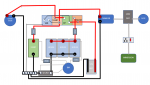
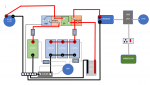
Electrics

It is not usual to fuse the alternator output. If the fuse blows the alternator diodes will very likely fry.

You can certainly wire the charger to the starter battery, and with the BEP DVSR that appears to be how you have to do it. The VSR will then charge the house battery when the starter battery has been charged to a specified level.
My thoughts were if the VSR was dual sensing the charger ( and solar charging) could charge the house battery as their first priority, the VSR switching in the starter battery when the house bank reaches a certain level of charge. However its not dual sensing so the starter battery will be the first priority for any charging system.

The VSR is dual sensing.
 
35mm cable will be fine. Use it for connecting the batteries together, from the batteries to the isolator switch and from the engine isolator to the engine, plus all relevant negatives. You need to use it to go to the domestic switch, in case you want to start the engine from the domestic bank, for the same reason the domestic bank fuse must be rated accordingly.

Forget about calculating the draw of the starter motor, that's just nonsense. You are not protecting the starter motor, you are protecting the cable, 35mm cable is rated at 240a, so fit 240a fuses to both battery banks.

Fit cable from the domestic bank capable of carrying the combined loads that it needs to carry, plus a bit. Fuse this cable close to the domestic isolator, with a fuse rated for the cable. Don't waste time trying to work out the loads the fuse will need to protect, rate for the cable. Individual fuses further upstream will be rated for individual loads.

As you have a dual sensing VSR connect the alternator to the engine battery and the mains charger and/or solar power to the domestic bank, the VSR will take care of the rest. As the VSR is dual sensing it might seem irrelevant, but connecting the alternator to the engine battery means the engine battery gets charged if the VSR fails.

Do not fuse the alternator.

Alternator connection, two choices.
More often than not the alternator cable is connected to the battery cable at the starter motor solenoid. If left there it will charge the engine battery and the VSR will allow it to charge the domestic bank. If you ever need to use the emergency switch, in the event of a starter battery failure, with the battery isolator turned off, the alternator will not charge the domestic bank.

The alternative is to run a new cable from the alternator output to the load side of the isolator switch. This would allow the alternator to charge the domestic bank directly, if the engine battery was isolated and the emergency switch was closed.

The BEP cluster is connected poorly. Remove the connecting strips and make two short interconnecting cables. Connect one cable to one terminal of the emergency switch and to terminal B, the other to terminal D and the remaining terminal of the emergency switch. The difference between this method and the BEP connections is that you can isolated a faulty battery and run everything from the good bank via the emergency switch.

PVB is correct that you will need a negative to the VSR. This should be shown in the BEP instructions.
 
The VSR is dual sensing.

I though it was but everything I read seemed to imply otherwise.

As you go on to explain this allows the solar and/ or shorepower chargers to be connected to the house battery bank as I had been suggesting.
 
Loads of useful info, thanks. I have found the negative connection for the VSR, for some reason it is a fine light grey line rather than the heavy black all the other negative connections are shown as. I need to have another think and minor redesign :)
 
I though it was but everything I read seemed to imply otherwise.

As you go on to explain this allows the solar and/ or shorepower chargers to be connected to the house battery bank as I had been suggesting.

The information on the BEP site did suggest it was single sensing, as you say, but the actual spec sheet says

"DVSR Operation Explained - Charging: The DVSR is connected
between two battery banks. When the DVSR senses a charging
voltage (13.4VDC or 26.8VDC) on either of the banks, it automati-
cally activates and joins the two battery banks after a short delay (5
seconds), so they are charged as one battery bank."

Nice to see them say "senses a charging voltage", rather than the usual incorrect blurb about it waiting to charge one bank before closing.
 
Your diagram doesn't show the negative connection for the VSR. It won't work without the negative connection.

You don't need a fuse in the alternator output - the battery fuse will cope if there's a fault.

I'd suggest a 250A or 300A MegaFuse next to the starter battery, and a 150A fuse next to the house battery (unless you're going to be connecting any high-current users such as an inverter, windlass, etc).

I'd suggest that if the house battery fuse is too small to run the starter motor, you could simplify things by binning all the emergency start stuff?
 
I'd suggest that if the house battery fuse is too small to run the starter motor, you could simplify things by binning all the emergency start stuff?

Better to fit the correct fuses.

Between the batteries and switches = cable rating. Between the domestic switch and busbar/panel/whatever = cable rating, thereafter = cable rating/device load as appropriate.
 
A cautionary word on shunts. The NASA BM1 is supplied with a 100 amp shunt and looks very light weight. I personally would not want my engine to be connected to one of these. If the shunt fails, and they are well known for it, not only do you lose the electrics, you lose the engine too. I would connect the NASA shunt as shown in the OPs second diagram. You lose the input from the alternator, but that only affects the SOC readings anyway.

If you use a battery monitor with a higher rated shunt then looking at the OPs second diagram, move the engine battery negative from the busbar to the left most domestic battery.

By comparison, the Victron BMV 700 battery monitor is supplied with a hefty 500a shunt :encouragement:
 
Personally and I know this will annoy Paul, I think the entire set up is far too complicated for a single engine set up. A decent calibrated voltmeter on each battery bank will give more than adequate information about battery state of charge, so bin the BM1 (had one once, it lasted barely two seasons, and never showed me a reliable report of the battery charge status) and its shunt, you can add an ammeter into the domestic feed if you want to monitor consumption. Then bin the VSR and use a decent Off - 1 - Both - 2 - Off switch, contrary to the opinion of some, they do exist.

Then form a rigid habit of selecting 1 for domestics only then Both when the engine is running. Spend the money saved on a decent two channel battery charger. Also when the selector is at Both a simple cross check of the VMs should show identical readings. I always fit a low amp fuse to the +VE to the VM. Should a meter become faulty this prevents a fire risk short circuit developing.
 
I am going to have multiple users of this boat so relying on the user to understand a 1/2/0 switch is not a good idea in my opinion. I am very much of the opinion that system should be designed to take the inevitable human error out of the equation
 
Then form a rigid habit of selecting [...]

In post #33 the OP said: "a systems approach to risk means you don’t rely on the user to maintain or inspect." I imagine his attitude to the system's effective operation relying on "rigid habits" of the user will be similar, and rightly so.

Machines are notoriously good at rigid habits, let's leave it to them.

Pete
 
I am going to have multiple users of this boat so relying on the user to understand a 1/2/0 switch is not a good idea in my opinion. I am very much of the opinion that system should be designed to take the inevitable human error out of the equation

When you are lending out your boat, you need a system that is not only simple to use, but also simple to explain how it works.
A colleague of expressed it as 'imagine explaining it to your Mum over the phone'.

Some boats, it's not remotely obvious whether turning off the battery isolators disconnects the shore power charger and/or solar from the battery.
That sort of thing is not ideal if other users are left wondering how to leave things set when they leave the boat.

On the one had you have people who have been brought up with leaving the batteries isolated when they leave the boat. So charging needs to go around that.
On the other hand, there is the school of thought that the battery isolator is there to isolate the battery. Completely.
Then there is a 'middle way' where the isolator is only bypassed by something with a low value fuse, like trickle charging or a Navtex receiver.
 
Personally and I know this will annoy Paul, I think the entire set up is far too complicated for a single engine set up. A decent calibrated voltmeter on each battery bank will give more than adequate information about battery state of charge, so bin the BM1 (had one once, it lasted barely two seasons, and never showed me a reliable report of the battery charge status) and its shunt, you can add an ammeter into the domestic feed if you want to monitor consumption. Then bin the VSR and use a decent Off - 1 - Both - 2 - Off switch, contrary to the opinion of some, they do exist.

Then form a rigid habit of selecting 1 for domestics only then Both when the engine is running. Spend the money saved on a decent two channel battery charger. Also when the selector is at Both a simple cross check of the VMs should show identical readings. I always fit a low amp fuse to the +VE to the VM. Should a meter become faulty this prevents a fire risk short circuit developing.

I 'sort of' agree with this, but OTOH, the 'requirements' seem to have got quite complicated too, in an ill-defined way.

There are an awful lot of people out there who don't understand how their own boat is wired.
 
When you are lending out your boat, you need a system that is not only simple to use, but also simple to explain how it works.

True. I don't lend her out, but I don't think the explanations for mine could get any simpler.

"The battery switch is in the base of the port settee. Turn it on when you arrive at the boat, turn it off just before you leave."

Pete
 
True. I don't lend her out, but I don't think the explanations for mine could get any simpler.

"The battery switch is in the base of the port settee. Turn it on when you arrive at the boat, turn it off just before you leave."

Pete

Exactly. My boat (with factory installed wiring) has 3 isolators. One in the aft cabin next to the fuel shut off valve for the engine. One under the chart table near the switch panel and domestic circuit board for domestics and one in the forecabin for the bow thruster. The battery charger works independent of the isolators.

Seems simple and logical to me.
 
Personally and I know this will annoy Paul, I think the entire set up is far too complicated for a single engine set up.

It doesn't annoy me, but i am disapointed that you can't see the simplicity of having separate circuits rather than the 12B switch. Particularly when you advice changing a system to a 12B setup.

A decent calibrated voltmeter on each battery bank will give more than adequate information about battery state of charge, so bin the BM1 (had one once, it lasted barely two seasons, and never showed me a reliable report of the battery charge status) and its shunt, you can add an ammeter into the domestic feed if you want to monitor consumption.

I agree that the BM1 is not great, the one on the boat i just did the partial re-wire on was reading a .2a discharge, when the only thing on was the BM1 :confused: I would not connect the engine neg to the BM1, the shunt is not up to it IMO.

I'm happy with a volt meter for the engine battery, but i like my Victron battery monitor on the domestic bank. I don't so much use it for SOC, but i like to be able to see amps in/out and it includes voltage alarms and a relay that automagically switches my mains charger on if the batteries get low (mains charger is off by default in the Summer and the solar panels take care of charging). By the time you've fitted a shunt and ammeter you may as well fit a decent battery monitor.

Then bin the VSR and use a decent Off - 1 - Both - 2 - Off switch, contrary to the opinion of some, they do exist.

Oh dear :ambivalence:

Then form a rigid habit of selecting 1 for domestics only then Both when the engine is running. Spend the money saved on a decent two channel battery charger. Also when the selector is at Both a simple cross check of the VMs should show identical readings. I always fit a low amp fuse to the +VE to the VM. Should a meter become faulty this prevents a fire risk short circuit developing.

Why not have two separate circuits, get into the habit of switching on when you arrive, off when you leave, that's it, nothing else. No faffing around changing switch setting when you're underway or any other time. Arrive at boat, turn on, turn off as you leave.

What money will you save ? Let's look at some real World figures :

BEP 12B switch £76.60, Sterling 30a 3 output charger £276.95 = £353.55

3xBEP isolators £75, Victron VSR £42, Victron 30a single output charger, £155 = £272

Oops !
 
Top