Electrics

When you are lending out your boat, you need a system that is not only simple to use, but also simple to explain how it works.
A colleague of expressed it as 'imagine explaining it to your Mum over the phone'.

Some boats, it's not remotely obvious whether turning off the battery isolators disconnects the shore power charger and/or solar from the battery.
That sort of thing is not ideal if other users are left wondering how to leave things set when they leave the boat.

On the one had you have people who have been brought up with leaving the batteries isolated when they leave the boat. So charging needs to go around that.
On the other hand, there is the school of thought that the battery isolator is there to isolate the battery. Completely.
Then there is a 'middle way' where the isolator is only bypassed by something with a low value fuse, like trickle charging or a Navtex receiver.

My thinking is this, when you leave to boat you turn the isolators off, so you know everything is off. Nothing is using power and the plotter isn't likely to catch fire if it fall apart inside. But, the plotter is fused anyway, so unlikely to happen, better safe than sorry though :)

We leave some things on, maybe the bilge pump or the radio memory, but they'll be fused anyway.

So, with the isolators off we need to have the mains charger and solar controller connected to the batteries or the battery terminals of the isolator (often makes for neater wiring). But these should be well fused. The charger will have it's own fuses and i fit a fuse at the battery end of the wiring. Same with the solar controller, a decent one has its own fuse and the battery end should be fitted with a fuse too. So, no reason not to leave the chargers on all of the time, irrespective of switch position, one less thing to tell the crew about.

My instructions would be word for word of Petes "The battery switch is in the base of the port settee. Turn it on when you arrive at the boat, turn it off just before you leave."

Not that there's a cat in hells chance of anyone borrowing my boat :boxing:
 
It seems to me that most cruising yachts these days have a significant number of circuits which want to be permanently live when the 'main switch' is 'off'?

I'm not familiar with all the up to date standards, but to comply with BSS, all electrical systems must be capable of being quickly isolated from their power sources in an emergency.
Does that mean that an isolator which isolates the battery from e.g. permanent live connection to eberspacher, battery charger is required?

This is really a different function from the 'main switch you turn off when going home to Surrey'.
 
It seems to me that most cruising yachts these days have a significant number of circuits which want to be permanently live when the 'main switch' is 'off'?

I'm not familiar with all the up to date standards, but to comply with BSS, all electrical systems must be capable of being quickly isolated from their power sources in an emergency.
Does that mean that an isolator which isolates the battery from e.g. permanent live connection to eberspacher, battery charger is required?

This is really a different function from the 'main switch you turn off when going home to Surrey'.

Apart from a radio memory feed, and maybe a bilge pump, I can't think of a significant number of permanently live circuits. And, anyway, most cruising boats don't need to comply with BSS.
 
Radio memory feed is a good point. Last boat I sorted out the radio on, the 'permanent feed' could draw 10A.
Most car audio does not have a low power feed specifically for the memory.
The battery is either isolated or it isn't.
 
Radio memory feed is a good point. Last boat I sorted out the radio on, the 'permanent feed' could draw 10A.
Most car audio does not have a low power feed specifically for the memory.
The battery is either isolated or it isn't.

Both the car radios I have fitted had a separate power feed for the memory, just as they need in a car. Otherwise, as in a car they would lose all settings when the power is turned off.

In the boat I wired I put in an "always on" box with 3 circuits for items such as bilge pump, radio memory and VHF
 
It must have had a massive memory!:D

No, the permanent live is the main supply.
It means the switched supply does not draw 200W for 'da bass' through the ignition switch (or some terminal of the body computer?).
I forget what brand it was. But not IIRC a 'marine' model.
 
No, the permanent live is the main supply.
It means the switched supply does not draw 200W for 'da bass' through the ignition switch (or some terminal of the body computer?).
I forget what brand it was. But not IIRC a 'marine' model.

you should have had a thin yellow cable for the memory unless it is a very old unit. You can power it with a miniature 12v battery if you dont want the memory to be powered by the main battery.
 
I used to leave the mains charger connected to the batteries, but horror stories on here of batteries being fried by defective chargers means I always isolate the batteries when leaving the boat. A few very low current permanent connections won't harm the batteries - or be potentially dangerous.
 
E66DFE4B-2A91-49BA-88AD-74A7D24881F5.jpg

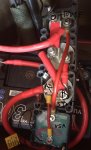
THe switch cluster. It is hard to fit all the wiring in! I hope I now have it so that the alternator charges the start battery and then the VSR parallels. I have a 240v charger on the house which should also parallel through the VSR. To start turn on start. To join all banks turn on all switches. To start through the house bank turn on house and emergency parallel.
 
View attachment 71447

THe switch cluster. It is hard to fit all the wiring in! I hope I now have it so that the alternator charges the start battery and then the VSR parallels. I have a 240v charger on the house which should also parallel through the VSR. To start turn on start. To join all banks turn on all switches. To start through the house bank turn on house and emergency parallel.

If (as it looks) A and C are the battery connections, then it is wired correctly and will work as you hope. Neither charging input will fully charge the bank to which it is connected before the VSR closes, it will close pretty much when the charging input reaches the "trigger" voltage, but that's normal for most VSRs.
 
It is as you say, thanks
It was interesting to alter the standard cluster as advised on here and I think it is better. The standard way it is wired means that if you want to use the house bank to start the only way is to parallel it with the start bank where as the forum way allows you to isolate each battery individually or join them together.

I had to put heat shrink on to the joining bar that is used because it gets very close to the cable terminals when wiring the forum way but I suspect this would be good practice anyway.

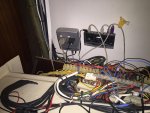
Now it is on to the spaghetti in the panel above!
 
Top