Electric inboard

Hacker

Well-Known Member
Joined
4 Nov 2015
Messages
1,211
Location
Falmouth
Visit site
Has anyone here fitted an electric inboard engine? We were discussing engine options for an 18ft Devlin Shrimper. Easiest option is an outboard, however putting a diesel inboard (or indeed a petrol inboard) were also possible options. I was interested in possibly completing the boat and would rather have an inboard that is quiet. If anyone has installed one a) what was the overall cost (engine, batteries, etc) b) how did you maintain charging; is it possible to use solar to keep the charged?
 
I've fitted a 24v 100lb outboard to my 27ft broads sailing cruiser (approx 3 tons disp.)
I get 3 kts with no wind against which is ok for me to go almost silently in the river.
I've got 6 85 AH AGM batteries which give about 5 hours run time.
Charging by 20 A mains battery charger.
The outboard is rated at about 45A so a 100 w solar panel would take on average about 4 to 5 days to charge for 1 hour motoring.
 
As stated above, loads of info, costs and links here .... Sailing Uma— ELECTRO-BEKE

When I did a repower on my Bavaria 36 I did briefly flirt with the idea of fitting an inboard electric - advantages are clear, quieter, simpler, no vibration and no fuel filters, no water contamination, no service headaches, no rusting exhaust elbows or diesel bug to worry about.

Unfortunately, once I had costed it up it was close to €15K for the saildrive (shaft drive is cheaper) and another €20K for a 48V 500Ah Lithium Ion battery. I wasn't too pleased with the range and there was not enough room on the boat to make solar charging of something this big a viable option, and I felt I needed to do a lot of sailing to recuperate energy too - we sometimes get really crap weather where I motor-sail into waves and headwinds on autopilot at around 6 knots for hours on end and I didn't want to have to tie myself to a serviced marina berth at the destination to recharge a heavily depleted battery - if I made it at all - fighting a headwind or a tide with an electric motor is not for the faint hearted, it drops the range to tens of nautical miles where my diesel will keep going at 6 knots for around 30 hours.

I do think it will go electric eventually, and for someone who motors out of a harbour and then sails all day (like in the olden days of true auxiliary engines on sailboats), I believe it is a viable option if that is your style, but right now for me, recharging is too time consuming in comparison to refuelling (AFAIK there is no marine equivalent of a fast charger unless you hook up to a super-yacht berth) and the costs are still eye-watering. My diesel re-power cost almost 1/4 of an electric system.

You can cut the cost by using AGM batteries instead of Lithium but you can't discharge as deeply and lifetime is reduced considerably if heavily used.

So I'm still diesel for the time being - range, cost, and recharging time being the main reasons - but I have an engine which I do often use as the main source of propulsion for hours on end.
 
I have no love for internal combustion engines but my diesel has a nominal range of 72 hours, though the most I have used is about forty. It would have been nice to have escaped the noise for this duration but it will be a long time before electric can compete. For short inland use and those who only use power to move from their berths, electric power could work, but for such a short time the advantage of quietness will be less of a factor anyway, so economic considerations will surely govern the market.
 
It’s the recharge problem that stops me, followed by range and then cost. If I have a 300 mile trip I want to do, with anchorages at the end of it and little wind forecast for the next week it wouldn’t work.

As others have said, the technology is already there for day sailors from marinas, and I have enough solar to run all electrics for as long as I need, providing there is enough wind to sail but windless passage making and avoiding marinas stops it being viable even if battery technology becomes ten times better.
 
As implied above, it's all about power density. A 100 Ah 12V battery stores (at MOST) 1.2kWh of energy; 1 litre of diesel contains 10kWh! A litre of diesel weighs about a kg (rather less), and a 100Ah battery will weigh perhaps 30kg. Even allowing that the conversion of diesel to useful energy is only at the 20-30% mark, that means that 1 litre of diesel weighing a trivial amount will push your boat far more effectively than a 100 Ah battery. even if we assume the 100Ah batter's energy can be used with 100% efficiency (which it can't). And we can all carry a LOT more than 1 litre of diesel.

Basically, electric power is still a niche thing and looks like continuing to be so for a long time. battery technology is improving but it has a LONG way to go before it reaches the energy density of fuel-based systems. I'd be looking at fuel-cell technology in the medium term; there are rapid developments happening there which may result in versatile and efficient fuel cells being available in the 5-10 year time-frame. Don't ask me more about that; I am privy to information under non-disclosure terms.
 
When we were thinking of building new Anderson 22's - about 20 years ago - I was very keen to see if we could fit an electric inboard ( normal fit is an outboard in the cockpit well, already far preferable to a transom hung outboard for this size boat ).

I had some serious chats with boffins from Torqeedo - sadly the gist of it is, it won't suit a boat with shallow bilges and a high aspect ratio keel,

One still has to carry a massive load of batteries, apart from cost it would probably suit a traditional wineglass section hull , using batteries as ballast - charging would be slow even with lots of solar panels and wind generator/s so maybe a small internal combustion engine as a hybrid - ideally with the ability to propel the boat as well as charging.

The technology hasn't really moved on much, one still ends up with what's basically a U-Boat.
 
I met someone doing the atlantic crossing in La Palmas that had an electric setup installed. They couldn't motor for days but that wasn't their style. The saved the energy for when they really needed it. Has a huge bank of Lithium.

Once in place it was very easily to connect up apparently. Much quieter and cleaner clearly. I can't remember how long they said they could motor for but about 10 hours I think at around 6kts. Masses of torque. They had perhaps 1200w or solar and then two windvanes. They cooked on induction.

This is what they said:

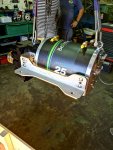
"After some research into the market we went for the Bellmarine’s TorqueMaster 25 Pro. That is 25kw, 96 volt. There’re a few things with this el-motor that stood out from the rest of the manufacturers and enough to catch our attention. Firstly, it can run on 800 RPM to meet the propellers needs. It’s been around for some years now and are installed in the many ferries sailing on the canals of Amsterdam. It’s robust, it has IP66 standard, are water cooled and are incapsulated in stainless steel. The only maintenance needed is a bit of a dust cleaning. Most importantly; the el-motor will have enough power to get us out of dangerous situations."

IMG_20181030_112657.jpg

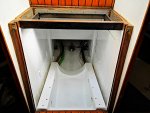
IMG_20181026_130024.jpg

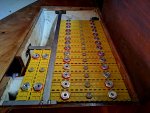
IMG_20181011_142301.jpg
 
...for someone who motors out of a harbour and then sails all day (like in the olden days of true auxiliary engines on sailboats), I believe it is a viable option if that is your style...

I'm probably alone in wanting that to be my style. I'm not sure the advance from dinghy sailing is very appealing, if the freedom to use auxiliary power almost inescapably leads to a significant proportion of overall distance covered, habitually being motored.

It may be obvious to say that yachtsmen sailed more when they couldn't motor, but isn't it probable that the acute senses necessarily honed over time by the chaps who didn't have (or really couldn't trust) auxiliary engines, are less well used today, even though the sailing performance of modern yachts would have made their lives far less challenging?

The best thing about electric power (apart from the silence) might be its very limitations.
 
Top