Ian_Edwards
Well-Known Member
My Eberspacher Hydronic 10 stopped working, the controller worked, but nothing happened at the heater. It was working OK last time I used it, and ran for about 3 hours, and appeared to shut down without a problem.
The heater runs 3 matrix heaters and there's a heat exchanger coil in the calorifier.
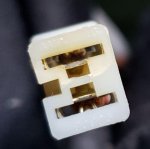
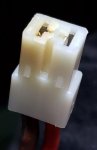
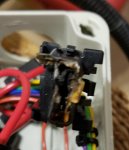
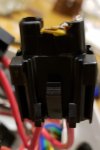
On investigation, which isn't easy, the heater is under the cockpit and mounted on the transom, and requires dismantling bits of boat to gain access, I found a melted fuse holder, the centre one of 3 fuse holders and the negative terminal on the main power supply a little scorched (last 2 photos).
I'd recently checked the current drawn using a DC clamp meter with the following results:
I can't see the first few seconds of the start-up sequence, it takes a while to press the button on the controller and get back to the clamp meter.
Battery voltage 14.5v, absorption mode.
initial burn 6amps
winds up to 10 amps as the fan winds up.
jumps to 18.5amps when the 3 matrix heaters kick in.
Dropped back to 13.8amps after about 5 min.
switching aft matrix heater off, drops to 11.5 amps
switching forward matrix heater off drops to about 9 amps, then reduces further as the thermal load reduces and the fan winds down
switching mid matrix heater off drops to 3.5amps.
switching aft matrix on 6.5amps
switching forward matrix on 9 amps
switching mid matrix on 10.75amps, increasing to around 13.5 amps as the heater ramps up.
Battery charger off 12.62volts current 9.4 amps.
Battery charger back on 14.5volts 13.5 amps
That all seemed OK, and the maximum current was within the 25 amp rating of the fuse recommended by Eber.
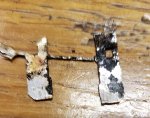
It's clear that the fuse holder had got very hot before the fuse had blown, as far as I'm aware it was a 25 amp blade fuse and you can see from the photo, that it hadn't blown as, in melted the metal strip, it almost looks like it had fail mechanically at the RHS, I extracted the two half with a pair of pliers.
The Eber had had a full professional overhaul last winter, with new glow pin and screen and a new flame failure sensor. I also got the engineer to replace the 3 fuses and the relay which switches on the matrix heaters.
Why did the fuse holder melt before the fuse blew? it really isn't supposed to happen.
and
Why has just the negative terminal of main 12 volt supply got hot enough to toast the plastic case?
and
Is there anything I can do to stop this happening again?
I'll replace all three fuse holders and the connector, it's cheap and easy to do, but what else?
The heater runs 3 matrix heaters and there's a heat exchanger coil in the calorifier.
On investigation, which isn't easy, the heater is under the cockpit and mounted on the transom, and requires dismantling bits of boat to gain access, I found a melted fuse holder, the centre one of 3 fuse holders and the negative terminal on the main power supply a little scorched (last 2 photos).
I'd recently checked the current drawn using a DC clamp meter with the following results:
I can't see the first few seconds of the start-up sequence, it takes a while to press the button on the controller and get back to the clamp meter.
Battery voltage 14.5v, absorption mode.
initial burn 6amps
winds up to 10 amps as the fan winds up.
jumps to 18.5amps when the 3 matrix heaters kick in.
Dropped back to 13.8amps after about 5 min.
switching aft matrix heater off, drops to 11.5 amps
switching forward matrix heater off drops to about 9 amps, then reduces further as the thermal load reduces and the fan winds down
switching mid matrix heater off drops to 3.5amps.
switching aft matrix on 6.5amps
switching forward matrix on 9 amps
switching mid matrix on 10.75amps, increasing to around 13.5 amps as the heater ramps up.
Battery charger off 12.62volts current 9.4 amps.
Battery charger back on 14.5volts 13.5 amps
That all seemed OK, and the maximum current was within the 25 amp rating of the fuse recommended by Eber.
It's clear that the fuse holder had got very hot before the fuse had blown, as far as I'm aware it was a 25 amp blade fuse and you can see from the photo, that it hadn't blown as, in melted the metal strip, it almost looks like it had fail mechanically at the RHS, I extracted the two half with a pair of pliers.
The Eber had had a full professional overhaul last winter, with new glow pin and screen and a new flame failure sensor. I also got the engineer to replace the 3 fuses and the relay which switches on the matrix heaters.
Why did the fuse holder melt before the fuse blew? it really isn't supposed to happen.
and
Why has just the negative terminal of main 12 volt supply got hot enough to toast the plastic case?
and
Is there anything I can do to stop this happening again?
I'll replace all three fuse holders and the connector, it's cheap and easy to do, but what else?