
Easiest / dumbest question ever - oil

vodzurk

Well-Known Member
Joined
24 Aug 2016
Messages
282
Location
Bristol
www.youtube.com
Still green to this whole motorboating lark...

Is oil the same as car oil?

My engine's Owners Manual (Volvo Penta AQ151 for a Sealine 195) states...

Quality: Multigrade oil Service SF (SE)
Viscosity: SAE 10W/30 alt. 10W/40

So if I stop by a regular car motorshop, any old 10W/30 is what I need?

Bonus question: Check "Cooling water level in the expansion tank for the fresh water system is correct". This just tap water, or distilled?
 
Still green to this whole motorboating lark...

Is oil the same as car oil?

My engine's Owners Manual (Volvo Penta AQ151 for a Sealine 195) states...

Quality: Multigrade oil Service SF (SE)
Viscosity: SAE 10W/30 alt. 10W/40

So if I stop by a regular car motorshop, any old 10W/30 is what I need?

Bonus question: Check "Cooling water level in the expansion tank for the fresh water system is correct". This just tap water, or distilled?
You got it, any oil with that viscosity and the specification SE or SF will do. IIRC the S stands for Spark ignition and if the specification says CF it stands for Compression ignition
The cooling water, you need antifreeze mix in there, not just for the antifreeze but the anti corrosion element it contains. If you mix it yourself, use de ionised. Having said that, all the shade tree mechanics in the world have only ever used ordinary water!
Stu
 
Still green to this whole motorboating lark...

Is oil the same as car oil?

My engine's Owners Manual (Volvo Penta AQ151 for a Sealine 195) states...

Quality: Multigrade oil Service SF (SE)
Viscosity: SAE 10W/30 alt. 10W/40

So if I stop by a regular car motorshop, any old 10W/30 is what I need?

Bonus question: Check "Cooling water level in the expansion tank for the fresh water system is correct". This just tap water, or distilled?

What Stu says about the oil .... except that SF is an obsolete category. You are unlikely to find anything less than SJ

Top up your cooling system with a 50% antifreeze mixture as Stu advises... if you keep topping up with just water you will diluting the antifreeze and the corrosion inhibitors. Unless your tap water is very low in dissolved solids distilled or deionised water is preferred for dilution. Buying the antifreeze ready diluted makes some sense.

You engine requires a conventional / low silicate / inorganic acid type of antifreeze as used in older engines not the longlife / OAT type used in modern engines. Do not mix the two types!

Dont try to keep the expansion tank brim full or you will be topping up every time you use the engine. Let it find its own natural level, which it will do in the absence of leaks, and maintain it at that.
 
Keep an eye out for leaks from the sea water pump as it has a tell tale hole that drips onto the cam belt pulley and builds up crud that allows the belt to jump
See book for change times
 
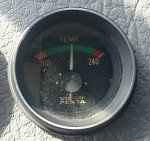
Mmm, just checked the water filter, oil and coolant... And all seems fine. We had a complete service at purchase 4 months back.

Which doesn't explain why the temperature gauge touched the start of the red bit last time we were out for 90 mins, at half throttle.

Any thoughts?
 

Attachments

  • _20170819_143209.jpg
    _20170819_143209.jpg
    176.1 KB · Views: 10
Last edited:
Mmm, just checked the water filter, oil and coolant... And all seems fine. We had a complete service at purchase 4 months back.

Which doesn't explain why the temperature gauge touched the start of the red bit last time we were out for 90 mins, at half throttle.

Any thoughts?

It could be because:
the heat exchanger is dirty ; the seawater pump needs a new impeller; the water intake is restricted; there is some other restriction to the seawater flow
 
Impeller was changed on the service...

Not sure about restrictions, as it certainly seems to blow out a good amount of water...

Leaving heat exchanger. Will have to do some research on how to check or whatever it is I need to look at with that.

Cheers!
 
You got it, any oil with that viscosity and the specification SE or SF will do. IIRC the S stands for Spark ignition and if the specification says CF it stands for Compression ignition
The cooling water, you need antifreeze mix in there, not just for the antifreeze but the anti corrosion element it contains. If you mix it yourself, use de ionised. Having said that, all the shade tree mechanics in the world have only ever used ordinary water!
Stu

No no no!,You must use "marine" oil at 20 times the price (for exactly the same stuff but with a picture of a happy mobo on it) otherwise you wont feel special!

Pre-mix antifreeze works out about the same price as mix your own and a shed load less hassle. Upside of concentrate is less volume to store since modern engines are fairly resilient to tap water.
 
No no no!,You must use "marine" oil at 20 times the price (for exactly the same stuff but with a picture of a happy mobo on it) otherwise you wont feel special!

Pre-mix antifreeze works out about the same price as mix your own and a shed load less hassle. Upside of concentrate is less volume to store since modern engines are fairly resilient to tap water.
Yep, you got it, why I was asking about the oil :).

Vowed never to set foot in a chandlers again (unless website has competitive price already listed) after seeing how much they try and charge.

Good call on the pre-mix antifreeze... though looked to be full of coolant anyhoos.
 
Makes me wonder whether the thermostat is sticking temporarily. The water flow from the exhaust would be unaffected but the engine would overheat.

Urgh... Sounds at this point like I might have to get a specialist on the case :(.

I agree its well worth checking the thermostat.

Place it in a pan of warm water and slowly increase the temperature. It should just begin to open at 82C and be fully open at 92C.

It is often difficult to see the initial opening but it can be detected by gently pushing the thermostat open and trapping a piece of thread. Suspend the thermostat by the thread in the pan of water. It'll fall off the thread as soon as it starts to open.
 
Last edited:
No no no!,You must use "marine" oil at 20 times the price (for exactly the same stuff but with a picture of a happy mobo on it) otherwise you wont feel special!

Pre-mix antifreeze works out about the same price as mix your own and a shed load less hassle. Upside of concentrate is less volume to store since modern engines are fairly resilient to tap water.
Lidl finest is as good as any.
Stu
 
What Stu says about the oil .... except that SF is an obsolete category. You are unlikely to find anything less than SJ

Top up your cooling system with a 50% antifreeze mixture as Stu advises... if you keep topping up with just water you will diluting the antifreeze and the corrosion inhibitors. Unless your tap water is very low in dissolved solids distilled or deionised water is preferred for dilution. Buying the antifreeze ready diluted makes some sense.

You engine requires a conventional / low silicate / inorganic acid type of antifreeze as used in older engines not the longlife / OAT type used in modern engines. Do not mix the two types!

Dont try to keep the expansion tank brim full or you will be topping up every time you use the engine. Let it find its own natural level, which it will do in the absence of leaks, and maintain it at that.

Interesting, the other day was in Carrefour in La Linea, anoracking amongst the car stuff shelves, they actually have CD oil for sale!
Stu
 
Interesting, the other day was in Carrefour in La Linea, anoracking amongst the car stuff shelves, they actually have CD oil for sale!
Stu

Yes oils to these old specs are out there and turn up when you don't expect them, or when you know where to look for them. eg Morris Lubricants "Classic Marine 10W-40" and "Golden Film 20W-50" both to to API classification CC/SF
 
I agree its well worth checking the thermostat.

Place it in a pan of warm water and slowly increase the temperature. It should just begin to open at 82C and be fully open at 92C.

It is often difficult to see the initial opening but it can be detected by gently pushing the thermostat open and trapping a piece of thread. Suspend the thermostat by the thread in the pan of water. It'll fall off the thread as soon as it starts to open.

Oh God, no idea how to (1) follow those instructions, nor (2) how to deal with any detected outcome.
 
Yes oils to these old specs are out there and turn up when you don't expect them, or when you know where to look for them. eg Morris Lubricants "Classic Marine 10W-40" and "Golden Film 20W-50" both to to API classification CC/SF

All better than no oil at all!
 
Oh God, no idea how to (1) follow those instructions, nor (2) how to deal with any detected outcome.

Put thermostat in an old pan, cover it with water, bring to the boil, if thermostat doesn't open at around boiling point it's knackered. Not too difficult is it?
 
Top