
Buck Turgidson
Well-Known Member
One area they fail all they time and come undone regularly - in the imaginations of those who have never used one and are incapable of embracing any change....
Back in the real world it isn't really like that though.
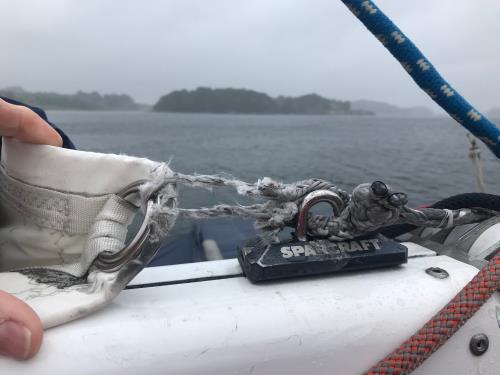

One area they fail all they time and come undone regularly - in the imaginations of those who have never used one and are incapable of embracing any change....
Back in the real world it isn't really like that though.
I make my own in different sizes, never HAD one failHas should read 'had'
Quite obviosly had some serious interferience


A soft shackle just seems unnecessary - how do you attach the sheet to the soft shackle? My understanding is you need an eye in each sheet - so now we need to splice 2 eyes and one (or is it two) soft shackles.
Ochone, ochone, Chon! Have ye forgot all they taught you in the Toberonochy Brownies when ye were chust a wee bitty skelf? Have ye forgot a' aboot the 'Left Handed Duntocher Ham Hitch And Two Half Whatsits'....? Ye'll be needin' to hand yer wee badge back....
Here's a good answer to a problem you didn't know you had.....
Replace the karabiner/mousqueton/snaplink with a halfway-decent soft shackle with an antichafe sleeve slipped on, and Robert's your mother's brother.
Brilliant ? 13 posts until someone pointed out the post was about the other end of the sail .
It has produced some interesting ways of attaching the sheets though.

Pretty funny. I use soft shackles for a few things, but I did not post because the tack can be a chafe prone spot and he did not post pictures.Brilliant ? 13 posts until someone pointed out the post was about the other end of the sail .
It has produced some interesting ways of attaching the sheets though.
Neeves: I transitioned to soft shackles for head sails (from cow hitch) for two reasons... that will not always apply.
1. Inner and outer sheets. The genoa on my PDQ runs two sets of sheets because the shroud location. A metal shackle on a clew is an evil thing and a soft shackle works.
2. Trailering my F-24. It's handier to be able to leave the sheets on the boat. One less thing.
But I would cow hitch other wise and did for years. If creep is a concern (never did), a simple seizing will stop that. I have also used separate sheets with bowlines.; It's OK. I have also used continuous sheets, like a dinghy, on bigger boats; it can be a lot handier, depending on the layout and how often you cross sheet. It was much handier on my PDQ.
The first one I used was to attach the mainsheet to the tang on the boom. The previous owner had used a snapshackle which spontaneously opened during the delivery trip due to unfavourable angles on a run. I have found them very useful all over the boat, especially as I can make them whatever size I wish and don't have to trawl through chandlers to find a steel shackle the right size. So far:We have separate sheets installed along the deck for those times when we might be reaching (quite often) and the 'normal' sheets are in the wrong place (inside or outside the shrouds). We simply attach the spare or extra sheet with a bowline as the knot is not an issue - you don't tack when you are reaching (or we don't). We often need to use two sheets when its a tight reach to get the shape right and then we might sometimes cross sheet - but our sheets are long enough to do this.
When attaching the sheet (with the bowline) I would not even think of a soft shackle, its an extra 'thing' to have in your pocket, the sheet needs an eye in it, - and exactly - what is wrong with a bowline (do people find them difficult to tie, do they fail, are they difficult to release.? To me many uses of soft shackles is to justify having made them, not because they make life easier, or safer.
One day I WILL find an application where a soft shackle is superior to anything else. I confess I've only been looking for applications for soft shackles where nothing else is as good for only about 5 years - but eventually I am sure I will find something. And, yes, we do have soft shackles in the spares kit - waiting patiently.
If we used a soft shackle on the headsail tack the luff would be too long, the sail is made to accept a small 8mm stainless shackle at head and foot. Many mainsails and some headsails use a double halyard with a halyard shackle or block- difficult to replace with a soft shackle.
Our stayed headsail is a 150% Genoa on a furler and if the forecast is less than attractive we replace it with a stayed No4, its a self tacker. When stored the sails are stored with sheets attached. Similar with out unstayed screecher, with its 2:1 halyard - its sheets are attached when stored below. Attachment for all sheets for all headsails, we also have a storm jib on an inner forestay) is a cow hitch. All our sheets are dyneema, inserted into hollow tape of a matching size and sewn. The cow hitch in dyneema tape is smaller and smoother than any soft shackle and there is nothing to get caught up when tacking. Admittedly we had to sew the two sheets to the tape - once - but I know its quicker than making a soft shackle.
Soft shackles have been used for decades, made from other rope (not dyneema and strangely not that I know of from Kevlar). Despite the longevity of soft shackles metal shackles have remained supreme. Dyneema soft shackles are relatively new and hardly common place. I am sure in the fullness of time the role of dyneema soft shackles will become better established - but we have much to learn. It took years for dyneema to be acknowledged as UV resistant and the abrasion carachteristics of dyneema has taken decades to define.
So....I'm not against the new religious fervour of soft shackles - waiting patiently open minded for the opportunity and I'm pleased others are sufficiently motivated to trial them in as many applications as possible. Hopefully in the fullness of time someone will document without bias, nor religious bigotry the advantages and disadvantages.
Take care, stay safe.
Jonathan
The first one I used was to attach the mainsheet to the tang on the boom. The previous owner had used a snapshackle which spontaneously opened during the delivery trip due to unfavourable angles on a run. I have found them very useful all over the boat, especially as I can make them whatever size I wish and don't have to trawl through chandlers to find a steel shackle the right size. So far:
- Mainsheet to boom tang
- Mainsheet to traveller
- Genoa sheets to clew
- Anchor snubber to chain
- Chain-hook to rode
- 3rd reef point on luff of mainsail
- One of the cars on the mainsail track to the luff of the mainsail (long shackle rattled loose and both shackle and pin fell overboard, I didn't have a spare, so I made up a short soft-shackle on the spot)
- Genoa fairlead blocks to deck tracks (no grinding, rattling or awkward angles)
- 3rd reef point block to leech of mainsail
- Unused preventer lines run along boom, attached to elastic strops with soft-shackles
- Mizzen sheet to boom
- Mizzen preventer to boom
- 3rd reef line deck block to deck fitting
- Main Halyard, reef 1 and reef 2 deck blocks attached to deck fitting with soft shackle - gives better angle than a steel shackle
- Tack of staysail attached to deck fitting with a soft shackle
- Staysail sheets to clew
- Pole topping lift to pole
- Pole foreguy to pole
- Pole afterguy to pole
Probably more I've forgotten!
Our boat was built in 1977. We have been living aboard for almost exactly a year. We started in A Coruña and are now in Curaçao. As things have broken or systems have needed improvement, I have used soft shackles rather than stainless shackles because I can buy 40m of dyneema for around 50 EUR and then make them up as required. I don't often get an opportunity to get to a chandler, and when I do they often don't have the exact size or shape I need. In many places I have been recently, the supply chain is so bad that I simply couldn't get the size and shapes required at all.An interesting and educational list
An observation I might make - some of us have yachts that are more than, say, 5 years old and many of the applications you list were resolved using a stainless shackle and stainless shackles for those applications have been used, without complaint, for decades. Were we to dispense with our shackles and replace with a soft shackle in many applications there would simply be no benefit. When I look at new yachts at boat shows, Benny/Jenny and Bav - they still come stocked with the appropriate stainless shackles (that have been used for decades without complaint) and that when the proud owner takes possession he or she is unlikely to retire all the stainless for a soft shackle - unless there is some fundamental benefit. As I say - an interesting list but I don't identify any benefit. For example the shackle for a pole topping lift to pole can be operated single handed, very useful to a man on the foredeck, many shackles have springs to allow the kit to 'stand up' .......? Instead of a soft shackle you can use tape with a double overhand knot, simple, quick, cheap, safe (been used by climbers for decades) and can be made very short, or long.
Can you elaborate on:
Anchor snubber to chain
and
Chain hook to rode
If you use a soft shackle to attach snubber to chain why do you use a soft shackle to attach a chain to the rode. Why not just use a rolling hitch.
It is obviously easy to start at the bow and list all the various shackles and replace them with a soft shackle - it does not mean the soft shackle is any better or more simple The single handed application of a snap shackle being but one example, single handed attaching a snubber to a anchor chain being another and stand up blocks being a third example where a soft shackle might not be the best replacement for a shackle.
I'm still looking for the unique benefits to underpin the religious fervour.
Jonathan
?Our boat was built in 1977. We have been living aboard for almost exactly a year. We started in A Coruña and are now in Curaçao. As things have broken or systems have needed improvement, I have used soft shackles rather than stainless shackles because I can buy 40m of dyneema for around 50 EUR and then make them up as required. I don't often get an opportunity to get to a chandler, and when I do they often don't have the exact size or shape I need. In many places I have been recently, the supply chain is so bad that I simply couldn't get the size and shapes required at all.
The pole end has some tangs on it which are far too small to fit the snapshackles of the 3 control lines. My solution with the things I had on board was to make a soft-shackle that goes around the pole, through the tangs, now I can snapshackle to that.
It is possible that the main boom sheet tang is original. The metal-on-metal interaction has chewed significantly into the tang over the years, and the previous owner's solution failed dramatically and expensively (the rodkicker got bent) after about 300 miles. The soft shackle I put there has managed about 10000 miles so far.
A rolling hitch on the anchor chain holds just fine, but I have found that it chafes the snubber. Also, when it's under a lot of tension it can apply a twist to the chain which can result in the chain wrapped around the snubber, which increases chafe further. We spend weeks at a time at anchor and while 3 strand nylon isn't expensive, it's another supply problem - I don't know when I'll be able to get it again.
The chain hook is on a separate piece of 3-strand nylon. The eye in the hook is too small to tie the nylon to it directly, so I used a soft shackle. We have a snubber and a separate chain hook because I use the chain hook as a temporary tool when working with the anchor chain, but as it doesn't have a gate, I don't trust it for overnights or big gusts and bounce-backs,
I'm still looking for the unique benefits to underpin the religious fervour.
Some folks have spent what seems like half a lifetime exploring the vagaries of Soft Shackles. Here's a very useful site for those who'd like to join in - l-36.com/soft_shackles
One benefit that occurs - when a soft shackle is becoming 'worn out', it shows visibly on inspection.... then one can replace it.
Stainless shackles simply explode, without any visible warning. So also do chainplates....

