Dunno about you guys outside EU ... but blue power plugs .. !!

Refueler

Well-Known Member
Joined
13 Sep 2008
Messages
24,499
Location
Far away from hooray henrys
Visit site
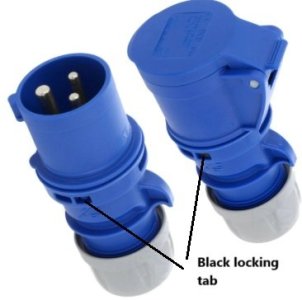
I used to buy the mains power plugs that screwed together ... but over here in Latvia - we have the EU designed style .. where you have to press a little black tab - then rotate the two halves to disengage one part from other ...

Usually I end up asking someone to rotate one part while I press hard to depress the black tab ..

I had to do this yesterday - the extension lead supplying mains for maintaining on-board batterys had failed ... its now in garage waiting me to look at it ...
Luckily we managed to connect without it ..
Mains connectors.jpg
 
I have used a suitable screwdriver in a vice to push the plug down on to leaving both hands free.
I have a small vice on the boat that has a sicker on the bottom to hold it down.
 
I used to buy the mains power plugs that screwed together ... but over here in Latvia - we have the EU designed style .. where you have to press a little black tab - then rotate the two halves to disengage one part from other ...

Usually I end up asking someone to rotate one part while I press hard to depress the black tab ..

I had to do this yesterday - the extension lead supplying mains for maintaining on-board batterys had failed ... its now in garage waiting me to look at it ...
Luckily we managed to connect without it ..
I think that i had one like that here in the UK last year. Might off had screws as well. Normally these safety tabs, as used on bleach bottles and the like, have a sharp knife put to them to make them user friendly to the older generation, ie ME !
 
What brand are they? The ones I've got are the same but never had a problem with them - and I'm of the older generation! Can't remember the brand as not on the boat.
 
I think that i had one like that here in the UK last year. Might off had screws as well. Normally these safety tabs, as used on bleach bottles and the like, have a sharp knife put to them to make them user friendly to the older generation, ie ME !

If you remove that black tab - then you cannot open the item to do the wire connections. My picture is slightly misleading .. the black tabs are the RELEASE tabs .. the actual locking tabs are the BLUE next to the black .. When you press the black tab in - the blue also goes in and you can then turn the hlaf to release. But you really have to use a strong push to get it to work ... making it hard to push tab and same time turn the half .. If the unlocking was too easy - then of course the item is less safe ...

I accept that the screwed versions I used to get - the screws were mild steel and corroded ... I used to swap them out for stainless ...
 
Blue just means 230v, also available in violet, white, orange, green, red and black.for different voltages and different sizes for different max current.

Not an EU design though - CEE originally, then BS 4343:1968 then IEC.
 
I see the same design of product advertised in the UK. We do still use CE rated stuff .
It is a coupler for joining cables and different to the more simple plug/socket type which are generally used to go into the shore power inlet on the boat and into the shore power outlet on the pontoon (or shore).
So looks like it is deliberately made to lock and to be tricky to pull apart accidentally (leaving live pins exposed) for situations where safety reasons may require a more robust coupler . For your own boat you could if you wish choose use the regular plug/socket type connectors.
 
I see the same design of product advertised in the UK. We do still use CE rated stuff .
It is a coupler for joining cables and different to the more simple plug/socket type which are generally used to go into the shore power inlet on the boat and into the shore power outlet on the pontoon (or shore).
So looks like it is deliberately made to lock and to be tricky to pull apart accidentally (leaving live pins exposed) for situations where safety reasons may require a more robust coupler . For your own boat you could if you wish choose use the regular plug/socket type connectors.
Interested to know why you say that its a 'coupler' conisdering that in terms of male / female - it is no different to other 'blue RV' connectors - only in the way you access the wire to pin connections.

Over here - this is the only form of the plugs male and female - unless you want 'wall mounted'.

For anyone interested - the lead failed due to wire breaking inside the plug ... which could happen to any plug ... lead is now fixed and ready for service again.
 
Interested to know why you say that its a 'coupler' conisdering that in terms of male / female - it is no different to other 'blue RV' connectors - only in the way you access the wire to pin connections.
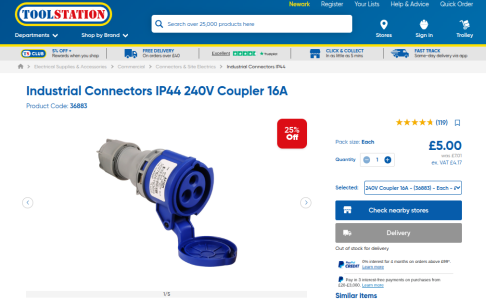
Coupler as described here
1770553589732.png

Just the description of coupler or trailing socket depending which retailer I look at . The regular type are still available in the UK but maybe they are being replaced. These do look quite robust. I would like to make a new cable as the one I used the most is looking a bit tired , Hence my interest,
 
For anyone interested - the lead failed due to wire breaking inside the plug ... which could happen to any plug ... lead is now fixed and ready for service again.
It sounds like it was assembled incorrectly. There should be a reasonable length of individual conductors inside the plug after the outer sheath is stripped. You then ensure the shortest one is the live so that if the cable grip did fail, the live lead would pull out first (rather than the earth).

The three insulated individual conductors are then curled in one "orbit" inside the plug body then the cord grip properly tightened around the sheathed cable so it cannot pull out. Then assemble the connector. If there isn't any slack cable left inside the plug housing then it will easily pull and break as you found.

This guy pushes some surplus cable into the housing before tightening the clamp to achieve the same goal.

 
Good video, but one thing also to notice is that 3-core cable is handed - it actually matters which end you use for the plug and socket!

Look at the plug end, where you are going to insert the wires: It's like this
plug.png
The socket is the mirror image, with the L on the left and N on the right.

Now look at the cable, with the L and N connected will the Earth come out neatly in the right place, or below the L & N? If it doesn't come in the natural place then you have the cable the wrong way round. A recipe for unreliability and yet so easy to get right.
 
It sounds like it was assembled incorrectly. There should be a reasonable length of individual conductors inside the plug after the outer sheath is stripped. You then ensure the shortest one is the live so that if the cable grip did fail, the live lead would pull out first (rather than the earth).

The three insulated individual conductors are then curled in one "orbit" inside the plug body then the cord grip properly tightened around the sheathed cable so it cannot pull out. Then assemble the connector. If there isn't any slack cable left inside the plug housing then it will easily pull and break as you found.

This guy pushes some surplus cable into the housing before tightening the clamp to achieve the same goal.


Gi'us a break guv !!

I really don't need lessons on connecting a b****y plug !!

You never had a broken wire in a lead / plug ??
 
Good video, but one thing also to notice is that 3-core cable is handed - it actually matters which end you use for the plug and socket!

Look at the plug end, where you are going to insert the wires: It's like this
View attachment 206235
The socket is the mirror image, with the L on the left and N on the right.

Now look at the cable, with the L and N connected will the Earth come out neatly in the right place, or below the L & N? If it doesn't come in the natural place then you have the cable the wrong way round. A recipe for unreliability and yet so easy to get right.

Gor Blimey .. considering that the convention looking at power socket as you plug in ... (not the back as you show) - is LIVE on the right .....

I know this from setting up emergency back-up generators for house etc.

The plugs / sockets are labeled at each connection anyway ..
 
The back of a plug - ie where you connect the wires - IS the same as a socket from the front. And the Line is on the right.
 
Gi'us a break guv !!

I really don't need lessons on connecting a b****y plug !!

You never had a broken wire in a lead / plug ??
Not in any that I've made up. Obviously you don't need any advice but my tips may help others less electrically articulate. You only have to see some of the You Tubers make a hash of it to realise how a little knowledge is a dangerous thing.
 
The back of a plug - ie where you connect the wires - IS the same as a socket from the front. And the Line is on the right.

I wasn't arguing ... if you think about what I posted - it agrees with your post ...

But considering the subject I started with this thread ... its not about how to wire them up !
 
Top