

Tim Good
Well-Known Member
As a follow on from this thread: http://www.ybw.com/forums/showthread.php?413504-Pardey-Bridle-Sea-Anchor-Method-Opinions
I thought I would begin a discussion on attachment methods and strengths for using a Jordan Series Drouge. In doing so I thought I would use my own boat which does not have drogue chain-plates and the possible options i have as a starter.
Boat: SeaStream43
Disp: 15t
Hull: Semi Full
From my reading I should make any fittings capable of taking the weight of the boat in the worst case breaking wave scenario. So in this case I should be trying look at approx 8T on each fitting with a bridle distributing the load at 30 degrees or less. So I look at what others have done:

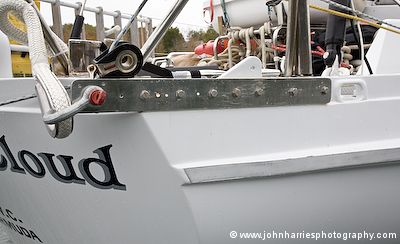


Now lets take my example and maybe some can advise. Look at my transom below. You'll see in the red circles are two very heavy duty anchor rollers made from 3mm stainless. they extend aft and overhand by about 150mm. I have figured that a bridle from these would not touch any other gear. Ignore my kedge and outboard ... Directly foreword of them are two large cleats.
I was thinking of some system whereby I install a large block of ply and a stainless plate inside the hull as a backing plate to reinforce the existing roller. I would then use a chain attached directly to the stainless rollers and then backed up to the cleats tightly, should there be any give at a critical moment. They would be fitted tightly so any give at all would take onto the cleat.
In this instance what problems do you envisage? Is it strong enough? Any other points of discussion / best practice advice.


I thought I would begin a discussion on attachment methods and strengths for using a Jordan Series Drouge. In doing so I thought I would use my own boat which does not have drogue chain-plates and the possible options i have as a starter.
Boat: SeaStream43
Disp: 15t
Hull: Semi Full
From my reading I should make any fittings capable of taking the weight of the boat in the worst case breaking wave scenario. So in this case I should be trying look at approx 8T on each fitting with a bridle distributing the load at 30 degrees or less. So I look at what others have done:
Now lets take my example and maybe some can advise. Look at my transom below. You'll see in the red circles are two very heavy duty anchor rollers made from 3mm stainless. they extend aft and overhand by about 150mm. I have figured that a bridle from these would not touch any other gear. Ignore my kedge and outboard
... Directly foreword of them are two large cleats.I was thinking of some system whereby I install a large block of ply and a stainless plate inside the hull as a backing plate to reinforce the existing roller. I would then use a chain attached directly to the stainless rollers and then backed up to the cleats tightly, should there be any give at a critical moment. They would be fitted tightly so any give at all would take onto the cleat.
In this instance what problems do you envisage? Is it strong enough? Any other points of discussion / best practice advice.
Last edited:


