Drogue Chain Plates Strength?

A few thoughts from a steel boat... I've 50 x 50 x 5 @400mm long stainless angle welded to the deck/hull with about 50mm cantilever past the transom so comfortable with that. Hard to find any figuyes to calc but 700mm of weld in sheer ain't gonna go anywhere I reckon. Moving back and thknking a bit after this thread the 5mm angle seems a bit thin for a shackle pin, probably weld some plate on there though getting a hole drilled big enough for a 5/8" 209 crosby bow shackle might be a bit of a pain. 16mm would be ok with 18v cordless for a 2t crosby but 3 - 1/4t might take a moment. Anyone saying "you're overthinking this" isn't going anywhere and doesn't understand huge forces. If going to the bother of installing something for a JSD then might as well do it bulletproof. Then think the bridle legs which came with the drogue will get ditched in favour of some monstrous dyneema which arrived after a red wine incident on ebay :) Bridle node likely 2 x 3-3/t shax into a 4-3/4t shack or a master link. Forget low friction rings etc, these sorts of potential loads the local crane supplies is where you should be shopping. ;)
Maybe of greater concern is keeping it above the windvane, thinking a handful of fish floats in the bridles. Seems pretty common for a jsd to trash a windvane paddle though not so common to find out exactly what happened. As this is all to try and push the odds more in your favour seems a handful of floats would be a step forward .. All this for something which might well never get used. But it might, and it might be serious...
 
Maybe of greater concern is keeping it above the windvane, thinking a handful of fish floats in the bridles. Seems pretty common for a jsd to trash a windvane paddle though not so common to find out exactly what happened. As this is all to try and push the odds more in your favour seems a handful of floats would be a step forward .. All this for something which might well never get used. But it might, and it might be serious...

This problem has been discussed on Morgan's Cloud. I've modified the solution suggested there and have.a system to launch extendable fairleads (using 10mm diameter fibreglass battens). This prevents the bridle from looping back under the wind vane rudder. It's a method I can use single handed and can report that it works very well ... on our bedroom carpet. I may do a diagram.
 
This problem has been discussed on Morgan's Cloud. I've modified the solution suggested there and have.a system to launch extendable fairleads (using 10mm diameter fibreglass battens). This prevents the bridle from looping back under the wind vane rudder. It's a method I can use single handed and can report that it works very well ... on our bedroom carpet. I may do a diagram.
I was still a member when that was going on., didn't seem a very open minded discussion from memory. Floats seem a bit less involved but who knows til you get there..
 
I was still a member when that was going on., didn't seem a very open minded discussion from memory. Floats seem a bit less involved but who knows til you get there..

I hadn't thought of floats but I wonder if they could still get washed under the wind vane rudder in a surging wave. Anyway this is my sketch. I've only shown the batten on one side.

718cMfEh.png
 
Last edited:
@Neeves and anyone else with knowledge or a thought.

Any ideas on an ideal clearance and length for the "anchor shank" slot should be to stop the shackle locking (assuming a 16mm bow shackle)? Obviously between the slot and the outside of the plate there needs to be smaller then the jaw of the shackle to slide the shackle through and smaller then the inside diameter of the bow. I assume the slot doesn't need to be as large as the eye (threaded part of the shackle) as if this touches the slot the shackle would be at near 90° to the plate and the last of your worries? I'm sure there's no right answer but as you're clued up on all things anchors it would be good to hear your thoughts.

I'm on mk3 design, teardrop plate so to speak. 10mm 316 (although I'm not ruling out Duplex). 80mm shackle end (a bit more meat for not bending), tapering to 60mm (thin enough to take in hull curvature) with 4 bolts 120mm apart. I'm thinking 20x50mm slot but I was going to make a mock up and experiment.

Next question, I would have thought you don't want the slot ending where the plate overhangs the hull (if I had a 20mm slot there would be roughly 30mm either side which may create a weak point in the centreof the plate? How much overhang before the slot would be deemed acceptable?

If non of the above makes sense then apologies, what my other thread shows is listen to people that know!
 
Tom, Yellow B,

I'm not sure I understand, or wonder if you are misunderstanding.

The slot needs to take the eye of the shackle. The eye being the part through which the clevis pin passes and one eye is threaded. Both eyes are the same size. If the eye passes through the slot = either eye will pass through the slot. When installing the bow of the shackle would be in the slot and the clevis pin would be attached to the bridle arm. The shackle can now articulate. You shackle should be a Crosby G209a and to ensure you are looking at the correct quality a 3/8th" shackle will have a WLL of 2,000kg. You could buy one with a nut on the end and a cotter pin - but Loctite would be secure (mousing if you like belt and braces)

The key to not having the shackle lock up is to bevel the edges of the slot. If you look at most anchor slots they are simply laser or water cut and are sharp and its the sharp edges that cause the issues. Not all slots in anchors are sharp - I think Rocna bevel theirs - but its an extra process and money talks. If you go back in the thread you will find that Roger advises that one needs a Burr and a pretty high speed drill to round the edges. If the edges are rounded they will not point load the shackle. Whatever you do - its the aft end of the slot that needs the attention.

I cannot answer your question numerically - except to say if you have a slot big enough for the eye and the edges bevelled (rounded - bull nosed) the shackle does not lock up easily, or at all. So the dimension is that of the eye, a millimetre extra or so, and the beveling. The slot wants to be parallel to the length of the chain plate. Ive never looked at the dimension of the slot


However I do favour replacing the shackle in that location completely, adding a 2 part thread LFR, adding dyneema (either as sewn tape or as spliced loops) and then attaching the bridle of the drogue to the spliced dyneema or sewn tape. If I were splicing dyneema I would cover the resultant loop with dyneema hollow tape to add an extra layer of security (against abrasion) - but I do like belt and braces (especially when it costs nothing. You need to add the dyneema protective cover before splicing.

One thing I note from those that use JSDs is the level of wear on - everything. The cones are commonly shredded - which suggests more thought needs to be given to cone construction - and that those who have made their own from rip stop nylon might like to ponder anew.

The slot in the chain plate, and a circular hole for a 2 part thread LFR will need the end of the chain plate increased is size slightly, because the holes are bigger than the holes for a shackle clevis pin.

Following my belt and braces, or overkill, I'd take the dimesnsions bandied about for a chain plate made from 316 and use the exact same dimension for one made from 2205 Duplex stainless. 2205 has over twice the strength of 316 and a much higher yield. 316 is actually stronger than many think but its yield is very low and the low yield leads to the idea 316 is weak. So forget the strength, the UTS, of 316 - have a look at the yield (as you really don't want your chain plates bending). 316 as a backing plate, with whatever glass is necessary. is more than adequate. If you are adding glass - then make sure the finish is a smooth and as flat as possible - for the backing plate. If I were adding glass I'd cover the wet glass with plastic sheet or the backing plate with packing tape and clamp the backing plate on top as it sets off - then the surfaces would match.

Using textile, rope or tape, at the chain plate/bridle interface should reduce the risk of a bent chain plate. I would emphasise that chain plates bending are not something anyone has reported - but it seems an easy upgrade to make.

I'd cow hitch the textile to the chain plate and use a shackle to attach bridle to cow hitched loop. I'd monitor the cow hitched loop for abrasion and have spares - just in case though with a LFR there should be no, or minimal, abrasion. If an aluminium LFR is used it will corrode in contact with the stainless bridle plate - which is why I'd suggest stainless 316 2 part threaded LFRs. You could use a gasket between the rings and the stainless - which I did look at - but it fell into the unnecessary basket when I used 316 rings and a duplex plate.

Both Ronstan and (closer to you) Holt make aluminium LFRs. Ronstan's rings are made in China (and some of my 2 part 316 rings were made by the same Chinese company, good quality for what they did for me - and Ronstan seem happy. Holt also make 2 part aluminium rings and I think they make in house. I don't recall if they make a stainless version of the size needed but I think they do have the skills. From memory Holt 2 part rings are quite long and may need to be shortened to fit into a 10mm plate. I get the impression Holt are quite innovative, are interested in more than dinghies - and might be sympathetic.

Jonathan
 
Last edited:
Using textile, rope or tape, at the chain plate/bridle interface should reduce the risk of a bent chain plate....... I'd cow hitch the textile to the chain plate and use a shackle to attach bridle to cow hitched loop.

We've corresponded about this, and you know I favour it. Your idea of fitting 2-part LFRs is an excellent improvement.

The attachment of chainplates ( in my case, those Harken Special Titanium Deckeyes I have ) to bridle arms is more easily done using long Soft Shackles which can be looped through-and-back twice or thrice. Dispense with great heavy steel shackles! Use lighter, flexible and stronger Dyneema!

That should give a surplus MBL in excess of the bridle-arm max. loading. Did someone suggest the 'Max AUW of the vessel'? Oh, yes.... Don Jordan. These Soft Shackles should, of course, be sleeved in anti-chafe tubing. For belt and braces, a spare but slightly longer S'Shackle could be rigged over the top of the primary one, should chafe be a continued worry. They're easy and cheap to make......
 
We've corresponded about this, and you know I favour it. Your idea of fitting 2-part LFRs is an excellent improvement.

The attachment of chainplates ( in my case, those Harken Special Titanium Deckeyes I have ) to bridle arms is more easily done using long Soft Shackles which can be looped through-and-back twice or thrice. Dispense with great heavy steel shackles! Use lighter, flexible and stronger Dyneema!

That should give a surplus MBL in excess of the bridle-arm max. loading. Did someone suggest the 'Max AUW of the vessel'? Oh, yes.... Don Jordan. These Soft Shackles should, of course, be sleeved in anti-chafe tubing. For belt and braces, a spare but slightly longer S'Shackle could be rigged over the top of the primary one, should chafe be a continued worry. They're easy and cheap to make......


I did think of using soft shackles to join the bridle arm to the chain plates, through the LFRs. I resisted mention soft shackles as we (me) simply do not use them and I thus have no experience of usage. One of my rules is - Don't recommend items about which you know - nothing.

The environment in which a drogue is used is simply not sufficiently documented to know if a soft shackle is appropriate.

We have a yacht that is at the peak of a large wave and is taking a beating from surf and wind and then that same yacht rushes down the face of a wave into a comparatively windless trough when it will stop moving, or not moving very fast and may have turned beam on to motion and thus one bridle arm is slack. A soft shackle is held together with an eye and a knot - nothing positive about it - and you are trusting your life to a knot in an eye.....? I'd like to hear how other people find their use of soft shackles leaves a positive mark, or a bad taste. If its wrong - you lose a bridle arm.

I appreciate that using a shackle/carabiner to attach a dyneema strop (through the chain plate) to a dyneema bridle arm seems to be the suggestion of a Luddite and certainly contradictory.

As Kukri said 'funny things happen at sea'.

And I have not thought of an alternative to some form of knot.

The lifting industry uses a lot of textile slings and have a cross section of specialist devices to be used with slings

YOKE

Van Beest, Pewag, Rud etc all have their own cross section of devices (available from any lifting component distributor near you).

Interestingly I have not noted the lifting industry using soft shackles?

Jonathan
 
Last edited:
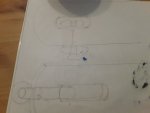
@Neeves apologise, it was late and I was rushing to finish the post so thought it may not make sense, apologies for the awful drawings as well.

I was wondering if it's acceptable to have the slot small enough to fit the shackle as the top picture, to fit the eye through lengthways then articulate the shackle into position (bottom drawing).

20210223_110339_copy_816x612.jpg

Roger on the bevel, I've emailed a few places on Duplex 2205 however I'm struggling to find a supplier of small quantity.

I need to reread this thread when I haven't got two little boys after my attention and a wife telling me to turn the light off, LFRs haven't gone out of the other ear.

Many Thanks
 
Last edited:
Like GHA I have a steel boat and when I was building her I fitted lots of 316 stainless steel 10mm U bolts on the transom and at the aft of the side deck so I could easy attach various safety line like jack stays and a drogue.

The stern U have steel backing plates to take any extra load.

A rule of thumb re welding is the 1 " of good quality steel weld will carry a 1 ton of load. This will depend on the thickness of the base steel.

Now knowing the drogue bridle is fixed in the center

The angle of the side leg of a bridle will not exceed the angle between the bridle leg and a straight transom. i.e if the leg is at 60 degrees to the flat surface of the transom it will never exceed 60 degrees at if it tris to the oversite leg will prevent it. The leg can do to 0 degrees in the extreme if the bridle is across the transom.

This means the angle of the chain plate should be IMHO be equal to the angle of the bridle when pulling straight. There will be a little bending when the drogue is off center but as has been said the drogue will tend to pull the transom straight so reducing the bending load as it straightens
 
@Neeves apologise, it was late and I was rushing to finish the post so thought it may not make sense, apologies for the awful drawings as well.

I was wondering if it's acceptable to have the slot small enough to fit the shackle as the top picture, to fit the eye through lengthways then articulate the shackle into position (bottom drawing).

View attachment 109854

Roger on the bevel, I've emailed a few places on Duplex 2205 however I'm struggling to find a supplier of small quantity.

I need to reread this thread when I haven't got two little boys after my attention and a wife telling me to turn the light off, LFRs haven't gone out of the other ear.

Many Thanks

I was on the boat when I initially replied and could not download the pictures/drawing.

The drawing is fine - exactly how mine are designed. The eye goes in sideways and then the body (or bow) rotates. The steel round the hole needs to be narrow enough to allow the eye to be inserted and the other eye pass 'outside' the steel. This means the steel round the eye will be the width of the width of the space between the eyes of the shackle. If you are using a higher tensile strength material, steel, stainless steel or aluminium this is not an issue as the space, the width of metal round the slot is more than enough - and will be stronger than the shackle. The G209a shackles are a G80 quality.

The addition is the bevelling of the slot, important at the working end, and aft sides. But if you have the time - do it all round (it looks neater) - both sides so that the edge of the hole meets and becomes semicircular (a bullnose). (I confess I don't know what the technical name is for a rounded internal edge)

On steel supply - I had not realised how difficult it might be to source 'exotic' metal plate. Here I can ring up a number of stockists in and around Sydney and order metal plate, 316 or Duplex 2205; 5083 or 7075 aluminium and a variety of steels ranging from 600 MPa to over 1,000MPa give them dimensions (which may need to vary as until I speak to them I don't know what are standard plate thicknesses they hold in stock) and pick up in the afternoon. Very thin high MPa steels have to come from Melbourne, so they come by mail/courier.

I had fondly imagined the UK would be similarly endowed with stockists.

Another route - which is how I found how to order very thin HT steel plates, 3mm thick, is to contact the manufacturer (SSAB) and ask who is their distributor, contact the distributor and they might tell you who of their customers might offer a cutting service. This is best done by phone - you get a more sympathetic hearing. If SSAB and Bisalloy are good examples then the manufacturers of the steel are very keen to extend their market and if you explain what you are doing they see opportunity (that they may not have addressed previously). As with this post - both SSAB and Bisalloy go up, slightly, in the Google rankings - every mention helps. From memory Sandvik for 2205 stainless (but I might have that wrong - check a Google search). Some companies here think this is a route to wealth and charge exorbitantly - so you might need to search around. I've noted you can buy cut metals in the US so had assumed something similar existed in the UK.

I'm NOT suggesting ordering from Oz, delivery costs are horrendous :(

Jonathan
 
This was a VERY detailed and technical thread, and my head is spinning.

I am looking to have two drogue chainplates made for our 30ft 5t (probably realistically 6t) long keel yacht.

(We have the drogue)

I was thinking 400 x 100 x 5mm stainless (with the same backing) and 5 or 6 10mm bolts.

Probably adequate, or way underspecced?

Transom is pretty narrow, so wondering if this would affect the design.

And - how likely is it to trash the Navik water paddle?

- W
 
I was thinking 400 x 100 x 5mm stainless (with the same backing) and 5 or 6 10mm bolts. Probably adequate, or way underspecced?

And - how likely is it to trash the Navik water paddle?

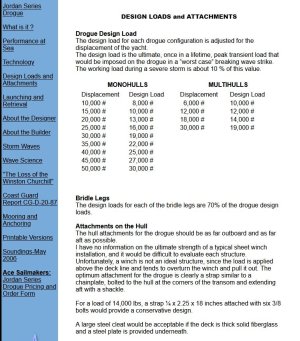
You need to start with the max. laden AEW of your boat, then Don Jordan's guidance re Design Loads. ( attached )
e.g. a 15000lb boat has a JSD Design Load of 10000lb

Each bridle leg - and therefore each chainplate - is spec'd for at least 70% of Design Load.

The slim end-section of each chainplate aft of the hole for shackle must also be spec'd for at least 70% of Design Load. So must the shackle(s) used.

The hull itself, in way of the through-bolted arrangement(s) also needs to cope with 70% of Design Load. Many boats will need substantial internal reinforcement using triaxial cloth/resin or G10/thickened epoxy, for the strength of the existing layup can only be guessed at.

The mechanics of through-bolted steel plates loaded in shear is well understood, and guidance available. Not so, steel/composite/steel structures.
Spacing of bolts matters. Bolts need to be 'preloaded'. Some pro guidance is available - but not for steel/composite/steel. A suitably-experienced structural engineer's guesstimate is the optimum route, for Finite Element Analysis is neither cost-effective nor credible in that boaty role.

Ensure you don't weaken the JSD critically by use of non-appropriate knots or underspec'd rope-rode. See Marlow Ropes' guidance - or ask here.


Design Loads.JPG
 
Last edited:
Cant see the pictures, but I THINK I can imagine whats going on from the description.
If using rear hull-side plates to take rearward pull (therefore mostly loaded in shear) would it be worth tying the plates together across the transom, to take an outward pull? I suppose it might depend on whats in the way.

If such a transverse tension member isnt practical or desirable, would an L plate transferring outward load to the transom be worthwhile?

EDIT: I see above its argued that with a bridle there will be no outward load on the plates, which I suppose might be true, unless one leg of the bridle breaks
 
Last edited:
This was a VERY detailed and technical thread, and my head is spinning.

I am looking to have two drogue chainplates made for our 30ft 5t (probably realistically 6t) long keel yacht.

(We have the drogue)

I was thinking 400 x 100 x 5mm stainless (with the same backing) and 5 or 6 10mm bolts.

Probably adequate, or way underspecced?

Transom is pretty narrow, so wondering if this would affect the design.

And - how likely is it to trash the Navik water paddle?

- W

Very cryptic, Zoidberg

- W

Your boat displaces 12000 lbs (6t)
Design Load from the table for 15000 lb displacement in Zoidberg's post is 10000 lb (I went up one, being conservative, rather than interpolate)
From the notes in the table, for a design load of 14000 lb you need 0.25" x 2.2.5" x 18" plate on each side, secured with 6 x 3/8" bolts

You specified 0.2" x 4" x 15" which is probably okay for a 10000 lb design load according to the tablel and notes (which are for a 15000lb displacement) Your bolts sizes is okay, but I would increase the number to 6.

I assume by drogue, you mean a JSD sized for your vessel. If you are talking about another style of drogue then the table may not be relevant for your design.

Narrow transoms should not impact the design significantly. Many styles of transom and wind vanes have been used with JSDs and they do not get trashed, notably on the Golden Globe Race.

If you can stretch to $36 for a years subscription, which can be cancelled at any time, then Morgans Cloud has excellent information on chain plates and many other aspects - membership page 2024 Buy Matrix. It would be worthwhile researching as the advise is straight without multiple forum opinions.

I have no association with Morgan's Cloud except as a subscriber.
 
From the notes in the table, for a design load of 14000 lb you need 0.25" x 2.2.5" x 18" plate on each side, secured with 6 x 3/8" bolts
Quibblers and pedants should be aware that aeronautical engineer Don Jordan provided NO definitive data about Optimum Chainplate design; rather, he suggested one example, and left it to others to develop the topic.

There is close to no reliable eng data relating to the mechanical 'strength' properties of boat structures in those areas of the hull where the Maximum Design Load would be transmitted into the structure - but lots of online opinion, mostly based on 'that looks sort of all right'.
Same thing with bolts, sizes, properties and spacing.

The volume of load-bearing material aft of the hole at the end of strap chainplates is critical, for that is where material failure is most likely. How much is enough? What Safety Factor is appropriate? How should that be calculated? Back to 'that looks sort of all right'.....?

The few souls I've encountered with a passing awareness of the several Shear Modes of Failure interested in this application were found on Sailing Anarchy, and were experienced engineers who sailed. Their 'best guesses' are the ones I've relied on....
 
@webcraft stagger the bolts in your chain plate so that they do not all sit on the same horizontal line. Two rows of bolts, one above the centre line, one below the centre line, alternating bolts above, below. Reading an article suggests that it reduces the likely hood of a catastrophic "unzipping" of an in line arrangement of bolts, while retaining the same strength, as an inline arrangement.

Example shown in this link A Serial Sewing Project | Good Old Boat
 
@webcraft stagger the bolts in your chain plate so that they do not all sit on the same horizontal line. Two rows of bolts, one above the centre line, one below the centre line, alternating bolts above, below. Reading an article suggests that it reduces the likely hood of a catastrophic "unzipping" of an in line arrangement of bolts, while retaining the same strength, as an inline arrangement.

Example shown in this link A Serial Sewing Project | Good Old Boat
Another thing to consider is that if the pull is either upwards or downwards significantly out of the plane (stern pitched up or down by a wave) then nearly all of the force is on the last 1-2 bolts. A long line of blats or long strap only works optimally, for example in the case of a chain plate for rigging, when the pull is always in one line. A good reason for the strap to have some width and to be conservative.

This is exaggerated to make the point that assuming a straight pull is probably wrong, and that if the pull angle is variable, a straight strap, like a chain plate, is not optimal. The hshackle hole is drawn a tiny bit too low. But just something for discussion. Given the low incidence of JSD chain plate failure (none?), I actually believe the standard design is fine.
drouge+chainplate+design+1.jpg
 
Last edited:
"that looks sort of all right'..." ;)

I say again - There is potential for Tear Out Shear in way of the first pair of bolts, and it is the GRP, not the chainplate material, that is likely to fail.

Again, the area volume of stainless material immediately aft of the large attachment hole is critical. It is also subject to wear-elongation when a 'rusty' steel shackle saws away at it for hours on end.

I've seen overlarge s/s washers, and also round bar, welded on there to improve the load-bearing and abrasion resistance.
 
Top