
RunAgroundHard
Well-Known Member
For those of us who rarely drill stainless steel, as DIYers, PBOners, low cost drill bits are just fine.

Again, Different WorldI thought you were going to say that you buy cheapies....so that when you loan them to your friends....and they break them....they buy you expensive replacements

On a lathe one can be cutting new material & apply pressure at a continuous feed rate. This stops case hardening. This applied with suitable lubricant makes a difference. Correctly selected modern tipped cutters run at the correct speed & feed is essential if HSS bits are not used. If they are then corect bevels should be followed & many guides are avaiable. Chips need to be small for safety reasonsLearn to sharpen bits. For anything under 10 mm this should take well under a minute. Some of mine are nearly a century old. They're shorter than they used to be.
Coolant. If you don't have coolant, at least use oil.
If it does no make nice chips on contact, sharpen it. Also, don't for get pilot drilling. This is particularly helpful for larger sizes without a drill press, since it is impossible to get sufficient feed pressure in many geometries.
Curiously, I seem to have less trouble on the lathe than drilling. The reasons are that the lathe tends to use a small cutting edge, I am focused on chip formation, and it is easy to regulate all of the variables.

I have a drill bit sharpener (although a grinder is just as effective).....but I find them to be close to useless for anything other than soft materials.....I think it’s because you are actually grinding off the hardened surfaceLearn to sharpen bits. For anything under 10 mm this should take well under a minute. Some of mine are nearly a century old. They're shorter than they used to be.
Coolant. If you don't have coolant, at least use oil.
If it does no make nice chips on contact, sharpen it. Also, don't for get pilot drilling. This is particularly helpful for larger sizes without a drill press, since it is impossible to get sufficient feed pressure in many geometries.
Curiously, I seem to have less trouble on the lathe than drilling. The reasons are that the lathe tends to use a small cutting edge, I am focused on chip formation, and it is easy to regulate all of the variables.

At least on a HHS drill, the entire drill is hardened. They should cut the same after sharpening, if the angles are correct.I have a drill bit sharpener (although a grinder is just as effective).....but I find them to be close to useless for anything other than soft materials.....I think it’s because you are actually grinding off the hardened surface
You mean "coolant" as in ethylene glycol/water antifreeze, or as in a "cutting oil" water/(vegetable?) oil emulsion?Learn to sharpen bits. For anything under 10 mm this should take well under a minute. Some of mine are nearly a century old. They're shorter than they used to be.
Coolant. If you don't have coolant, at least use oil.
If it does no make nice chips on contact, sharpen it. Also, don't for get pilot drilling. This is particularly helpful for larger sizes without a drill press, since it is impossible to get sufficient feed pressure in many geometries.
Curiously, I seem to have less trouble on the lathe than drilling. The reasons are that the lathe tends to use a small cutting edge, I am focused on chip formation, and it is easy to regulate all of the variables.
Cutting oil emulsion. Also stainless cutting specialty products (I don't know UK brands).You mean "coolant" as in ethylene glycol/water antifreeze, or as in a "cutting oil" water/(vegetable?) oil emulsion?
Hadn't heard of the former being done, and wouldn't normally have had any handy, since it was in the (car) engine, but now I dont have a car, but bought antifreeze as a wood treatment, so I could easily try it.

5 days later and did you drill it ? If so how did you get on .............Rooster do a Laser block eye with larger holes in case you need larger rivets.
Pre Drilled to 1/4" Laser/ILCA boom block attachment Lac...
It would be convenient for me to buy a standard one and drill it myself if I need to.
Am I right in assuming that's all Rooster did and if they can do it, I can do it to? (I imagine stainless to be brittle and resistant to drilling?)

5 days later and did you drill it ? If so how did you get on .............


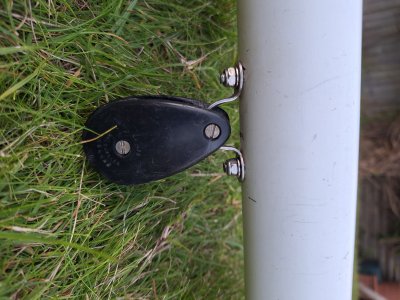
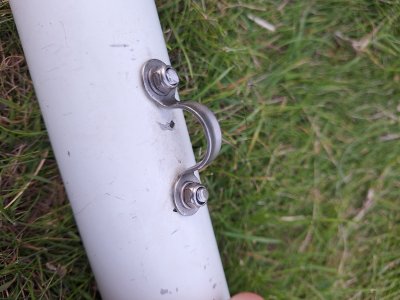
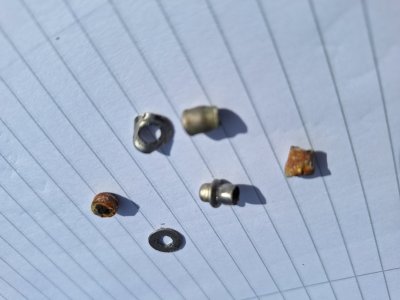
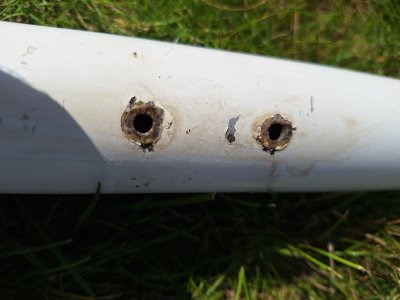
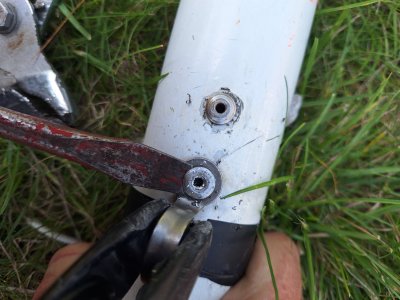
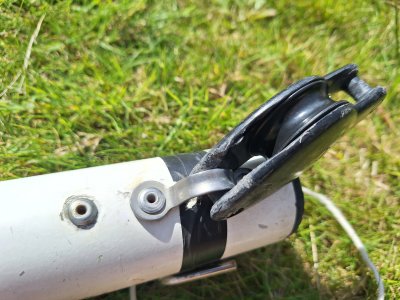
Which bit is the stainless ?So, it went really well. The topic should perhaps be "Laser boom refurb" rather than, Drilling stainless.
Anyway, the only stainless steel drilling I needed to do was the rivets. And the advice in the thread was really useful. Used sharp HSS drills and lubed with Olive Oil. It wasn't easy, but it worked. The strategy to drill spinning rivets at 30 degrees turns out to be utter lies! I devised various ways to hold a rivet spinning. None pretty.
Measured the holes.
BOOM =======MID========== CLEW =
MID block, both 5.3mm.
CLEW block, 5.3mm and 5.5mm
Both holes on the "loop fitting" are 5.4mm.
I'd been thinking none of this would matter if I could just use bolts, but clearly that's impossible on the mid boom block.
As luck would have it as I was googling the Rooster site for the dimensions of the standard "loop fitting" to decide the best rivet/loop hole sizes I found this blog article:
The Laser Boom - Bolt it up! (From the Rooster Archives)
It introduced the idea of mousing the bolts through. Seemed pie in the sky to me, but I figured the price of a new end plug was a worthwhile bet, saving me the hassle of buying an heavier duty riveter than my own. Anyway the first bolt went in a minimal amount of persuasion. The second was an absolute pig, but by then I knew it would go in so I stuck with it.
So now instead of sourcing larger stainless rivets, heavy duty riveter and an outsized loop fitting I can buy the standard loop fitting, end cap and simply bolt it on. Result.
Shook the old bits of rivet and a stone out of the boom. I drilled 4, and 5 rivets slid out.
So, thanks YBWers. Much appreciate the help.
View attachment 199032View attachment 199033View attachment 199034View attachment 199035View attachment 199036View attachment 199037
What hardened surface? HSS Drill bits are the same material right through. I have been sharpening my drill bits since I was shown how in the mid 1960's.I have a drill bit sharpener (although a grinder is just as effective).....but I find them to be close to useless for anything other than soft materials.....I think it’s because you are actually grinding off the hardened surface
Which bit is the stainless ?
Given the difficulty of fitting I suppose you might not have isolated the SS from the aluminium all that anally, and at a wild guess wont be very keen to take them off again to re do.
 Angle grinder and a great deal of care I guess.


