Does size really matter when you’re single handed?

A guy I know has just finished a circumnavigation in a 28 footer. He says his next boat will be bigger. He was looking at a 34/36 footer
Absolutely you can do it and if I was singlehanded generally then I’d happily live aboard a 30 plus footer. But with two of us and guests sometimes it’s a real floating home where the size to have one cabin permanently for storage plus a couple of double cabins with doors for guests wth two heads makes for a more pleasant lifestyle.
 
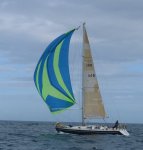
Never had much of a problem on my Lightwave, kite and all(make sure you get it right to the top too, still a metre to go in the picture), LW is also nicely controllable forwards and backwards under power, you just need to plan every move well ahead of time, plus have a plan B, C and preferably D too if possible.

Courage mon brave - it can only go wrong...!

Guernsey solo race.jpg
 
Was that Thom?
I went half way around in mine.
Yep, we met Thom in Antigua. He left for Horta the day after we left Carriacou for Horta. We kept in touch via Inreach and VHF when we sailed passed him in the Atlantic. We partied in lockdown in Horta. We were all in quarantine anchored in the harbour, not allowed ashore by Portuguese authorities even though we had all been as sea for at least 17 days. The local resistance took us to each others boats once the police had gone home for the day?. We all eventually got ashore after being given covid tests, all negative. We carried on partying in Peters Cafe
 
My experience of single handing is limited to my own 30 ft Kingfisher. Docking is the least of my worries, as dinks can be repaired, but the two things that really put the wind up me were an unreliable auto tiller and difficulty reefing. When the forecast wind force 6 becomes an 8, you soon realise that getting to the mast and back is character forming. If the tiller won't hold a course you are in the lap of the gods.
I enjoy my own company on board, but when it gets a bit knarly another pair of hands is a great comfort.
 
My observation around single handed is that everything is fine up to the point where greater than one thing goes wrong at the same time. When more than one thing goes wrong at the same time you really do appreciate more than a single set of hands. ie Rope around prop and Main halyard stuck.. Engine cuts out and roller reefing jammed.. There is always lots of scope for >1 things going wrong.

Therefore when single handing is going to be a feature of your sailing I would always opt for a boat in better condition rather than decide on size. Bigger boats have more to go wrong and when they do they cost more.

Personally I would ask yourself what you need and then try and get it in the smallest boat possible. For me everything I require fits happily in a 32ft boat. Galley, heads, heating, Hot water, Comfortable berths, wheel steering, decent donkey and strong anchor..

I would say with enough money splashed at the problem a single hander can manage a bigger boat - but to avoid stress the costs would be exponentially more..
 
My observation around single handed is that everything is fine up to the point where greater than one thing goes wrong at the same time. When more than one thing goes wrong at the same time you really do appreciate more than a single set of hands. ie Rope around prop and Main halyard stuck.. Engine cuts out and roller reefing jammed.. There is always lots of scope for >1 things going wrong.

Therefore when single handing is going to be a feature of your sailing I would always opt for a boat in better condition rather than decide on size. Bigger boats have more to go wrong and when they do they cost more.

Personally I would ask yourself what you need and then try and get it in the smallest boat possible. For me everything I require fits happily in a 32ft boat. Galley, heads, heating, Hot water, Comfortable berths, wheel steering, decent donkey and strong anchor..

I would say with enough money splashed at the problem a single hander can manage a bigger boat - but to avoid stress the costs would be exponentially more..

Absolutely this. It's why, for me, keeping the boat technically simple, with manageable loads in the rig, is key.
 
I'd add that sale plan is key... I have done a couple of solo Atlantic crossings on a swan 38 and a hustler 30... more recently I have been sailing a cutter rig and find that breaking up the sale plan into smaller triangles is a plus. If not wanting to go for a cutter rig then the swan had a slutter rig which allows changing from a part furled genoa to a fully out jib without going forwards. The game changer in my world was getting an electric winch which the main halyard and reefing lines can be run to.... it means I react with main sail size much more frequently... I am faster to shake out reefs and faster to bring them in... Its not size that matters really... its the ability to moor and the ability to reduce the sail plan in a blow without feeling ove whelmed.
 
Thanks all for the responses. Really helpful to think through. A bit crushing to learn that competence will be an issue regardless of size. I will look to the 36-42 and carry on playing on other peoples boats as time/Covid allows
Never had much of a problem on my Lightwave, kite and all(make sure you get it right to the top too, still a metre to go in the picture), LW is also nicely controllable forwards and backwards under power, you just need to plan every move well ahead of time, plus have a plan B, C and preferably D too if possible.

Courage mon brave - it can only go wrong...!

View attachment 107602
that looks lovely! Is that a 395 lightwave?
 
Far too much chance of being stuck helpless on the pontoon while the boat drifts off and does something naughty
That's why my single handing technique is to take a centre line ashore and get it round a cleat PDQ. That limits the possibilities for mischief from the boat. Single handing in difficult conditions, you simply aren't going to get two lines attached before a skinny fin-keels boat goes a-wandering, especially if those things on that tiny finger aren't cleats, but loops.
 
That's why my single handing technique is to take a centre line ashore and get it round a cleat PDQ. That limits the possibilities for mischief from the boat. Single handing in difficult conditions, you simply aren't going to get two lines attached before a skinny fin-keels boat goes a-wandering, especially if those things on that tiny finger aren't cleats, but loops.

My boat doesn't have a midships cleat, and I always thought I would miss it.
Indeed, the plan was to have them fitted this Winter.
However, over the last 7 months I have learned to do without.
I compensate for the lack of a midships cleat by docking at a very low speed. The boat will be all but stopped when I come into a berth.
The low freeboard also helps. I step ashore with both bow and stern lines and take my time about it.
 
That's why my single handing technique is to take a centre line ashore and get it round a cleat PDQ. That limits the possibilities for mischief from the boat. Single handing in difficult conditions, you simply aren't going to get two lines attached before a skinny fin-keels boat goes a-wandering, especially if those things on that tiny finger aren't cleats, but loops.

Different situations call for different solutions but yes, very often a short spring from the midships cleat is a good line to get on first. I don't think that's controversial.

My point is nothing to do with what lines go on first, it's that I don't leave the boat unmanned until it's at least somewhat secure.

Pete
 
Different situations call for different solutions but yes, very often a short spring from the midships cleat is a good line to get on first. I don't think that's controversial.

My point is nothing to do with what lines go on first, it's that I don't leave the boat unmanned until it's at least somewhat secure.

Not always possible when coming alongside singlehanded.
Unless I misunderstand what you mean by .somewhat secure'.
 
I referred to my method in post 7. I can't find the technique on youtube (it was there because I cannot claim to have invented it)

The effect is to have a line from midship and one from towards the stern which can be winched in as tight as suits.

Low freeboard is probably the greatest advantage for a yacht either coming alongside a pontoon or getting onto moorlng... After that you can add snatch blocks ,cleats winche clutches etc as you feel necessary to adopt to your needs.
 
I referred to my method in post 7. I can't find the technique on youtube (it was there because I cannot claim to have invented it)
This one?

I might be completely wrong, as I have limited bandwidth available here so have not watched it myself, but I know Duncan Wells' Stress Free Sailing is often advocated in these threads. He seems to have split his videos randomly between Vimeo and YouTube.
 
This one?

I might be completely wrong, as I have limited bandwidth available here so have not watched it myself, but I know Duncan Wells' Stress Free Sailing is often advocated in these threads. He seems to have split his videos randomly between Vimeo and YouTube.
That's the one. ? it is so easy and simple and has always worked for me since I discovered it (only about 5 times, because I use a mooring most of the time....)
 
I'd add that sale plan is key... I have done a couple of solo Atlantic crossings on a swan 38 and a hustler 30... more recently I have been sailing a cutter rig and find that breaking up the sale plan into smaller triangles is a plus. If not wanting to go for a cutter rig then the swan had a slutter rig which allows changing from a part furled genoa to a fully out jib without going forwards. The game changer in my world was getting an electric winch which the main halyard and reefing lines can be run to.... it means I react with main sail size much more frequently... I am faster to shake out reefs and faster to bring them in... Its not size that matters really... its the ability to moor and the ability to reduce the sail plan in a blow without feeling ove whelmed.

How was the difference in the Atlantic crossings in those two different sizes of boat? Advantages and disadvantages?
 
That's the one. ? it is so easy and simple and has always worked for me since I discovered it (only about 5 times, because I use a mooring most of the time....)

I use a very similar method, but mine looks a bit simpler to setup. I use a line with a spliced eye in one end, put the eye over a sheet winch (on the coaming) and two or three turns of the other end around the winch drum. So the line is now doubled up, run that along the side deck, around the front of the midships cleat and back to a point adjacent to the helm, where i loosely tie it to the top guardwire. The rest of the procedure is pretty much the same as Duncan Wells version, throw the loop over a cleat and put the engine back ahead, the boat pivots on the midship cleat, even if the looped line is over a pontoon cleat level with the cockpit.

If i want to pick a buoy up i don't mess around at the bow. I go forward and attach a line to a bow cleat, run it back to the cockpit, making sure it's outside of the rigging etc. Come alongside the buoy until it's level with the cockpit, stop the boat, pass the line through the mooring buoys strop or whatever it's got and as the boat move back in the tide, go forward with the end of the line, taking any slack in and tie off. One the boat has settled, make any adjustments needed. This is also a better technique even when you have crew, no point shouting and or signalling up and down the boat when you can both be in the cockpit.
 
This one?

I might be completely wrong, as I have limited bandwidth available here so have not watched it myself, but I know Duncan Wells' Stress Free Sailing is often advocated in these threads. He seems to have split his videos randomly between Vimeo and YouTube.
Lovely.
And where does he show you how that works on the French and Dutch minimal buoyancy fingers that are a measly 3m long and have that natty loop for tying off at the end? Or the Baltic model, where you are expected to lasso two pilings en passent, while backing in with a forty knot cross wind and a long keel?
 
Top