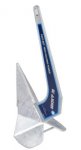
Does anyone here have any advice to give about anchors?

No evidence. Just a personal opinion that I should have made clear. My Vulcan seems to dig in immediately (in sand anyway). As far as I can tell, the sole purpose of the roll bar is to orientate the Rocna original so that it also digs in immediately. If the Vulcan is managing to achieve that without the roll bar then it seems that the designer has removed the need for the roll bar. When I had the Vulcan at home, it would not balance upside down and would always roll the right way up. It's a very clever design.

I hate to mention that a Spade does exactly the same thing and was developed in the early 1990s.

Jonathan
 
Despite aficionados strident claims about the superiority of their particular "new-age" anchor, I doubt if there is any significant difference.
Charles, I am surprised that you say that as, from previous posts, you seem quite a scientific chap. The reasons that I believe that the differences are significant are -:
1. There is enough independent testing history to make the 'straight holding' superiority of NG anchors irrefutable.
2. Test commentaries have noted that NG anchors tend to set more easily.
3. Forumites and others who have switched to NGs, invariably, say that they have to re-drop less often.
4, I have seen the better 'set and hold' to be true with my experience of my Fortress vs. my Danforth as a kedge anchor. (I am looking for a bow anchor, though)
5. I have seen the better 'set and hold' to be true on my friends boat after he changed from a big plough to a Rocna. (Including one emergency drop in Cherbourg with a failed engine on a Lee shore where anything but an immediate set would have meant the boat would have meant disaster.) [/QUOTE]

Probably the "best" holding power to weight is the Fortress.
I loved my little Fortress. I often deployed it from the dinghy for other people whose (stern-to) bow anchors were dragging in harbours. It never failed to set first time and, although it was a smaller size, it held some big boats in big winds.
However, the Fortress has drawbacks as a main bow anchor.

But if you know how to anchor the CQR, Delta and Danforth are all perfectly OK.
I certainly am no expert and seem to be getting worse (or maybe my old CQR was better than my current Bruce). But, if my technique is still rubbish after hundreds of nights at anchor then that is all the more reason for me to get the best anchor possible!
There are other people who know how to anchor very well, indeed, who have come a cropper anchoring. "Perfectly OK" may not be good enough in certain conditions.

Unless made of money I'd suggest the one that sets you back the least is the best for you.
Aye, there's the rub. The ££££s!
I know that you are not saying that the cheapest anchor is good enough. I think that what you mean is that NG anchors are not worth the significant difference in cost. That is why I am torn between blowing my budget on the Vulcan/Rocna and compromising on the Kobra 2.
 
So I went for a Fortress. Half the weight, stow in the roller, and digs in well thanks to sharp flukes. Holds well too. Been a good change.

I have thought about a Fortress as I had very good experiences using one as a kedge and storm anchor, (until it was stolen). I have a slight concern about their reputation to unset if there is a 180 degree shift - although I know that they are also said to reset very quickly.
Since they are in the same price range as the Spade and Rocna, I would be inclined to go for those heavier anchors. But, if I was gifted a big enough Fortress, I would happilly settle for it as my main anchor.
 
Can I have your Bruce?

I will hang on to the Bruce for a while until I am confident with the new anchor., (And I get fed up with it being in the way!) That will probably mean this October and into the spring. But, if you can wait till then, and assuming that I am happy with the new anchor, yes, certainly. (I assume you have seen from my profile that the boat is in Greece)
 
I had a very similar dilemma to the op on my similar sized, new to me, Dufour 30.
After previously having a spade on my old boat.
I settled on a 12kg Kobra 2.
___________________________

If you are happy with the Kobra2 after the rather more expensive Spade, then it adds to the favourable testimony from Kobra2 owners on this thread. I am beginning to think that it might be a more sensible use of my overdraft than the Rocna.

I am inclined to go for a bigger size, though. 16 Kg, or maybe even 20 Kg.)
There were a couple of posts on this thread asking what scientific basis there is for getting an anchor larger than the manufacturer's recommended size.
Apart from the fact that you boat may encounter conditions above those (e.g. 50 Knot winds) that the manufacturer has based their recommendations on, my GCSE science makes me think me that a heavier anchor will penetrate the bottom more than a lighter one, when it drops. (i.e. It makes a bigger dent when it lands.) It may only dig in half a centimetre deeper, but this can only help in giving it a better chance of gripping in a difficult surface. I stand by to be corrected by those who progressed beyond to Higher Physics.
 
I am inclined to go for a bigger size, though. 16 Kg, or maybe even 20 Kg.)
There were a couple of posts on this thread asking what scientific basis there is for getting an anchor larger than the manufacturer's recommended size.
Apart from the fact that you boat may encounter conditions above those (e.g. 50 Knot winds) that the manufacturer has based their recommendations on, my GCSE science makes me think me that a heavier anchor will penetrate the bottom more than a lighter one, when it drops. (i.e. It makes a bigger dent when it lands.) It may only dig in half a centimetre deeper, but this can only help in giving it a better chance of gripping in a difficult surface. I stand by to be corrected by those who progressed beyond to Higher Physics.

Just empirical from me, but my anchor (Spade) is the maker's recommended size, and I've had difficulty on some occasions breaking it out, because it digs in very deeply. Wouldn't like to have to recover a heavier one. I never had similar problems recovering the CQR or the Bruce. The Bruce was also a 15kg anchor, was sometimes reluctant to set, and broke-out easily when required.
 
When I bought my Rocna I was assured that the recommended size was sufficient for all conceivable conditions. I cannot claim to have sat out hurricane force winds but so far have no reason to doubt these claims. OTOH I have witnessed a smaller boat than ours with a bigger Rocna having considerable setting problems, whereas ours went in with no bother.
 
My Kobra (an original, but the geometry is the same) gave us 10 years' faultless service, then dragged 3 times in a month in NE Sardinia as F8 mistrals flipped through 180 degrees. We then hired a car in Porto Vecchio and drove to the Spade dealer in Bastia. We haven't dragged since once the anchor has been set.
 
When I bought my Rocna I was assured that the recommended size was sufficient for all conceivable conditions. I cannot claim to have sat out hurricane force winds but so far have no reason to doubt these claims. OTOH I have witnessed a smaller boat than ours with a bigger Rocna having considerable setting problems, whereas ours went in with no bother.

Can you recall what wind strength and sea conditions were considered to be "conceivable". I know that some anchor sizes given are recommended for up to 30 knots of wind!
 
Ravi,

I think Charles is generalising and saying that modern, or NG, anchors are very similar and that it is difficult, or impossible, to tell the difference between them. I do not think he is saying you cannot tell the difference between modern and pre modern.

I would tend to agree with Charles, it is difficult in general for an owner to tell the difference and in most seabeds I doubt that if blindfold anyone could differentiate. The differences are cost, whether they fit your bow roller, is it easily available, whether there have been any compromises made in material or manufacturing in order to achieve a low price and maybe whether you mind bringing up seabed on strongly concave designs. . In peripheral seabeds, for example thin mud - differences are evident.

Looking at your post I am sure you and Charles are in agreement.

Jonathan
 
Last edited:
Can you recall what wind strength and sea conditions were considered to be "conceivable". I know that some anchor sizes given are recommended for up to 30 knots of wind!

Not precisely at the time but their current advice http://www.rocna.com/product-range/sizing-guide. Is 50 knots plus surge plus bottom with less than perfect holding. The photo of Peter Smith's boat at anchor in South Georgia(?) with 100 metres of bar tight chain out in huge wind strength is testament to the advice.
 
Latest on the anchor shopping .,.
I have got the prices for the various anchor options from my (excellent) local chandlers in Greece.
Bizarrely, the Rocna 15kg is cheaper than in the UK, the Vulcan 16kg is the most expensive and costs even more than the UK Rocna price!
The Kobra 2 in s a good price, (same as the UK) but he tells me that the supplier recommends the (20% cheaper) DC anchor which he says is "the next model of kobra so its better ".
My plan is to buy the Rocna if it fits. If it doesn't, the Kobra was my next choice.
The DC is new to me and I can't find any info on it. Does anyone know anything about this anchor and its merits compared to the Kobra2?
 
The DC anchor. We have one here, though whether it is the same I do not know. The DC apparently means Delta Copy - and it does look like a Delta but does not look like a Kobra. Delta dimensions are all published and it would be easy to copy. I do not recall that there are details of the metals used to make the Delta - so the DC might use different steels. The DCs here are cheaper than the original, both the DC and Delta are made in China - whether the DC works as well, or better, than a Delta do not know. Here it is cheaper than a Delta.

The thing I find fascinating is that the Delta, Kobra, Rocna, Mantus and now DC are all made in a similar way, with similar labour and distribution costs etc etc - but some are much more expensive than others. One might think if the market can stand the higher prices product there is a little niche in there for someone to make that same higher prices product - more cheaply. My cynicism is showing through again.

Jonathan
 
The DC anchor. We have one here, though whether it is the same I do not know. The DC apparently means Delta Copy - and it does look like a Delta but does not look like a Kobra. Delta dimensions are all published and it would be easy to copy. I do not recall that there are details of the metals used to make the Delta - so the DC might use different steels.
Thanks for that. I had never heard of the 'DC' and, without some testimony, I am reluctant to choose it as an anchor. I think I will stick with the Kobra2 as my preferred option if the Rocna does not fit.
One thing that I worry is that the Greek chandler that I am emailing for supplies refers to a "Kobra" anchor. Is there a Kobra 1 which preceded the Kobra 2 and are they singificantly different?


The thing I find fascinating is that the Delta, Kobra, Rocna, Mantus and now DC are all made in a similar way, with similar labour and distribution costs etc etc - but some are much more expensive than others. One might think if the market can stand the higher prices product there is a little niche in there for someone to make that same higher prices product - more cheaply. My cynicism is showing through again.
Jonathan

Yes, I find this intriguing too. Especially, since the Rocna is more expensive than the Vulcan in the UK but the Vulcan is considerably more expensive than the Rocna in Greece??? It suggests creative pricing that is not based on manufacturer's costs!
I have been trying to understand the justification for the prices. here is my thinking ....
Rocna - it seems to have the best reputation so it could probably get away with having the highest price but it came into the market challenging the Spade at and Rocna probably pitched the price competitively - and it has stuck.
Spade - Well, if your bow configuration won't let you fit a Rocna and you want to upgrade to an NG anchor there was no choice other than the much vaunted Spade. So, they could charge any price they liked... and they did. Now that they have competition from the Vulcan, they haven't dropped their price. It will be interesting to see if they are forced into a price drop.

Delta - This is much cheaper than the others - reflecting its age and the fact that is is considered a 'modern' rather than an 'NG' anchor. Priced as a 'budget' upgrade from a traditional (CQR / Bruce type) anchor.
Kobra - Again, cheaper reflecting the fact that is is considered a 'modern' rather than an 'NG' anchor. Competing with the, more established, Delta, so it has to offer an even lower price.
Vulcan - Trades on the good name of the manufacturer (Rocna) and can go where the roll bar Rocna does not fit. In other words, Rocna's Spade killer. 60% of the price of the Spade and promising the same performance. (Although the Vulcan is priced the same as the Spade in Greece which makes you wonder.....)
Manson - Sorry - haven't really researched this but it seem like a second choice to the Rocna for most people implying that they will need to compete on cost.

So, it looks like a price war between ....
1. NG Roll bar anchors - Rocna (dominant) and Manson (cheaper challenger)
2. NG Trad Anchors - Spade (dominant) and Vulcan (cheaper challenger)
3. Modern Anchors - Delta (dominant) and Kobra2 / DC (cheaper challenger)

The received wisdom is that anchoring performance is proportional to the 1 / 2 / 3 categories above and people are prepared to pay more for the security of an established and dominant product. That explains the sliding scale of costs of these hunks of metal which (with the exception of the Spade which has much more complex manufacturing process) are almost identically engineered.

Just my thoughts ....
 
A good summation of the rational behind anchor prices, Ravi.

The only difference between the design of the Kobra 1 and Kobra 2 is in the folding mechanism.
The Kobra 1 is currently only produced in sizes 2-10 kg the Kobra 2 has a more secure folding system and this is used for models 12 kg and above. I have a vague recollection that very early on even the larger sizes were the Kobra 1 design, but I may be wrong.

So if you are purchasing a Kobra today over 10 kg it will be the Kobra 2 model.

At least that's my understanding. Plastimo don't supply a lot of information in English.
 
Last edited:
The DC is new to me and I can't find any info on it. Does anyone know anything about this anchor and its merits compared to the Kobra2?
The DC is another convex plough anchor like the Delta and the Kobra. It is produced/distributed by Plastimo. There are a multitude of models in this category. They tend to share a lot of similar characteristics, but in my opinion the Kobra is slightly better than the Delta.

The Kobra is not expensive and personally I would purchase it over the DC (which I have not seen underwater, but is almost a copy of the Delta) and the Delta itself. The Concave roll bar anchors (Mantus, Rocna and Manson Supreme) and the steel Spade are, in my view, significantly better if they fit and you can afford them.
 

Attachments

  • image.jpg
    image.jpg
    13.5 KB · Views: 0
Last edited:
When you buy a low-cost anchor the manufacturer has made a deliberate compromise somewhere in order to reduce production costs. In many cases this means that the material used is cheaper, which not only reduces its purchase price but may well have knock-on effects in fabrication techniques (e.g. Rocna's use of water jet cutting to avoid thermal effects on the shank material). Photos of a bent Kobra were shown here not too long ago. Even Lewmar's Delta, who have always claimed high strength materials, are now using far lower strength steel than I believe they did at one time, resulting in bending in a few cases.

It may well be the case that lower strengths will never be an issue for some users but don't be fooled - high cost is not only a marketing ploy. You largely get what you pay for, even though as with most technology, small improvements seem to cost an inordinate amount extra.
 
+1

This is the unknown with the DC, if the Delta has been compromised (as Vyv suggests) and the DC is even cheaper then you have to worry where the savings might have been made. It could be they have pared their margin to the bone in order to support the boating public?

In the final analysis - even expensive anchors work out very cheaply if you use them frequently and unless you are unlucky anchors last forever. Personally I'd spend the money on the anchor before many other items and as Vyv says - in general you get what you pay for.

Jonathan
 
An update.

I have ordered the 15 Kg. Rocna after the cardboard template proved to be OK with the wooden bow platform. (Only Just!)

All being well, I will head out sailing next week and I will report back on how I find the Rocna compared to my much smaller Bruce.

Incidentally, a couple of boats on my pontoon have Turkish made Rocna type copies which they say are excellent. (At 70 Euros!)
 
Top