Does anyone here have any advice to give about anchors?

Hi Neeves, I still have those ball bearings..... sadly never got to use them.

Yes, I'm familiar with your last paragraph/statement and of course agree.

I did use a CQR on my Twister years ago with moderate success especially after discussing with others as to how best to get it to set.

However, having dragged a couple of times towards potential danger, once at night, I had to look into ways of improving the situation.

I've seen as you describe, some big boats with relatively small 'Mod' Gen' anchors and the obverse.

I have gone for the slightly smaller 'modern' anchor on the slightly heavier boat in both cases of boat ownership as above in my last blog and NEVER been disappointed so far, 10 yrs on.

If you wish to sleep on the anchor with relative security, for your boat and the crew, I would weigh up (apologies) the cost of the few quid for the anchor, against the potential human and/or vessel loss or damage.

With modern technology available, we tend to set an anchor alarm on the plotter for 0.02nm in any conditions that concern us, but thankfully have never been woken yet.

S.
 
No worries Scotty,

I'd always advocate spending the cash on a modern anchor but if cash is tight - other things can be more critical, like a GPS with 5m accuracy! Its upto the owner to prioritise - but there is no argument (AFAIK) modern anchors are better, pre modern are acceptable :)

To me the cash per unit night makes a modern anchor (even an expensive one) - a no brainer (but I'd buy a decent GPS first :)

Given that a 5kg modern on a 45' will be daft - I have not yet heard of anyone complaining their sensible choice of a modern anchor was too small - but an anxious to have a flurry of comments to show me I have selective hearing.

Jonathan
 
I can never figure out that if Lewmar can knock out a usable 20lb steel fabrication for a little over 100 quid.

Why are the Spade and Rocna three times the price?
 
Who said you need a monster anchor?

Sounds like forum spin ;)

You obviously have not taken a week off and followed Charles suggestion/link at the end of Post # 76 nor followed Dashew's nor Morgan's Cloud advise. Hopefully an advocate will be along soon and point out the error of your weighs:)
 
Who said you need a monster anchor?

Sounds like forum spin ;)

Jonathan has named Steve Dashew as one of the proponents of ultra-heavy anchors for world-girdlers. It has been suggested, only half joking, that he finally gave up using a special-order Bruce anchor when its fluke tip-to-tip dimension was wider than his boat! Also check out Evans Starzinger's website, he uses very heavy anchors, around 40 kg or more, on yachts of quite moderate length.
 
I'd forgotten Evans was also an advocate. Interestingly Evans Strazinger is the only person of whom I'm aware, who based on experiences, changed from a modern anchor and has reverted to using a pre-modern design (Bruce). The change might partially reflect the idea, or the suggestion, that a Bruce anchor works much more efficiently in sizes much larger than those most of us experience.

Jonathan
 
Last edited:
I can never figure out that if Lewmar can knock out a usable 20lb steel fabrication for a little over 100 quid.

Why are the Spade and Rocna three times the price?

In fairness, the Spade is an inherently expensive fabrication and the Rocna a trifle over-specified.
I think one becomes used to a particular anchor type and its foibles - I know of people who swear by the Bruce and others who extol the Brittany.
I myself used a CQR for 14 years until wear on the pin-joint made its performance too erratic to be lived with.
With anchoring I'd opine that the most important variable is the bottom, with operator competence the next most important. The type of anchor should be dictated by the sea-bed - because there is no universal "best" anchor.

Still people search in hope augmented by faith.

PS I anchor about 150 times a year, so speak more from experience than certitude.
 
I think you'll find noelex subscribes to "bigger is better" hypothesis.

Certainly Rocna want you to have a heavier anchor than their competitors - whether this is a lack of faith (in the design) or desire to maximise profit, is a moot point.

Not a monster though.


Sizing might be more to do with the testing ground..

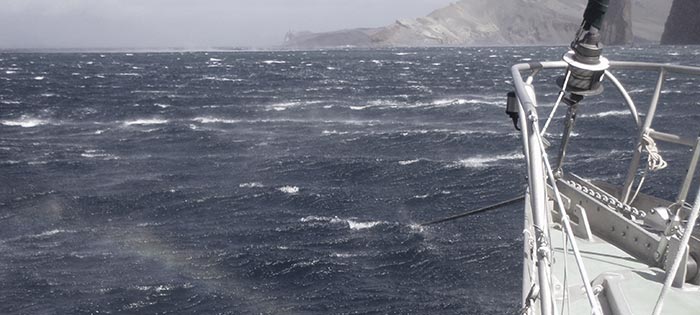
deception-island.jpg
 
As said make sure the anchor fits your bow roller and buy one that is one size bigger than the list size for your boat.

Rocna recommend for a 46' yacht a 25kg anchor if weighing less than 13t and a 33kg anchor if weighting less than 23t (its a big weight difference - but that's the way their anchor sizes work).

Edit, Interestingly (and I had never checked this before on Rocna's sizing chart) but our cat has the windage of a 45' Bavaria (from about 2012 vintage) but we weigh in at 7t in cruising mode. Rocna would recommend a 20kg anchor for us (or a 45' yacht of 6t) - which makes our 15kg anchor look parsimonious but not that far out. close edit.

Jonathan
 
Last edited:
Not a monster though.


Sizing might be more to do with the testing ground..


deception-island.jpg

In Rocna's case (using their boat/anchor sizing chart), I think it has to do with their step-sizes though I do delight in poking fun @ Peter - he does take himself somewhat portentously.
Noelex uses an anchor 2 sizes larger than recommended by Mantus a point that Jonathan keeps on making - heavier anchors ALWAYS perform better than their less weighty brothers in the maker's range.
And that weight really comes into its own in a thin layer of soft, over hard sand.
If you can handle it, and the boat can take the weight distribution, one will always be better off with an oversize anchor.
I can neither handle, or the boat take, a heavier than standard anchor - and Delta, CQR and Mantus all recommend the same weight for my boat.
So far it's only been asked to hold in 54 knots - by which time it's burrowed down about 450mm (sand on stiff mud) and the roll-bar has disappeared completely. That's probably more than one can exert @ full r pm in reverse.

In fluid, sticky mud nothing will out-perform a Fortress and weight for weight it will knock every other (except perhaps an alloy Spade) into a cocked hat.
 
Charles,

There is a thread which drifted into this, from Post 23 on.

http://www.ybw.com/forums/showthread.php?443871-Propellor-thrust-transmission-to-hull/page3

For our cat (40hp) I'd say full revs is about equal to about 30/35 knots. As mentioned our windage is equivalent to a Bav 45 (but they might have a bigger engine).

There is a suggestion that a grossly oversize anchor cannot be set sufficiently deeply (because the available engine power is insufficient) and the anchor simply sits with the fluke in the soft top surface. If/when the wind changes direction - and arrives as full blown sudden storm (we had one through Sydney this afternoon) the large anchor simply surfs out catches something in the toe - but maybe never has that chance to set before the yacht hits something. There is an interesting video, again on CF, showing exactly what happens to, even a, modern anchor when subject to a sudden change of direction, I'll add the link when I find it.

edit http://www.cruisersforum.com/forums/f118/videos-of-anchors-setting-155412-2.html

This is Video No 9 from Panope. This video is of a Manson Supreme, setting and then being re-set at short scope. The carrying of a large anchor, extolled by Dashew, is meant to allow one to be able to anchor safely at short scope - Dashew mentions 2:1. close edit

We almost never see our anchor (when it is deployed :) ) - its buried, fluke, shank and 2-4 metres of chain.

Jonathan
 
Last edited:
Can anyone explain to me how an anchor knows whether it is being "set" by an engine in astern, or just by the wind.
With a sailing yacht, I frequently anchor under sail, and my ***** anchor works fine. When did it become compulsory to "set" an anchor using 'x' engine revs?
 
Can anyone explain to me how an anchor knows whether it is being "set" by an engine in astern, or just by the wind.
With a sailing yacht, I frequently anchor under sail, and my ***** anchor works fine. When did it become compulsory to "set" an anchor using 'x' engine revs?

I was anchored in the Haringvliet and watched a Dutch barge come to anchor nearby. He just stopped, dropped his anchor, [an old fashioned sort,] then went below for his supper.
These professionals, they know nothing. Perhaps I should have gone and told him he was doing it all wrong.
 
Can anyone explain to me how an anchor knows whether it is being "set" by an engine in astern, or just by the wind.
With a sailing yacht, I frequently anchor under sail, and my ***** anchor works fine. When did it become compulsory to "set" an anchor using 'x' engine revs?

When there is no wind? :)
 
Can anyone explain to me how an anchor knows whether it is being "set" by an engine in astern, or just by the wind.
With a sailing yacht, I frequently anchor under sail, and my ***** anchor works fine. When did it become compulsory to "set" an anchor using 'x' engine revs?

The answer that that question is it depends......
On the bottom - If I see sand , I know the anchor will bight. - exceptions - when there is 3 inches sand over rock.

If I know it to be weedy mud, I have been caught out before not making sure it is in hard. Gentle astern revs won't break it out - but increase the power and off you go.

I prefer if its breezy to let the anchor be pulled in naturally.

If I am staying overnight I always dive on the anchor to take a look.

I wish I knew the answer.
 
Top