Do you remove your head sail?

Taking a biggish genoa down from the roller furler and folding it is hard on a smallish boat, and I cant easily do it on the moorings, so have to motor 45 minutes to pontoon. It also takes a time which could be more enjoyable used for more sailing, and fills up the saloon so we easily cant sit down. If I was rich enough or foolish enough to pay marina fees and had sail storage at home then that would be different. The new sacrificial strip was £230 and should last 5 years or more, and its job is to protect sail for me, not vice versa. Double gaskets round the sail in autumn or spring, and headsail off in January after our boxing day sail and back on in March, so any usage until then will need engine for motion and sailbags for seating.
 
We do leave ours on as we sail all year round. Walking through the marina though it is shocking to see the amount of neglected boats though. And surprising how many both neglected and cherished just tied up with manky old bits of string.
 
We leave a genoa on all winter, but put on an old one and keep the good one in storage. Been through a number of F10+ over the years, but recognise that if got a F12 may not be so lucky.
Dropping and folding a jib with vertical battens is too long and difficult job for us to do each time we go sailing.

Having had to go on board two boats this year and drop unfurled sails, I would say that most of the ones that come unfurled have not been stowed properly. And any boat with a foot or so of genoa clew visible certainly comes into that category - but that is often the majority of boats.
I agree with BlowingOldBoots approach ...

When I roll away my genoa I stop and pull the sail tight on the sheets, about 4 times and finish with around 3 wraps of sheet, then pull the sheets tight and secure on their cleats. When pulling back on the sheets I always get about a 1' of sheet back as the sail pulls tight around the foil. There has to be a bit of effort to get the sail tight and secure on the foil.

We also tie up the furling rope close to the stopper, so acts as a fall back on the stopper slipping.
However, one boat this year had done everything right except that the furling rope chafed through. So now when leaving for a period we also hand tie the furler drum with an extra rope.
 
Some good tips picked up for extra security: tie (or lock) off the drum, stopper knot, spinnaker sheet wrap.
 
We always leave the genoa up and furled all Winter even though we sail during about 7 months of the year only, and often leave 4 months without visiting at all .

The reason is that even an apparently hosed and dried sail leaves a smell and sometimes mould in the cabin over months, and the cockpit lockers are already full of other smelly stuff including fuel cans and the asymmetric. We are not going to take the sails home by EasyJet or trust whichever random boatyard we are wintering in to look after them, which often isn't offered anyway.

The mitigation is as others have said - furl well so not even a corner is sticking out. Cleat and stop the furling line. Lock off the drum with another short line, and parcel up the sail with another line as high as I can reach (which alas isn't to the clew).

Decades of this practice has only once caused the boat to fall over on it's cradle, losing it's mast, destroying all internal furniture on one side and making a 3m hole in the side of the boat.
 
Having had to go on board two boats this year and drop unfurled sails, I would say that most of the ones that come unfurled have not been stowed properly. And any boat with a foot or so of genoa clew visible certainly comes into that category - but that is often the majority of boats.

...We also tie up the furling rope close to the stopper, so acts as a fall back on the stopper slipping.
However, one boat this year had done everything right except that the furling rope chafed through. So now when leaving for a period we also hand tie the furler drum with an extra rope.

The sailmakers' flap is good for business though!

Seriously, +1 to all that. Also carefully eyeball the entire leech for any sign of wear and then ensure it is kept evenly tight throughout the entire furl. For the tiniest of loose patches is all a big wind requires to get to work :ambivalence:
 
I do the same plus going up the mast and removing wind instruments and tri-light.

With my previous boat which was hank on genoa I dropped the mast at the end of the season to service the gear at the head and gave all the standing rigging a good wash with fresh water and then stored under cover until Spring. My newer boat has a furling genoa so it is a little more difficult to drop the mast, I have this Winter as there is some maintenance to do but I probably won’t go to the extent of dropping the mast every year.
As for sails they are sent away for washing and valeting.
I empty the boat completely at the end of the season, it makes it easier to work on if required so don’t anticipate any mildew on kit left on board over the winter.
Mind you SWMBO does complain that the spare bedroom becomes unuseable in the winter months with ‘all you boat rubbish’.
 
The mitigation is as others have said - furl well so not even a corner is sticking out. Cleat and stop the furling line. Lock off the drum with another short line, and parcel up the sail with another line as high as I can reach (which alas isn't to the clew).

Decades of this practice has only once caused the boat to fall over on it's cradle, losing it's mast, destroying all internal furniture on one side and making a 3m hole in the side of the boat.

FWIW, most of the South Coast marinas won't even lift a boat with a furled foresail.
 
OK - I have got to ask … I understand that you aren't rich enough to pay marina fees, but why does that make those of us who can afford to pay marina fees foolish?

Speaking on behalf of the old boy I have to say that I can remember that in the days when we had a swinging mooring I probably held the same views. If you are fit and able and can enjoy the benefits that a mooring can offer, you do tend to view marina fees as a needless extravagance, though I have to admit to having been 'foolish' for the last twenty years. On a mooring you are master of all you survey and can enjoy the peace and nature around you and might well be prepared not to be able to step aboard in the knowledge that you are effectively pocketing some thousands of pounds tax-free per year.
 
Taking a biggish genoa down from the roller furler and folding it is hard on a smallish boat, and I cant easily do it on the moorings, so have to motor 45 minutes to pontoon. It also takes a time which could be more enjoyable used for more sailing, and fills up the saloon so we easily cant sit down. If I was rich enough or foolish enough to pay marina fees and had sail storage at home then that would be different. The new sacrificial strip was £230 and should last 5 years or more, and its job is to protect sail for me, not vice versa. Double gaskets round the sail in autumn or spring, and headsail off in January after our boxing day sail and back on in March, so any usage until then will need engine for motion and sailbags for seating.

Similar here.
Struggling to drop and fold a big genoa on the deck singlehanded isn't exactly the kindest thing for the sail either.

But even a F10 does not instantly unwrap a moderately secure genoa, the ones I've seen trashed are on boats that either don't get looked at for months on end in the autumn and winter, or the sails are badly stowed to start with.
I put 3 or 4 turns of something like 6mm line around the genoa through the clew eye.
After a couple of days of strong wind, I've often notice the sail is not quite as neat as it started out. Sorting it between blows stops it getting out of hand. The same genoa has been up for about 8 of the last 10 winters and lived through some blows in a fairly exposed bit of Portsmouth Harbour.
But I start to panic if the boat goes more than a fortnight without at least one of us checking it out.
Not just because of the genoa, but also the mooring, batteries, bilge, checking it hasn't been rammed or colonised by gulls or oiks from Turk Town....
 
Speaking on behalf of the old boy I have to say that I can remember that in the days when we had a swinging mooring I probably held the same views. If you are fit and able and can enjoy the benefits that a mooring can offer, you do tend to view marina fees as a needless extravagance, though I have to admit to having been 'foolish' for the last twenty years. On a mooring you are master of all you survey and can enjoy the peace and nature around you and might well be prepared not to be able to step aboard in the knowledge that you are effectively pocketing some thousands of pounds tax-free per year.

It seems an odd thing to pick out as a 'needless extravagance' - I have loads of needless extravagances - and if I didn't pay marina fees I wouldn't use my boat as much. If I can afford the fees I still don't see why it's foolish.
 
I keep sailing most of the winter. I switch to an old no.2 in the furler in October and use it over the winter. With the sun slipping behind the mountains at around 3pm in Dec and Jan I really want to get the most out of a winter sail. It's one thing taking it for granted that race crew will be happy to flake two or three headsails when you get back in, but another making casual cruising crew flake a headsail on the pontoon as it gets dark and the temperature drops and they would rather be heading home. So it stays in the furler. It's an old sail - although I will buy a new no.2 when it finally gives up.
 
It seems an odd thing to pick out as a 'needless extravagance' - I have loads of needless extravagances - and if I didn't pay marina fees I wouldn't use my boat as much. If I can afford the fees I still don't see why it's foolish.
I don't think that I said that being in a marina was necessarily foolish but that those who sail from moorings can easily view it that way. Similarly, northerners might view those who live in the expensive and crowded south-east as foolish, and they would be entitled to feel this way, and express it. That doesn't mean that my fellow-southerners are all idiots, though it is possible you might disagree.
 
20181103_131202.jpg

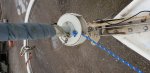
I remove the Genoa when the boat comes out of the water for winter. I don't always remove the main, however, its always covered up. However, I always lock (see picture) the furler when I leave the boat even during summer and I wrap the sheets around a few turns.
 
I've given up winter sailing so all the sails come off, normally early October. As I do it on my own and am on a fore and aft river mooring, I have to wait for a day when there's not too much wind and it's blowing in the right direction, folding the genoa is a bugger, so I do it roughly then take it to my village hall to fold it properly.
Hoisting it in Spring is the hardest job, I have to put a turn on the mast winch then bring the halyard forward to the electric windlass, then with a foot on the windlass button, a hand to tail the halyard and a hand to feed the sail into the furler track and a lot of swearing, the genoa eventually goes up.
 
I have a dry sailing contract so my boat sits in the yard except for the 3 or 4 times a year she is in the water for a month or six weeks. When she is in the yard I remove the sails so that they will last longer
 
I’ve seldom removed either mainsail or Genoa during the winter months. My reasoning has been that the mainsail is adequately protected in its sail bag on the boom and similarly the Genoa rolled up on its spar is equally secure. The only additional security measure that I take is to ensure that the furling drum cannot rotate. This is achieved by the application of additional lashings and then relaxing the tension on the furling line itself.
Living aboard for the bulk of recent years, I have witnessed many headsails on other yachts that have become unfurled. Particularly through the winter months. Being of a curious nature I have usually taken the opportunity to investigate the cause of such events. Without exception it has turned out that the furling drum has been released because a furling line has either slipped through a clutch or fretted through. Usually the latter cause. There are obviously several points in a furling line’s path to the cockpit where abrasion can occur.
Mike.
 
Top