Do ex dinghy sailors make good cruising yachtsmen?

That's not quite correct. Many dinghies, especially hard-chined ones, exhibit a massive increase in weather helm as they heal and an inexperienced helm can easily find themselves head to wind with the sails flapping. That would be on a beat. If it happens on a reach the resulting broach will probably cause a capsize. On a broad reach or run the boat can also decide to go the other way...
Yep - done all the above! 🤣

Mind you, I've done all the above in yachts too - maybe I should take up stamp collecting, or knitting... 🤔
 
Yep - done all the above! 🤣

Mind you, I've done all the above in yachts too - maybe I should take up stamp collecting, or knitting... 🤔
Multihulls do none of those things. They do of course come with a whole raft of other problems to contend with. Burying the lee bow and grinding to a horrible teetering halt, burying all the bows leaving teeth marks on your heart, refusing to bear off unless you ease the jib, beware that one when trying to duck starboard boats, and worst of all, if your trusty female crew is utterly at the end of her tether, the boat will let you know by dumping a flexi tub load of water down the neck of her jacket at an unexpected moment.
 
I think there are a lot of Wayfarer sailors who would strongly disagree with you. There's quite a few who spend their holidays doing a multi-day cruise around the west coast of Scotland, sleeping on the boat at anchor. Their boats are set up with slab reefing and at least two reef points. Some even have proper roller reefing on the genoa. Obviously a dinghy can't handle the same amount of weather than a yacht with it's heavy keel can but knowing the limitations of your vessel and of yourself is the basis of seamanship.
It took a few years and a many answers to the question from yachting friends, "Why would you need that on a dinghy?" to come up with a good cruising set-up. Even finding a sailmaker willing to make a new mainsail with two reefs in 5 oz Dacron was a challenge ("You don't need that for a Wayfarer"). A hard-chined dinghy laden with cruising gear is a good bit stiffer than the average racing dinghy that doesn't stray far from the safety boat, but as Puffin says above, knowing the limitations of your vessel and of yourself is the basis of seamanship.
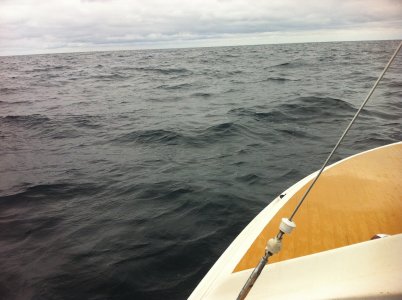
The picture below is from our 50-mile crossing of Georgian Bay in the Great Lakes of Canada, with navigation by dead reckoning and no land in sight for hours.
 

Attachments

  • IMG_0168.jpeg
    IMG_0168.jpeg
    1.8 MB · Views: 2
Even finding a sailmaker willing to make a new mainsail with two reefs in 5 oz Dacron was a challenge ("You don't need that for a Wayfarer").
We don't have that problem in the UK. There are a number of lofts who are happy to build dinghy mainsails with reef points. For Wayfarers the go-to loft is McNamara for both racing and cruising sails. Mike McNamara has a long association with the class and although his main focus has always been on racing (he's been National Champion numerous times) he has a deep understanding of the boat. Jeckells will also build you mainsail in 5oz cloth with two reef points and I'm sure there are other lofts that will as well.
 
We don't have that problem in the UK. There are a number of lofts who are happy to build dinghy mainsails with reef points. For Wayfarers the go-to loft is McNamara for both racing and cruising sails. Mike McNamara has a long association with the class and although his main focus has always been on racing (he's been National Champion numerous times) he has a deep understanding of the boat. Jeckells will also build you mainsail in 5oz cloth with two reef points and I'm sure there are other lofts that will as well.
Agree. My W had McNamara sails, and he was quite happy to add two reefs when I sent the main back for work.
The second reef is very deep, and I've rarely used it. But under double reefed main alone, I've single handed the boat in very strong conditions. I only did it a few times and then the novelty wore off.

Big respect for those who dinghy cruise. I've often thought about it, but the most I've actually done was a couple of overnights, camping ashore.
 
'Good' is an interesting question. Cruise Sailing, most especially long distance/ocean crossing is primarily a mental challenge rather than a physical/skills one and much like climbing mountains, it's not something you can 'cross-train' for, so you'll not know whether it's for you until you try.
That said, we aren't nor ever were, 'proper' sailors, so when coming to the sport cold, we began by doing a dinghy sailing course, plus some further practice dinghy sailing just to learn the basics (can we even do this?) and have never regretted that decision. Over the years we've met many very competent and experienced cruising/keel boat sailors who struggled to achieve things which we thought were obvious/easy as a result of that one summer sailing dinghies.
 
Top