DIY CMCE lightning preventer

Brc45

Active Member
Joined
10 Sep 2023
Messages
52
Visit site
They seem to be just a stack of metal plates with insulators in between - hardly worth their prices.

What do you reckon are the best materials to make one in a local metal maker shop?
 
They seem to be just a stack of metal plates with insulators in between - hardly worth their prices.

What do you reckon are the best materials to make one in a local metal maker shop?
Links in your other post suggest that silicon bronze, which is about 98% copper, is the alloy of choice. Failing that, I don't know its availability in sheet form, I guess that copper would be next best.
 
The SERTEC CMCE MARINE operates as a passive sensor system that provides permanent protection by balancing and deionising the effects of atmospheric phenomena using one or more compensators. By stabilising the existing electric field in its environment, it creates a ‘shield’ that cancels the formation of the ascending tracer by draining the electric charges to the earth or surrounding water in harmless milliamperes. This eliminates the formation of lightning within the protected area.

Each capacitor has one of its electrodes referenced to the ground system which is charged with the same polarity as it. The free electrode induces atmospheric charges of opposite polarity to the ground system, balancing internally between its electrodes. This generates a flow of charges to the ground system, which are absorbed from the atmosphere, not allowing the formation of lightning.


:sick::sick::sick:

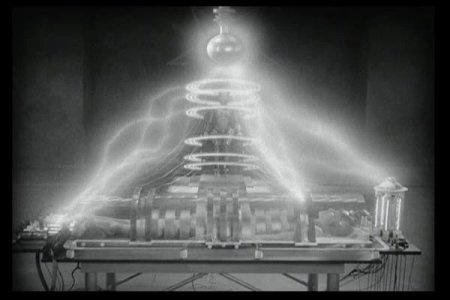
Looks like they've even given it a bit of a Fritz Lang design for good measure.

vdg2.jpg

vdg.jpg
 
Links in your other post suggest that silicon bronze, which is about 98% copper, is the alloy of choice. Failing that, I don't know its availability in sheet form, I guess that copper would be next best.
Thanks! They remind me of those ball poles in science class lightning generators and Frankenstein movies. I think those are just chromed steel?
Sertec - one of the purveyors - i think mentioned galvanised steel.

Biggest problem is that from the word-salad descriptions on OEM sites, I can’t tell whether there‘s a conductive path between the top and bottom plates, or a kind of a capacitor sandwich. My guess, it’s the latter.

They also remind me of a large trailer towing hitch ball. I wonder if cutting one in halves horizontally and putting a plastic insulator between the halves with epoxy would work?
 
The SERTEC CMCE MARINE operates as a passive sensor system that provides permanent protection by balancing and deionising the effects of atmospheric phenomena using one or more compensators. By stabilising the existing electric field in its environment, it creates a ‘shield’ that cancels the formation of the ascending tracer by draining the electric charges to the earth or surrounding water in harmless milliamperes. This eliminates the formation of lightning within the protected area.

Each capacitor has one of its electrodes referenced to the ground system which is charged with the same polarity as it. The free electrode induces atmospheric charges of opposite polarity to the ground system, balancing internally between its electrodes. This generates a flow of charges to the ground system, which are absorbed from the atmosphere, not allowing the formation of lightning.


:sick::sick::sick:

Looks like they've even given it a bit of a Fritz Lang design for good measure.

Thanks! So, i guess the way to DIY this might be to find the biggest of those Van der Graaf contact balls, cut that in half, and put an insulator in between?

What to use for the insulator then?
 
Thanks! They remind me of those ball poles in science class lightning generators and Frankenstein movies. I think those are just chromed steel?
Sertec - one of the purveyors - i think mentioned galvanised steel.

Biggest problem is that from the word-salad descriptions on OEM sites, I can’t tell whether there‘s a conductive path between the top and bottom plates, or a kind of a capacitor sandwich. My guess, it’s the latter.

They also remind me of a large trailer towing hitch ball. I wonder if cutting one in halves horizontally and putting a plastic insulator between the halves with epoxy would work?
I think you're confusing two technologies, the Van Der Graaf generator and a lightning conductor. I believe Sertec's marketing is also attempting to do this so you envisage their product surrounded by St Elmo's fire efficiently doing it's job when all you need is a grounded conductive spike higher than the thing you are trying to protect.

Why DIY snake oil instead of using proven cheap & cheerful technology?
 
I think you're confusing two technologies, the Van Der Graaf generator and a lightning conductor. I believe Sertec's marketing is also attempting to do this so you envisage their product surrounded by St Elmo's fire efficiently doing it's job when all you need is a grounded conductive spike higher than the thing you are trying to protect.

Why DIY snake oil instead of using proven cheap & cheerful technology?
From their movie, it seems their goal is to prevent an arc, rather than conduct it through:
 
I think you're confusing two technologies, the Van Der Graaf generator and a lightning conductor. I believe Sertec's marketing is also attempting to do this so you envisage their product surrounded by St Elmo's fire efficiently doing it's job when all you need is a grounded conductive spike higher than the thing you are trying to protect.

Why DIY snake oil instead of using proven cheap & cheerful technology?
100% copper is used for land based conductors. Maybe silicon bronze offers rather better corrosion resistance in air at sea?
 
From their movie, it seems their goal is to prevent an arc, rather than conduct it through:
A spike lightning conductor also prevents the arc - the aim isn't to attract the bolt but to dissipate the local charge. There are still quite high currents involved, hence the heavy conductors to earth, but a lightning conductor that is hit probably melt the conductor!

As others have said, this is at best unnecessary complication and at worst snake oil.
 
For the boat I use a weighted length of wire dangling in the water clamped to a backstay, as probability several others do.
Thanks! Researching about catamarans being more difficult to ground, because their path down to the water is not straight, I’m wondering why the cat OEMs don’t provide an option to dangle a 000 or 0000 cable from bottom of mast straight down into the water below?

If the insulation were white, it would be hardly noticeable, and easy to replace.

Has anyone tried that?
 
I live in a very high lightening strike area for the world.

some years ago I grounded my TV aerial to try to protect it from lightning strikes with 10sqmm cable.

W did have a lightening strike. I found my TV aerial in my swimming pools and the grounding cable melted for about 200mm length such is the power of a direct lighting strike
 
A spike lightning conductor also prevents the arc - the aim isn't to attract the bolt but to dissipate the local charge. There are still quite high currents involved, hence the heavy conductors to earth, but a lightning conductor that is hit probably melt the conductor!

As others have said, this is at best unnecessary complication and at worst snake oil.

Why would the conductor be hit, if it’s actually dissipating the local charge?
 
I've been in two lightning strikes ... one was forked direct hit to antenna on office roof ... other was sheet lightning hit ships vhf antenna and fried gear on bridge / around accoms deck ...

Wives out at the time ended up with hair frizzed up like in a cartoon ...

Lightning directors did nothing to protect ...
 
For the boat I use a weighted length of wire dangling in the water clamped to a backstay, as probability several others do.
I think this is a terrible idea. Assuming stainless steel wire of back stay the resistance is quite high compared to copper or iron. That will vaporise the wire more quickly. Best bet is a wire clamped to base of ali mast then over the side to water. Ali mast can carry a lot of current easily. Don't earth stays. ol'will
 
Top