Dinghy or Yacht

Leisure 17 and Tom C’s DS book will get you going safely for little cash. Find a mooring/berth for your boat first! A decent, hands on club, is very helpful.
I would agree with that (see avatar) and you could probably find a L17 for sale for no more than a decent dinghy.

The reason dinghy sailing does not appeal to me is the need to wear a wet (or dry) suit and the expectation that you will capsize and need to learn how to right the boat. Even in a small cruiser like the L17, you do not expect to capsize it, and even if you did, it should be self righting.
 
I would agree with that (see avatar) and you could probably find a L17 for sale for no more than a decent dinghy.

The reason dinghy sailing does not appeal to me is the need to wear a wet (or dry) suit and the expectation that you will capsize and need to learn how to right the boat. Even in a small cruiser like the L17, you do not expect to capsize it, and even if you did, it should be self righting.
There are dinghies and dinghies. I used to sail a Firefly mostly, and my usual garb was a woollen shirt and corduroy trousers, and no lifejacket in the summer on inland waters. There are plenty of dinghies that you can sit ‘in’ and expect to stay dry in in summer weather, and where the chance of a capsize is too low to be concerned about.

A lot of sailors express a dislike of racing, but racing doesn’t have to be formal. Often a sailing school will send the class out on a short race around the buoys. This is where the children (mostly) learn to forget about the technicalities and develop a real feel for what the boat is doing. In any case, as everyone knows, when a similar yacht comes into view going your way, it will turn into a race whether you like it or not.
 
Wow folks, they were very quick replies. Thank you. I definitely am not interested in racing. Late 50's. Not keen on fishing myself out of the drink on regular occasions. If I was to go for the yacht, it may be a daysailer. To save the mooring fees. Dinghy, an Enterprise or a wayfarer I was thinking. It would be nice to have a night away with one. What feedback can you fine people offer me?
Kind regards


As ridgy has suggested, buying either of those two boats has the potential to put any newcomer off sailing for life.

Don't put the cart before the horse, have a think about what to buy when you have sailed a bit. Dinghy work is not essential but it gives you a huge amount of relevant experience for little money and some people never really catch up on what they have missed.

Once you know you are actually going to get on with sailing, buy a boat asap and get out there. I would not get involved in any extensive RYA type residential keelboat courses, they are expensive and don't suit everyone.

.
 
You may find the general guidance from the Royal Yachting Association worth reading.
Start Boating

Many clubs run a Try a Boat scheme and it could be worth checking out your local clubs. Most are in May at the beginning of the main season.

Redrooster, if you let us know where you are based and where you intend to sail, then you should get specific recommendations.
25 miles from Lowestoft. 35 ish from Felixstowe
 
Life is short.
I'm a lifelong dinghy sailor, but I would not encourage delaying yacht sailing with a season in dinghies or anything.
If you want to make progress, you can try several approaches in parallel.

In my opinion, the best sailors generally start in dinghies, but that's easiest if you grow up with parents who sail or in a suitable place on the coat.
There is a lot to know about coastal cruising which is not much related to being good at actually sailing the boat.

I'm also a long term club member, but I'd point out that clubs vary a lot and not all have much to offer in terms of training adults.
At least not formally. Some clubs are fertile ground for finding opportunities to sail with other people.
IT's worth visiting a few contacting people and talking to the various clubs.

I would consider looking for Facebook groups in your area for 'crew available/wanted'.
Also any pay'n'play charter-sharing 'clubs'.
The RYA and Noble Insurance websites have lists of clubs, see what's near you.

RYA courses can be good value.
Other training organisations like the various Tall ships/OYT/'one boat charity' operations may be worth a look?
There are a good few boats out there taking paying crew in one way or another.

Ask around at work or wherever, people who sail get everywhere and if they can't hep you themselves, they can often have ideas about where to ask etc.

If you think you want to own a boat, don't delay thinking about where to keep it, many of the value options, like club moorings, have waiting lists.
 
My own experience may be informative even though I started 60 years ago. As a student I joined the university sailing club to learn how to sail. I found out that although there were two Enterprises available there were no instructors. Two of us took one of the Enterprises out and couped it. We found it very difficult to get it upright again. Later that summer both dinghies were taken to Rothesay and along with another student we camped on Bute for a week and learned to sail them.

I then bought my own GP 14. Which I couped the first time I tried to sail it. I admit that it was stupid to sail that day but there was a race on. And when I got to the start line I found that it was cancelled due to the high winds. I sailed the GP for a few years but there was no other GPs where I was sailing so I bought a 14 ft YW Dayboat and had several happy years without a capsize. In that period I also capsized Fireflies, Fireballs and a Flying Dutchman, all of which put me off boats starting with F. I then bought a worn out 6 metre and started to find out what goes wrong in keelboats.

Pros an cons.
Dinghies are cheap, easy to store in summer and winter and you'll learn to sail quickly or give up. BUT they can capsize. If you don't want to go swimming regularly then avoid sit-on dinghies like lasers.

Keelboats are more expensive and need a place to moor in the sailing season. They can also be hard to lay up in winter unless you take the Maurice Griffiths approach and either sail all year or sell (or wreck) your boat in the Autumn.

I envy you. All the fun lies ahead.
 
There may be some fast, efficient sailors who have never sailed dinghies, but they are very definitely in the minority. Dinghies, preferably a fairly fast and capsizable one, give you an very instinctive feel for wind and to a lesser extent for sail trim. Get it wrong and go swimming, or at least get agile enough to climb over the side onto the centreboard. The next stage is when you don't, or almost never, capsize to leeward, but on a really fast plane occasionally go in to windward. Again, the less often this happens on really windy days the better you are. If you never capsize, it doesn't mean you are that good, just that you are not trying hard enough!

I can fully understand though that some people don't want to get cold and wet, though it's better these days with cheap wetsuits available. I don't really see that there is much learning advantage in sailing a slow almost-uncapsizable dinghy. Apart from the pleasure of being out sailing - which is the whole point of the thing - the only difference between that and a small cruiser is that on the cruiser you can heave to and make some tea or coffee.

I think I'm saying that dinghies are a very "fast start" to being a skilled "sailing" sailor. They don't teach you handlng under power or how to manouevre big boats. Well over 50 years ago, with lots of first dinghy and then tiny cruiser sailing, plus some occasional crewing on bigger cruisers, I took a Yachtmaster Offshore practical examination in a UKSA boat, and passed with the instructors comment that I "... could certainly sail: though I was rubbish at handling under power, but would probably learn". At the time my own cruiser was a plywood Caprice with a Seagull 40 as outboard. It was either on or off, no gears.

I'm still better at sailing than handling under power.... Too many years sailing on and off moorings and not enough in and out of marinas.
 
There may be some fast, efficient sailors who have never sailed dinghies, but they are very definitely in the minority. Dinghies, preferably a fairly fast and capsizable one, give you an very instinctive feel for wind and to a lesser extent for sail trim.
I can certainly tell the difference among my friends. One sign of lack of experience is the tendency to hold the tiller like a motorbike handlebar instead of just resting the hand on the tiller and curling the fingers over. I was pleased to see one grandson do this naturally a year or two ago.
 
There may be some fast, efficient sailors who have never sailed dinghies, but they are very definitely in the minority. Dinghies, preferably a fairly fast and capsizable one, give you an very instinctive feel for wind and to a lesser extent for sail trim. Get it wrong and go swimming, or at least get agile enough to climb over the side onto the centreboard. The next stage is when you don't, or almost never, capsize to leeward, but on a really fast plane occasionally go in to windward. Again, the less often this happens on really windy days the better you are. If you never capsize, it doesn't mean you are that good, just that you are not trying hard enough!

I can fully understand though that some people don't want to get cold and wet, though it's better these days with cheap wetsuits available. I don't really see that there is much learning advantage in sailing a slow almost-uncapsizable dinghy. Apart from the pleasure of being out sailing - which is the whole point of the thing - the only difference between that and a small cruiser is that on the cruiser you can heave to and make some tea or coffee.

I think I'm saying that dinghies are a very "fast start" to being a skilled "sailing" sailor. They don't teach you handlng under power or how to manouevre big boats. Well over 50 years ago, with lots of first dinghy and then tiny cruiser sailing, plus some occasional crewing on bigger cruisers, I took a Yachtmaster Offshore practical examination in a UKSA boat, and passed with the instructors comment that I "... could certainly sail: though I was rubbish at handling under power, but would probably learn". At the time my own cruiser was a plywood Caprice with a Seagull 40 as outboard. It was either on or off, no gears.

I'm still better at sailing than handling under power.... Too many years sailing on and off moorings and not enough in and out of marinas.
But someone who wishes to be a good all-round sailor could always get competent at handling a yacht, pilotage, navigation and all the other YM syllabus stuff before learning to sail fast in a dinghy.
Just owning a dinghy for a few years and going out a few dozen times doesn't ensure you'll be a better sailor anytime soon.
And if your objective is to enjoy getting from A to B along the coast safely under sail, doing it a little more efficiently because dinghies have taught you a few things may not add anything to the experience. I'll just get there either half an hour quicker, or having used a bit less diesel.
One could of course delete 'dinghy and insert 'windsurfer' in much of this discussion.

I would encourage seeking as much varied sailing as possible.
In the long run, some experience on yachts might make you a better dinghy sailor.
 
They don't teach you that on YM courses.
I was taught that on mine ? I also have no desire to 'race' another yacht and often depower the mainsail/heave to when I see some keen old codger in another boat passing me - the look of disappointment on their faces is a sight to behold.

Back to the OP's question. If the ultimate aim is to do coastal hops then I'd, join a club and crew for others then get a boat. I understand Lowestoft is not too far. I had an interesting entrance at 0045 hours with a 2 knot tide across the harbour entrance in August, even called up harbour control Not many dinghies will have a VHF radio, but a skill you will need to master.
 
Thanks so far, which Dinghy's are sit in. Some suitable for a novice. Just some for me to research.
Thank you
 
Last edited:
Thanks so far, which Dinghy's are sit in. Some suitable for a novice. Just some for me to research.
Thank you
Old people who sail yachts will tend to recommend 'sit in' dinghies.
I'd suggest deciding what you want from a dinghy.
Much to be said for joining a club where you fit in with a group of people and sailing similar boats to them.
That way you can learn from them more easily.
If possible, try a variety before buying.
Also, the best dinghy for you may vary with the venue.
Sailing on the sea where it's windy, I like my Laser.
Other places where there's less wind and waves, I prefer various others.
And your size matters, if you are 10 stone, don't buy a Phantom. If you are 15stone, don't buy too small.
Maybe look for a sailing school which has a range of dinghies, I don't know your area, but the Andrew Simpson organisation might be a start?
Watersports & Outdoor Activities | Andrew Simpson Centres
I expect the RYA has a list...

A lot of clubs have a few Lasers etc they will lend out to members.
 
Hi all, new here. Which is the best starting point to learn to sail?. Dinghy or small yacht? Intent on some costal cruising in the near future. Learn from an experienced sailer or an Rya course?
Kind regards

No Brainer!!

If you are intent on coastal sailing, learn in a small yacht, and on a series of RYA courses. Competent Crew, Dayskipper, Coastal Skipper, Yachtmaster, (if you feel the need).

Having sailed with experienced yachtsmen for over 30 years, and having been a navigation officer in the merchant navy, I learned more than I had ever known during a week of Yachtmaster RYA training on my own boat in 2007.

The RYA courses have a structure which leads logically from knowing nothing to knowing lots, and they are taught by someone with the skill to impart the knowledge and skills.
 
To be honest dinghy sailing "can" improve sailing techniques if you race. However I started sailing aged 10 on my parents brand new 30ft yacht and neither of my parents had sailed before. The youngsters at our club ribbed us for being armchair sailors. After a couple of year my brother and I built a Mirror dinghy. The first race was a wake up call for them as we came second and after that we rarely lost a race. After changing the yacht to a 34ft one, my parents were encouraged to join a cruiser race, needless to say my father got the bug. Changing clubs then pushed us into racing on the East Anglian Offshore Racing Circuit in the very late 1960's. This caused more changes in yachts and then longer distance cruising. I did race a Laser, but I was too young and light weight at the time. My own first yacht in 1982 was a 22ft extreme race boat that could plane. Later changed to a 28ft yacht in 1987 that I sailed singlehanded including using a spinnaker. Later I sailed with my parents on their 43ft yacht until work and family life meant I had to stop sailing in 1992. I returned to sailing at the end of 2013 buying a 1980 Westerly Fulmar, which I almost fully renovated. My wife suffers from motion sickness, so I usually sail singlehanded. Distance does not worry me and have sailed up to 110 miles in a day. Next year I am heading up the East Coast and stopping at the Shetland Isles before sailing down the otherside to return home.

These links might give you a taste of sailing and renovating my Fulmar.
Concerto under spinnaker
Ghosting on the Medway
Salcombe to Isles of Scilly and back
Sailing from Chatham to Portsmouth and back
Concerto at the Boat Show 2021
Concerto being renovated https://wiki.westerly-owners.co.uk/images/3/3f/Concerto.pdf

Just a final comment. Learning to sail is the simple part of yacht ownership. You need skills to berth, navigate, knowledge on the weather and tides, maintaining sails, electrics, engines, oh not to mention unblocking a loo, etc. It is a vast learning curve, but there is so much information available today that was only available in books when I started.
 
I bought the biggest dinghy I could find. I really wanted a yacht, but a dinghy (especially an old one) is a fraction the cost to own.

I didn't want to race (ever) so it didn't matter that the dinghy was old and a bit rough. The low cost mattered much more.

51421317510_123217d441_c.jpg


But, wanting the security of never capsizing and the versatility of accommodation, I eventually bought a small yacht too...

...unfortunately, the yacht cost five times as much to keep afloat as the dinghy costs to keep ashore. The comfort of the cabin was minimal, the cost of replacing anything was withering, and the yacht's sailing qualities were really inferior to the dinghy's.

I began by thinking that Redrooster obviously wants a small yacht, just the same as I did - he's not keen to race and he doesn't see any joy (there isn't much) in battling to keep an unstable, unballasted boat upright in chilly, gusty UK waters...

...but in his shoes I'd aim to avoid entry-level yachts altogether and get something with the headroom and facilities of a caravan. Yachts under 24ft feel more like camping in a 4x4...only slightly better than nothing, and still very expensive to berth.

Actually I still want a small cabin boat, but a particular design which I believe will suit me. Meanwhile, I still have the dinghy! :)

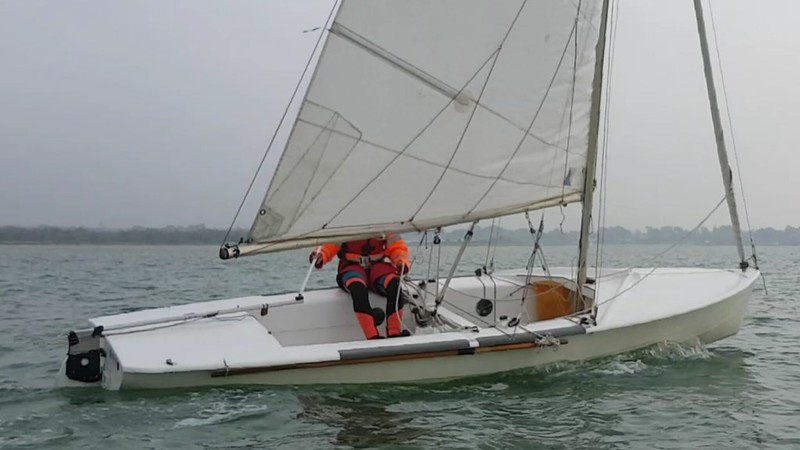
A dinghy teaches alertness by punishing doziness. Problems that afflict yachtsmen often seem to come from limited awareness or from easy reliance on the stability that ballast bestows. So perhaps learning in a dinghy is a benefit, but it isn't relaxing in a breeze. I was crouching warily on the floor in my rotten video below, because I didn't want a swim in the 9°C seawater in April.

Despite the dinghy's limits, it is a real thrill to sail. Every yacht I've helmed since has felt leaden, which I suppose they were. ?


Other threads that may be of interest

Top