Depth and Speed failed

Thanks that video is excellent - feeling much better about it now; hopefully I just have to turn it around and not remove it this time but it is certainly good to know for the future. Mine is in a locker rather than the bilge so not so easy to pump out so it will be sponges and bucket at the ready then.

As to mounting the transducer, this was done by previous owner so don't know the quality of the work but judging by everything else Ive had to fix it could well be done badly. Its mounted inside the hull - not through hull - and appears to be epoxied in place with loads built up around the sides so it will be a real pig to remove so I will probably just leave it there. The hull is solid grp so no core or double skin issues that could be interfering. If I do need to put a new one in I'll almost certainly get one of those oil bath mounting systems as that seems to get rid of any possibility of air pockets and allows for servicing but sadly no such system is in place at present.
 
Last edited:
OK, so probably nothing has changed there. The question is whether it ever worked :)

Pete

All I can tell you is when it was on the hard we turned it on and it showed a very consistent distance, even with the other electronics all turned on, I cant remember exactly what the reading was now and obviously wasn't the correct distance to the ground but it certainly was not leaping about.
 
A friend of mine had an old NASA depth sounder and, unlike other depth sounders I've seen where the displayed depth varies in a steady progressive manner, the numbers on this were constantly (and rapidly) changing. It was usable, but certainly not user friendly. I have no specific knowledge of these instruments, but is there perhaps any setting that you can alter to increase the display's damping?

Very occasionally my depth sounder (Stowe) will struggle to register the depth and the display will flash to make this apparent. It can happen when near a larger vessel that I assume has stirred up silt in the water. For some reason it can also happen on my berth in Chichester Marina (fish?). Is it possible that your problems could have been due to something like this?
 
A friend of mine had an old NASA depth sounder and, unlike other depth sounders I've seen where the displayed depth varies in a steady progressive manner, the numbers on this were constantly (and rapidly) changing. It was usable, but certainly not user friendly. I have no specific knowledge of these instruments, but is there perhaps any setting that you can alter to increase the display's damping?

Very occasionally my depth sounder (Stowe) will struggle to register the depth and the display will flash to make this apparent. It can happen when near a larger vessel that I assume has stirred up silt in the water. For some reason it can also happen on my berth in Chichester Marina (fish?). Is it possible that your problems could have been due to something like this?


Yes its possible to change between averaging and instantaneous readings and the sample rates can be varied to try and reduce errors but there are far more spurious than correct readings and they vary widely from <1m to over 50m so even when set to maximum averaging and longest sampling which gives the slowest rates of change its not providing anything meaningful. Higher rates of display make the apparent errors worse but it does at least show the source of the errors more clearly.
 
As to mounting the transducer, this was done by previous owner so don't know the quality of the work but judging by everything else Ive had to fix it could well be done badly. Its mounted inside the hull - not through hull - and appears to be epoxied in place with loads built up around the sides so it will be a real pig to remove so I will probably just leave it there. The hull is solid grp so no core or double skin issues that could be interfering. If I do need to put a new one in I'll almost certainly get one of those oil bath mounting systems as that seems to get rid of any possibility of air pockets and allows for servicing but sadly no such system is in place at present.

Are you quite sure the present one is not in an oil bath? Reading normally at rest but misbehaving when the boat moves around is often a sign of insufficient oil surrounding the transducer.
 
The only time it showed a steady reading was when it was out of the water on the trailer. Its definitely not in an oil bath.
 
The only time it showed a steady reading was when it was out of the water on the trailer. Its definitely not in an oil bath.

That maybe the issue...my understanding is that the idea is that they should be in an oil bath... on my old boat I found an inside hull transducer mounting (with transducer) that had been so well hidden it took me 4 years to find it - taking it apart, the transducer was in good condition, but all the oil had gone - I assume evaporated over time as the fit was tight to the tube and I can't imagine it takes much oil.... it might be worth trying a refill - but check the bottom of the fitting is water/oil tight first... :D
 
my understanding is that the idea is that they should be in an oil bath...

Don't have to be, that's just one option among several. Anything that gives a good air-bubble-free coupling between the transducer face and the water should be fine. Even a big blob of mastic with the thing stuck into it is ok, as long as there's no air inside the blob.

Pete
 
Think about it... The paddle wheel has a magnet in one of its vanes and so it sends a pulse each time it passes the sensor. The instrument head integrates the speed of pulses into a speed, but it doesn't know which way the wheel is rotating. Often the speed of the waterflow over the hull isn't quite in the direction you expect, so it can be worth twisting it a little in each direction until you get the maximum reading - then play with the calibration factor to achieve an accurate reading.

Just wondering whether you antifouled over the location of the depth sensor - I've never had a problem with this, but others tell me it can happen. I don't have a NASA unit, but sailed for many years on a boat with a noth a Target Depth and Target Speed. Over certain types of bottom, the depth went haywire - I guess the setting we were using for the hard sand bottom of Southampton Water didn't give good results on soft mud or weed (who knows?). As others have said, might be resolved by adjusting the sensitivity...

Rob.
 
Think about it... The paddle wheel has a magnet in one of its vanes and so it sends a pulse each time it passes the sensor. The instrument head integrates the speed of pulses into a speed, but it doesn't know which way the wheel is rotating. Often the speed of the waterflow over the hull isn't quite in the direction you expect, so it can be worth twisting it a little in each direction until you get the maximum reading - then play with the calibration factor to achieve an accurate reading.

That's exactly what I would have thought too but there is definitely a right and wrong way to point the paddle wheel, its slightly curved vanes presumably work better in one direction than the other which is why I was so surprised to have zero readout especially since it worked great when we just turned the wheel manually before the launch.

Just wondering whether you antifouled over the location of the depth sensor - I've never had a problem with this, but others tell me it can happen. I don't have a NASA unit, but sailed for many years on a boat with a noth a Target Depth and Target Speed. Over certain types of bottom, the depth went haywire - I guess the setting we were using for the hard sand bottom of Southampton Water didn't give good results on soft mud or weed (who knows?). As others have said, might be resolved by adjusting the sensitivity...

I'll have another stab at the settings when I'm down at the boat next but to answer your question yes indeed I have added 4 coats of coppercoat and 4 coats of Hempel epoxy anti-osmosis undercoat to the bottom after scraping of about 1/4" thick ( or about 10 years worth ) of crispy blue AF muck off her. I didnt re test it after finishing the bottom, it was only tested immediately after scraping the old stuff off just in case I had damaged anything so you might have hit the nail on the head. Thinking more on it now, I'm wondering if the vibration from the orbital sander might have had a detrimental effect too.
 
Update:

Speedlog is working - YAY !... no idea what it was but was sailing about 4 knts on Monday and it suddenly sprang into life and is working okay now - perhaps a bit a seaweed stuck up its hole somewhere.

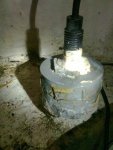
No joy with the depth sounder though. I took a photo of the transducer - there is some light oil residue nearby in the bilge but no amount of manual effort would unscrew the head of this thing to see if this is in fact one of those oil filled tube thingies, it doesn't look like what is advertised on NASA's website so before I take the big monkey wrench down next weekend and accidentally tear a hole in the bottom of the hull can anyone confirm whether this is one of the oil filled mounting systems or not?

nasa-sounder.JPG
 
Update:
No joy with the depth sounder though. I took a photo of the transducer - there is some light oil residue nearby in the bilge but no amount of manual effort would unscrew the head of this thing to see if this is in fact one of those oil filled tube thingies, it doesn't look like what is advertised on NASA's website so before I take the big monkey wrench down next weekend and accidentally tear a hole in the bottom of the hull can anyone confirm whether this is one of the oil filled mounting systems or not?

View attachment 32056

That looks like an oil bath of some description to me. If you can't unscrew the top try drilling a small hole into the top big enough to pour some oil through. Then using either a self tapper and soft rubber washer seal the small refill hole, or alternatively use a small bung or dab of sikoflex etc. Then if the problem reoccurs you can easily refill. If you have a leak from the chamber however you will need to fix this also.
The issue you have is identical to the one we experience but out transducer is still temporarily mounted onto a blod of plumbers mait - this tends to dry out and just needs replacing or re-seating once in a while. Friends of ours fix their similar issue by adding a bit of moisture, water or oil.
Not knowing what is already in the chamber may potentially cause an issue if the oil you pour in is significantly different in density and layering occurs across the transducers face? Don't know - might not be a problem for it.

Paul
 
If you can't unscrew the top try drilling a small hole into the top big enough to pour some oil through. Then using either a self tapper and soft rubber washer seal the small refill hole, or alternatively use a small bung or dab of sikoflex etc. Then if the problem reoccurs you can easily refill. If you have a leak from the chamber however you will need to fix this also... ...Not knowing what is already in the chamber may potentially cause an issue if the oil you pour in is significantly different in density and layering occurs across the transducers face? Don't know - might not be a problem for it.

Paul

Thanks Paul, good idea, it wouldn't surprise me in the least if the previous owner glued the top in place so a new refill point is a good ploy, I might even be able to rig up a small dipstick. Hopefully the top will come off with a tool that's more persuasive than my grip without breaking anything and I can then give it a good clean out and look for leaks before refilling with castor oil.

Update: Seems like Castor oil is on some kind of banned substances list and cant be bought over the counter any more although is available online. Hopefully good old veggy oil will work instead.
 
Last edited:
Got the top off and it was indeed an oil chamber - dry as a bone - topped up with vegetable cooking oil and put it back together and its working perfectly now.

Thanks guys, I would never have guessed that's what it needed.
 
Top