
jfm
Well-Known Member
The payment did get to the place that OP asked the bank to send it to. So the bank will not reverse it.If a transfer doesn't end up where you wanted then you can and should raise it with the bank.

The payment did get to the place that OP asked the bank to send it to. So the bank will not reverse it.If a transfer doesn't end up where you wanted then you can and should raise it with the bank.
I'm not sure which "point" you're referring to there, but there is no way police will deal with this as criminal fraud, when it's only £500 and they can easily file it under "breach of contract; civil matter" And nor should they - we don't want to be paying/distracting police on £500 lost by careless/hapless folk.At which point it becomes fraud, and a criminal matter which the police CAN get involved in. Entirely my point.
Yes, the thread has taken on a life of its own posing questions and answers that are unrelated to the meagre information that the (now absent) OP gave.Meantime, back in the real world, the OP doesn't even bother to log in here to see if someone found the secret to recovering his "monkey" while the wardroom JAG's continue in full Tidal flow.

I am sure you are correct but regardless of a persons ineptitude or gullibility they should be entitled to the protection of the law whether it's £500 or £5 million especially if it might lead to the apprehension of a serial fraudster ( scammer) that may have over several or more such ventures defrauded countless people out of to them significant sums of money.I'm not sure which "point" you're referring to there, but there is no way police will deal with this as criminal fraud, when it's only £500 and they can easily file it under "breach of contract; civil matter" And nor should they - we don't want to be paying/distracting police on £500 lost by careless/hapless folk.
There are a lot of mights involved in police work some of them pay off and some of them don't, when people start putting a price on the law then it's a sign of the depths that they and society have devolved to.Might, or might not. I mean, might or not lead to an apprehension, of a guy who might or might not be a serial operator as opposed to a one-off guy. But it will for sure burn up police resources. Worth considering how high up the police priorities this missing £500 should be. OP didn't need to lose the £500 at all - he handed it over voluntarily.
He is entitled to the protection of the law, but there are limits. He has full redress under the law if he bothers to get a written contract or the name address of the guy he's paying, or something even a bit useful. He didn't do those basic things. He needs to learn a bit of self-reliance. It's not the job of the state and other taxpayers to wipe his bottom.

And yet the vendor didn’t complete the sale, so (benefit of doubt) they didn’t receive it, otherwise it’s fraud and is a criminal matter rather than contract.The payment did get to the place that OP asked the bank to send it to. So the bank will not reverse it.
They can file it right up until there’s good evidence of fraud such as a received payment confirmed. The vendor can either admit they didn’t sell the boat and return the money or keep it and admit fraud. Alternatively, someone else might just say they received £500 and no idea where it came from. Vendor might have sold elsewhere as they didn’t get the deposit.I'm not sure which "point" you're referring to there, but there is no way police will deal with this as criminal fraud, when it's only £500 and they can easily file it under "breach of contract; civil matter" And nor should they - we don't want to be paying/distracting police on £500 lost by careless/hapless folk.
How do you know that?The payment did get to the place that OP asked the bank to send it to. So the bank will not reverse it.

Spot on. Small claims is where you need to go. It is easy and very quick. I actually think it costs £180 but if you win you get this and other costs back. I have used it once and what played out is scenario 3 above. He will pay because of he doesn’t the bailiffs will arrive - extra cost - and take as much as they need to get your money and costs back. Which is what happened in my case.Agree that. It's a gamble and it goes like this:
1. Send a letter warning legal action - cost is zero. Should be well written - legally folks on here can easily help
2. Next file a claim in country court (small claims track) -costs about £80 depending where you live
3. Then you have a possibility he will pay (great) or will no-show (great, because you win automatically. Third possibility is that he defends the claim, and while this case is a bit light on evidence it isn't terrible: there is a provable online ad, bank transfer, and the phone records of chasing the guy, and OP's own witness statement (again must be well written). That is pretty ok-ish evidence
So you might win on any of those 3 scenarios
.
Whether he pays after a court win depends on whether he is a decent guy and whether he cares about the CCJ that he will get if he doesn't pay - he will never get a credit card or loan again for next several years, so he should care about it.
So this is a decent strategy. Costs £80, which you get back if successful, but its quite a useful life lesson perhaps worth £80 to see how well the process works.
I do, but am happy to agree to disagreeI am sure you get the drift and thrust of the argument.

I don't, at least not with 100% certainty. I can only deduce from the OP's statements in this thread. But it kinda seems obvious that the money got to the bad guy's bank account.How do you know that?
It isn't fraud. It could be, but we would need lots more info to establish that. When someone enters into a contract to sell something, receives the deposit, then decides not to deliver the goods and just keep the money and ghost the would-be buyer, that isn't fraud under the English law meaning. It could be theft, but the onus to prove that (specifically that the deposit was returnable) would in effect be on the would-be buyer. There seems not to be anything like enough proof.And yet the vendor didn’t complete the sale, so (benefit of doubt) they didn’t receive it, otherwise it’s fraud and is a criminal matter rather than contract.
You're really way off the mark as regards the law.until there’s good evidence of fraud such as a received payment confirmed. The vendor can either admit they didn’t sell the boat and return the money or keep it and admit fraud.
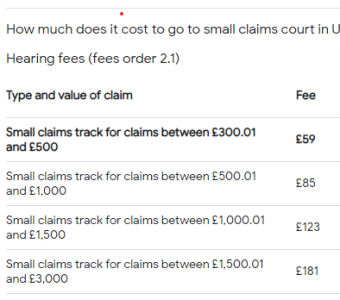
The claim here would be £585 - the original £500 plus the £85 court fee. So that puts it in the £85 bracket. As I saidI actually think it costs £180
Because jfm (and I ) have read what the OP wrote. There is no suggestion that the "seller" has not received the money, just that he is ignoring the OP and refusing to return it having (apparently) sold the boat to somebody else.How do you know that?
Good. I am not going senile then. My claim was 3 grand. Interesting as doesn’t seem to have gone up in years!! But to get to the bailiffs you need to go through a circuit court judgement I believe and then bailiffs so total cost likely to be higher that £85. In my case it was a 3 stage process as per above and only after the bailiffs sent out their notice did I get a response and my money back.The claim here would be £585 - the original £500 plus the £85 court fee. So that puts it in the £85 bracket. As I said
The below is just a snip from Google
View attachment 173750
Imagine you were a legitimate successful buyer and someone turned up to try and take a boat because they had paid the seller a deposit. That scenario wont end well.Yes so because it’s civil I can go over and take the boat until its resolved
Does he? Is that the name of the boat owner, the facebook user, the person who received the money, the unlucky person who's bank was hacked to use as a temporary "channel" for the funds before they left the country? Many scammers are not actually in the uk.I’m assuming that you are too light on evidence for successful legal system small claims, but you have a name and address.
Facebook marketplace is a sensible buying and selling platform for people who meet face to face to complete a transaction. I don't think its fair to blame Facebook if people do stupid stuff.Facebook need to get a grip on their site as the unweary can easily get caught out.
I wouldn't recommend telling the bank that your funds didn't reach the intended recipient. Banks have responded to criticism about the vulnerability of bank transfers. If you tell them you never meant to send it to Mr X when you did you are probably committing an offence yourself.The obvious answer would be contact your bank and explain that your money didn’t reach the intended recipient. They will then raise a dispute which would force the vendor to either return the money or commit fraud. At that point it becomes a criminal matter.
It becomes Fraud when there was an intent to deceive otherwise its potentially theft. I don't think the OP realises yet, but the person he sent the money to is most likely not the (previous) owner of the boat, and that is what would flip it to being fraud.At which point it becomes fraud, and a criminal matter which the police CAN get involved in. Entirely my point.
Actually, there's lots of vulnerable people like Mashy around, which is why people run these sort of scams and the police should be investigating and prosecuting (it would be very unlikely a scammer has only succeeded in scamming one person). Of course if the actual scammer is not in the UK there's zero chance of prosecution. BUT even if they do prosecute (12+ months at least before a trial?) and get a conviction there's absolutely no certainty that the victims get compensation and if they do it will probably be paid by installments - so another 12 months or more before you see the money! Worth reporting using the action fraud link several posts up anyway because it's the sort of information that *might occasionally* reveal a pattern.I'm not sure which "point" you're referring to there, but there is no way police will deal with this as criminal fraud, when it's only £500 and they can easily file it under "breach of contract; civil matter" And nor should they - we don't want to be paying/distracting police on £500 lost by careless/hapless folk.
There is nothing in what the OP says that implies a "scam" - indeed the opposite. He says he has checked that the seller did indeed own the boat and the boat exists and has been subsequently sold (by the person that is holding his deposit) to somebody else.Actually, there's lots of vulnerable people like Mashy around, which is why people run these sort of scams and the police should be investigating and prosecuting (it would be very unlikely a scammer has only succeeded in scamming one person). Of course if the actual scammer is not in the UK there's zero chance of prosecution. BUT even if they do prosecute (12+ months at least before a trial?) and get a conviction there's absolutely no certainty that the victims get compensation and if they do it will probably be paid by installments - so another 12 months or more before you see the money! Worth reporting using the action fraud link several posts up anyway because it's the sort of information that *might occasionally* reveal a pattern.

Might, or might not. I mean, might or not lead to an apprehension, of a guy who might or might not be a serial operator as opposed to a one-off guy. But it will for sure burn up police resources. Worth considering how high up the police priorities this missing £500 should be. OP didn't need to lose the £500 at all - he handed it over voluntarily.
He is entitled to the protection of the law, but there are limits. He has full redress under the law if he bothers to get a written contract or the name address of the guy he's paying, or something even a bit useful. He didn't do those basic things. He needs to learn a bit of self-reliance. It's not the job of the state and other taxpayers to wipe his bottom.
