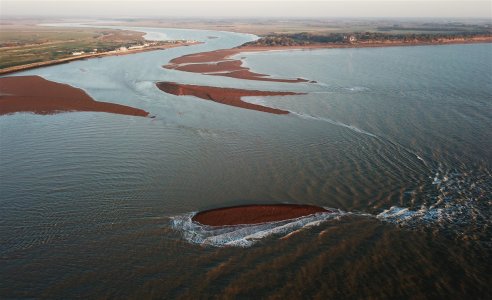
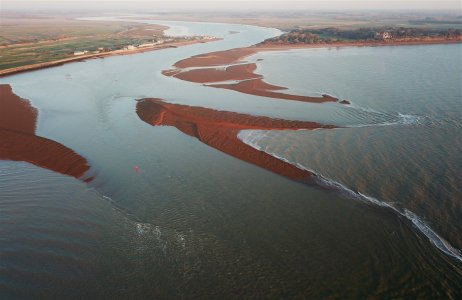
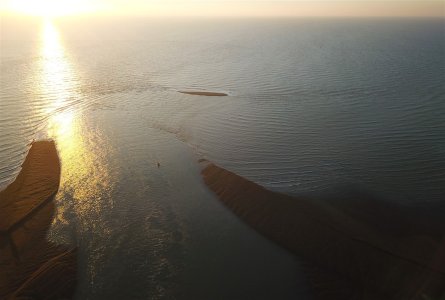
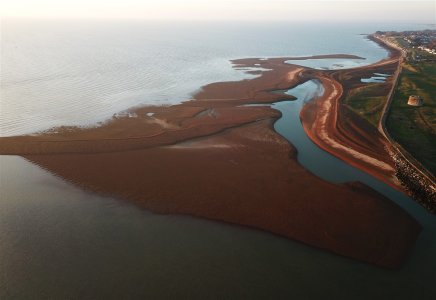
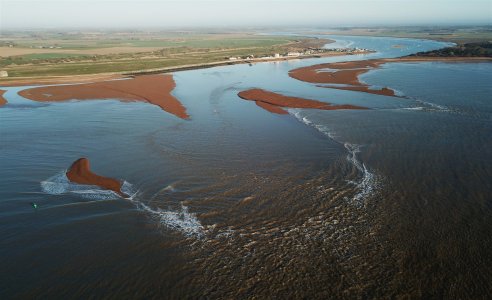
Deben entrance first look 2025

I suppose the Orwell/Stour ebb prevents the Deben forming a 'Ness' and makes sure each year get changed?
It's more to do with the interaction between river flow and longshore drift. A ness will form where the longshore drift changes direction. SO at the Deben, where the longshore drift is from NE to SW, a spit builds from the Bawdsey side extending in a SW direction. As the distance the river flows increases, a greater proportion of the sediment load of the river is deposited at the bar, and eventually, the flow is sufficiently blocked to force a new entrance at the Bawdsey side - just as we have seen over the last few winters. This cycle will repeat indefinitely; we can expect the entrance to slowly drift to the SW until the cycle repeats.

At Orford it's more complicated, as the presence of the Ness means that south of the Ness, longshore drift is to the NE, while north of it, it is to the S. Further, it is clear that the formation of a new channel to the sea is blocked by human intervention - there's a village (Slaughden) just at the point where it would break through! Also, the confluence of the Alde and the Butley River increases the flow at the present mouth, inhibiting the building of the bar to levels that restrict flow. But I suspect that without human interference, the Alde would long ago have broken through near Aldeburgh, and the stretch between the Butley River and Aldeburgh would have silted up.

In fact, the Google Maps image of the Ness shows an old channel between the Ness and the present channel; presumably that's a relic of a previous cycle that silted up when the Alde broke through the spit and reached the sea somewhere near Aldeborough.
 
Last edited:
Half of Aldeburgh is missing, the Moot Hall used to be in the centre of town. All of Slaughden has gone, I believe originally a village in its own right. The long shore drift has always been towards the southwest with the incoming Tide in this area. Same at Felixstowe, a flat ness with "Butlins" and then Landguard at the far end.
 
Is there likely to be a bar across the central channel where there is the white water - or indeed the main entrance?
 
Last edited:
Is there likely to be a bar across the central channel where there is the white water - or indeed the main entrance?
Yes, the white water to the north of the new outer knoll (on this small video at the start) is most likely the Deben bar.

Maybe, after the Trinity House survey in the spring, we will be routed to the North of the new knoll?

That is, if the winter storms haven't changed it by then!

The beached Mid Knoll buoy may not indicate the deepest water. We will see!


John
 
That's quite a big lump (knoll) further out to sea showing in the video - photos and video very useful. Looks quite high.

It's a pity that some of it can't be dug out and deposited at Hemsby, or taken to Ipswich Wharf and sold for building.

But I always thought that the Authorities should have bought a set of Beach Replenishment equipment in the 1980's and trundled up and down the coast pumping the sand to where needed - It wouldn't have been particularly expensive.

Good though that Trinity House are going to survey it this spring hopefully - I used to have a chart of the Colne that said that parts were based on a Hydrographic survey in 1888.
 
Last edited:
Just checked my 1956 copy of Jack Cootes. It showed a course NW direct from Bawdsey Spit to wards the Victory Pub., a very short leg.
Is it heading back towards that?
 
But I always thought that the Environment Agency should have bought a set of Beach Replenishment equipment in the 1980's and trundled up and down the coast pumping the sand to where needed - It wouldn't have been particularly expensive.
The Environment Agency was set up in 1996 as a result of the Environment Act 1995. A different body to the National Rivers Authority but took over the NRA's powers.
 
EA/NRA - Good point - Predecessor authorities in 1980's - Beach Replenishment seems to work well moving the wave break back from the cliff/sea wall but does need regular maintenance work - One pound per cubic metre then.
 
Last edited:
That's quite a big lump (knoll) further out to sea showing in the video - photos and video very useful. Looks quite high.

It's a pity that some of it can't be dug out and deposited at Hemsby, or taken to Ipswich Wharf and sold for building.

But I always thought that the Authorities should have bought a set of Beach Replenishment equipment in the 1980's and trundled up and down the coast pumping the sand to where needed - It wouldn't have been particularly expensive.

Good though that Trinity House are going to survey it this spring hopefully.

I used to have a chart of the Colne that said that parts were based on a Hydrographic survey in 1888.
It certainly is 'quite a bit of shingle'. But I recall ages back 19th/early 20th century on the southwest coast an offshore bank was dredged for building materials and as a result the village on the coast got washed away. And has the major cement stone dredging off the Naze in the 19th century put the Tower in risk? I think it is a big decision to interfere. West Mersea got a lot of the Harwich spoil couple of years back to rebuild Cobmarsh and Old Hall but that was harbour dredging.

As regards to the Colne, I shall have a go to the outer Colne this year. Having seen the changes on the Knoll since the last 1986 survey I think it worthwhile.
 
It certainly is 'quite a bit of shingle'. But I recall ages back 19th/early 20th century on the southwest coast an offshore bank was dredged for building materials and as a result the village on the coast got washed away. And has the major cement stone dredging off the Naze in the 19th century put the Tower in risk? I think it is a big decision to interfere. West Mersea got a lot of the Harwich spoil couple of years back to rebuild Cobmarsh and Old Hall but that was harbour dredging.

As regards to the Colne, I shall have a go to the outer Colne this year. Having seen the changes on the Knoll since the last 1986 survey I think it worthwhile.
Having lived in Devon for my initial foray into England, the village was Hallsands, and the dredging was to get building materials for the RN Dockyard in Plymouth...
 
It's a pity that some of it can't be dug out and deposited at Hemsby, or taken to Ipswich Wharf and sold for building.

But I always thought that the Authorities should have bought a set of Beach Replenishment equipment in the 1980's and trundled up and down the coast pumping the sand to where needed - It wouldn't have been particularly expensive.
The trouble with that kind of activity - and the reason it is uncommon these days - is that intervening in one place almost inevitably has unpredictable knock-on effects elsewhere. Also, any such project can easily be overwhelmed by one winter's gale; the forces of currents and waves far exceed anything we can bring to bear, and the majority of sediment transfer takes place during times of peak energy. So such projects have to be in permanent operation; you can't do something and then go away; you have to keep on doing it. Look at dredging at ports like Harwich - it has to be done and redone repeatedly to maintain the shipping channel.
 
Dungeness is a good example of this. Ever since the first Power station was built there, longshore drift was redisscovered and a contract has been in place ever since to counteract its effects by digging up shingle at one side of the Ness and trucking it to be tipped the over side. There is a narrow strip of land owned by Dungeness Estates which the lorries full of shingle must cross, enabling the estates to charge a comfortable wayleave fee.

On sea won ballast, in the 1950's, a Company by the name of Bowles dominated the ready-mixed concrete market in Cardiff, all the ballast being sea-won by their own fleet of suction dredgers. Closer to our East Coast home, all the ballast for construction of Sizewell B was sea-won and pumped ashore onto the site for washing and screening in order to reduce the impact of traffic on Suffolk roads. The cement and re-bar was all delivered to Leiston Halt by rail and then trucked onto the site (about 1.5 miles) for the same reason. Presumably there's some sort of licensing process for winning ballast at sea, which will require a hydrological survey of the consequences, just as for sea dumping the spoil from dredging.

Peter
 
The Deben entrance buoys are still in the 2024 positions but hopefully they will be re-positioned soon, along with the Woodbridge Haven buoy.

The Trinity House survey has been completed and the new buoy positions have been agreed with the Ferry Harbour Master(s).

Photo below taken this morning 31st March LWS 0.3m above CD.

The outer green can 'Mid Knoll buoy' next to the knoll on the left is due to be moved North.

If you are considering entering in the next few days then check with John Barber or John White.

Please don't rely on this photo.

John

DJI_0593 (1908 x 1165).jpg
 
Top